
A pipe bursts while you're away, or a washing machine hose fails overnight. By the time you find the problem, water has spread across the floor, soaked the baseboards, and reached materials you can't see. You're left wondering what to touch, what to shut off, and whether the cleanup crew arriving at your door understands more than how to remove standing water.
IICRC water damage restoration gives that emergency a structured response. The work involves assessment, contamination control, extraction, drying, documentation, and repair planning. The goal is not merely to make the floor look dry. It is to determine what happened, protect occupants, measure moisture inside materials, and reduce the risk of hidden damage.
Navigating the Chaos of a Sudden Water Leak
The first few minutes after a water loss feel disorganized because several problems appear at once. Water may be moving through rooms, electricity may be near wet surfaces, furniture may be absorbing moisture, and the original leak may still be active. A homeowner might reasonably reach for towels, a household vacuum, or a mop, but those actions rarely reveal how far the water has traveled.
A professional restoration response begins by creating order. Technicians identify the affected areas, determine whether the water is clean or contaminated, inspect porous materials, and decide which areas need isolation. They also look beyond visible puddles. Water can move beneath flooring, into wall cavities, under cabinets, and through insulation.
Practical rule: A dry-looking surface doesn't prove that the assembly underneath is dry.
The ANSI/IICRC S500 framework helps technicians make those decisions consistently. It treats restoration as a process with defined procedures and precautions, rather than an improvised cleanup. That distinction matters when a crew needs to decide whether to extract, remove, contain, disinfect, or dry a material in place.
What certification should mean on site
Certification by itself doesn't tell you everything about a company's communication, insurance process, or repair capabilities. It does give you an important question to ask: Which IICRC procedures will guide the assessment and drying plan?
A qualified contractor should be able to explain why equipment is being placed in particular rooms, what moisture readings mean, how contaminated areas will be separated, and what conditions will confirm completion. You should also receive a clear explanation of what the restoration team handles and what requires a plumber, roofer, electrician, or other specialist.
If you're still deciding whom to call, finding a cleanup service locally can help you compare nearby providers and ask about their restoration credentials before work begins. In an emergency, choosing a team that can explain its process is more useful than choosing one that only promises speed.
The right response brings calm through evidence. Technicians map the damage, record readings, control the environment, and make decisions based on the water's contamination level and the materials involved.
Understanding the S500 Standard for Professional Restoration
The ANSI/IICRC S500 Standard for Professional Water Damage Restoration is a procedural standard. In plain language, it describes what professional water damage restoration should include and the settings in which those procedures apply. It covers residential, commercial, and institutional buildings, along with the systems and personal property inside them.
That scope is broader than many homeowners expect. The standard isn't limited to removing water from a carpet. It addresses inspection, investigation, work planning, drying methods, contamination controls, and precautions for the people performing the work and occupying the building.
A standard that developed with the industry
The first edition, S500-94, was published in 1994 and described as the written body of knowledge for the water damage restoration industry. A second edition followed in 1999, replacing the earlier version after collaboration among industry experts, microbiologists, public health experts, industrial hygienists, and other scientists. The standard was updated again in 2015 as the fourth edition and in 2021 as the fifth edition.
The 2021 fifth edition applies to residential, commercial, and institutional buildings. In 2025, Standards Australia adopted ANSI/IICRC S500:2021 as AS-IICRC S500:2025, showing that the framework has gained use beyond the United States. You can review the publication history in the ANSI preview of the S500 standard.
How technicians apply the framework
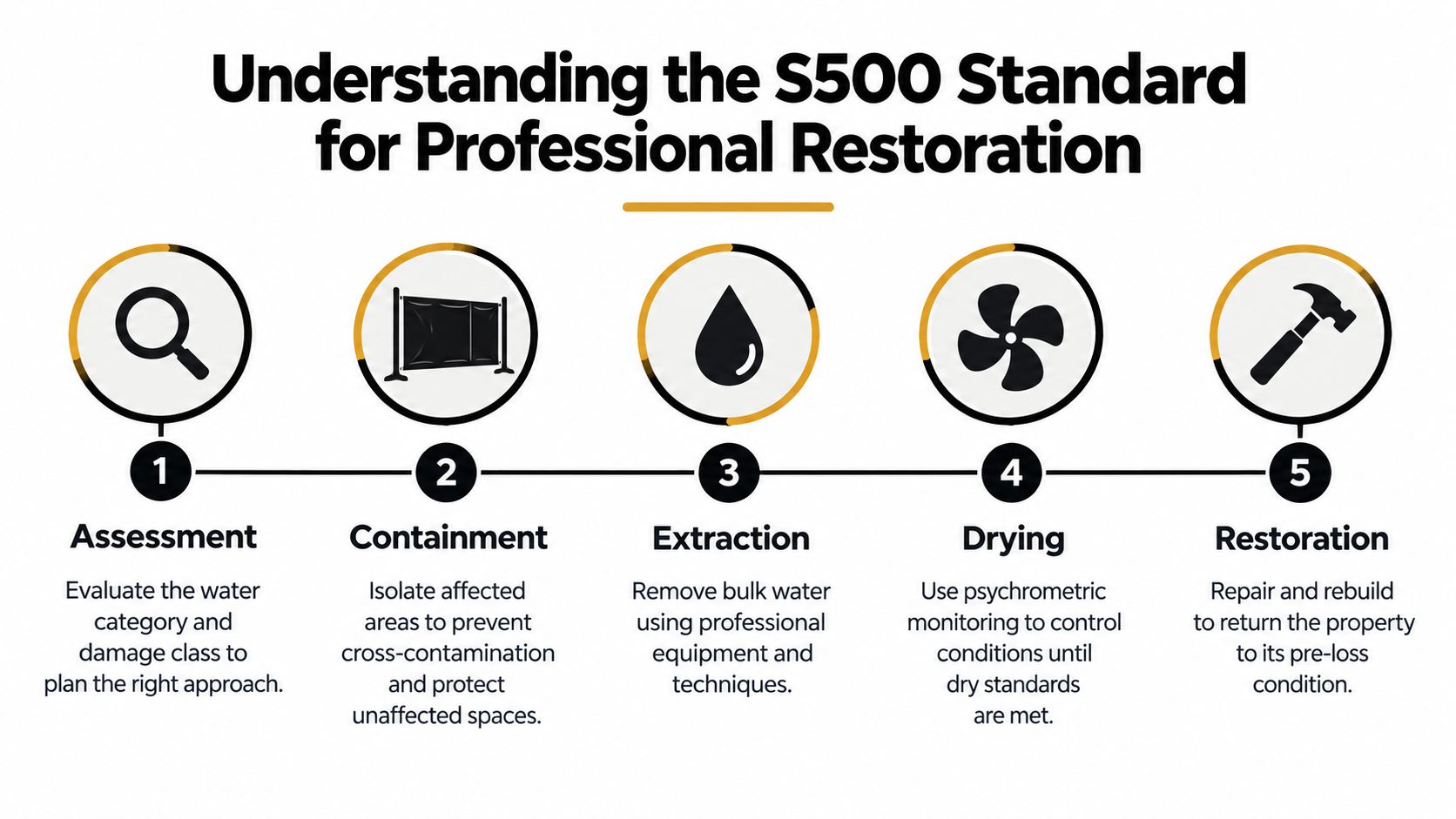
A typical S500-informed response follows a logical sequence, although the exact work changes with the loss:
- Assessment: The technician identifies the source, affected materials, water category, and drying class.
- Containment: The team selects barriers, pressure controls, and protective measures when contamination creates a cross-contamination concern.
- Extraction: Workers remove bulk water before relying on evaporation and dehumidification.
- Drying: Air movement and humidity control support evaporation while technicians monitor material moisture and indoor conditions.
- Restoration: The property owner and contractors plan repairs, cleaning, replacement, and return to the pre-loss condition.
This framework explains why a technician may spend time inspecting before placing air movers. The equipment plan depends on what is wet, how wet it is, what kind of water caused the loss, and whether the affected area can be safely dried without spreading contamination.
The standard also makes an important distinction between restoration and source correction. Drying the building and correcting the failed pipe, roof, appliance, or HVAC component are related tasks, but they aren't automatically the same contractor's responsibility. That boundary should be discussed before work begins.
For Phoenix-area property owners, an IICRC-certified restoration company can be evaluated by asking how the team applies the standard, records moisture readings, manages contaminated materials, and coordinates work outside its own scope. A certification logo should start the conversation, not end it.
How Water Categories and Classes Dictate the Response
Two separate labels shape a restoration plan. Water categories describe contamination risk, while Classes 1 through 4 describe the amount of water and the difficulty of drying the affected materials. Confusing these systems can lead homeowners to assume that a small visible puddle always means a small job.
Categories describe what the water may contain
Category 1 generally refers to clean water from a sanitary source, such as a broken supply line. Category 2 is gray water with contamination and moderate microbial risk. Category 3 is grossly contaminated water that can contain pathogens and requires strict hazard controls.
| Category | Contamination Level | Typical Source | Required Response |
|---|---|---|---|
| Category 1 | Clean water from a sanitary source | Broken supply line or similar clean-water failure | Extract and dry after confirming the water remains clean and the affected materials are suitable for that approach |
| Category 2 | Gray water with contamination and moderate microbial risk | Water that has become contaminated after contact with materials or an impaired source | Use a more controlled assessment, cleaning approach, and protective response |
| Category 3 | Grossly contaminated water that can contain pathogens | Sewage, heavily contaminated flooding, or water with substantial contamination | Use strict hazard controls, appropriate worker protection, containment, remediation, and cleaning procedures |
The category can change after water contacts building materials or remains in place. A clean source doesn't automatically make every affected surface safe to handle without evaluation. For a homeowner dealing with sewage or heavily contaminated flooding, EZ Plumbing's category 3 guide offers additional context about why these losses require more than ordinary mopping.
The practical question isn't only, “Where did the water come from?” It's also, “What did the water contact, and what is its condition now?” That answer affects protective equipment, containment, disposal, cleaning, and whether drying can begin immediately.
Classes describe the drying load
The S500 framework classifies losses into Classes 1 through 4 according to the amount and type of wet material and the likely evaporation load. That classification helps determine the initial humidity-control equipment needed, as described in this S500 equipment planning explanation.
- Class 1 involves the least amount of water, affecting only part of a room or area with minimal absorption.
- Class 2 affects at least an entire room of carpet and cushion and can wick up walls less than 24 inches, according to the industry description tied to S500.
- Class 3 involves the greatest amount of water, with ceilings, walls, insulation, carpet, cushion, and subfloor saturated across virtually the entire area.
- Class 4 involves specialty drying for low-permeance materials such as hardwood, plaster, brick, concrete, lightweight concrete, and stone.
A tiled bathroom with limited surface water may need a very different setup from a flood that saturates drywall, insulation, carpet, and subfloor. The technician's equipment decision should reflect the evaporation load, not a standard package used on every job.
This is also why category and class shouldn't be treated as interchangeable. A loss can have a serious contamination category while affecting a limited area, or it can involve a large drying load with a different contamination profile. A contractor explaining Category 3 water damage response should address both the health controls and the physical drying challenge.
The Science of Structural Drying and Time Sensitivity
Structural drying isn't complete because the carpet feels dry or the wall looks normal. Professionals need evidence that indoor conditions have stabilized, materials no longer support fungal growth, and the building materials and contents can return to normal conditions without further damage.
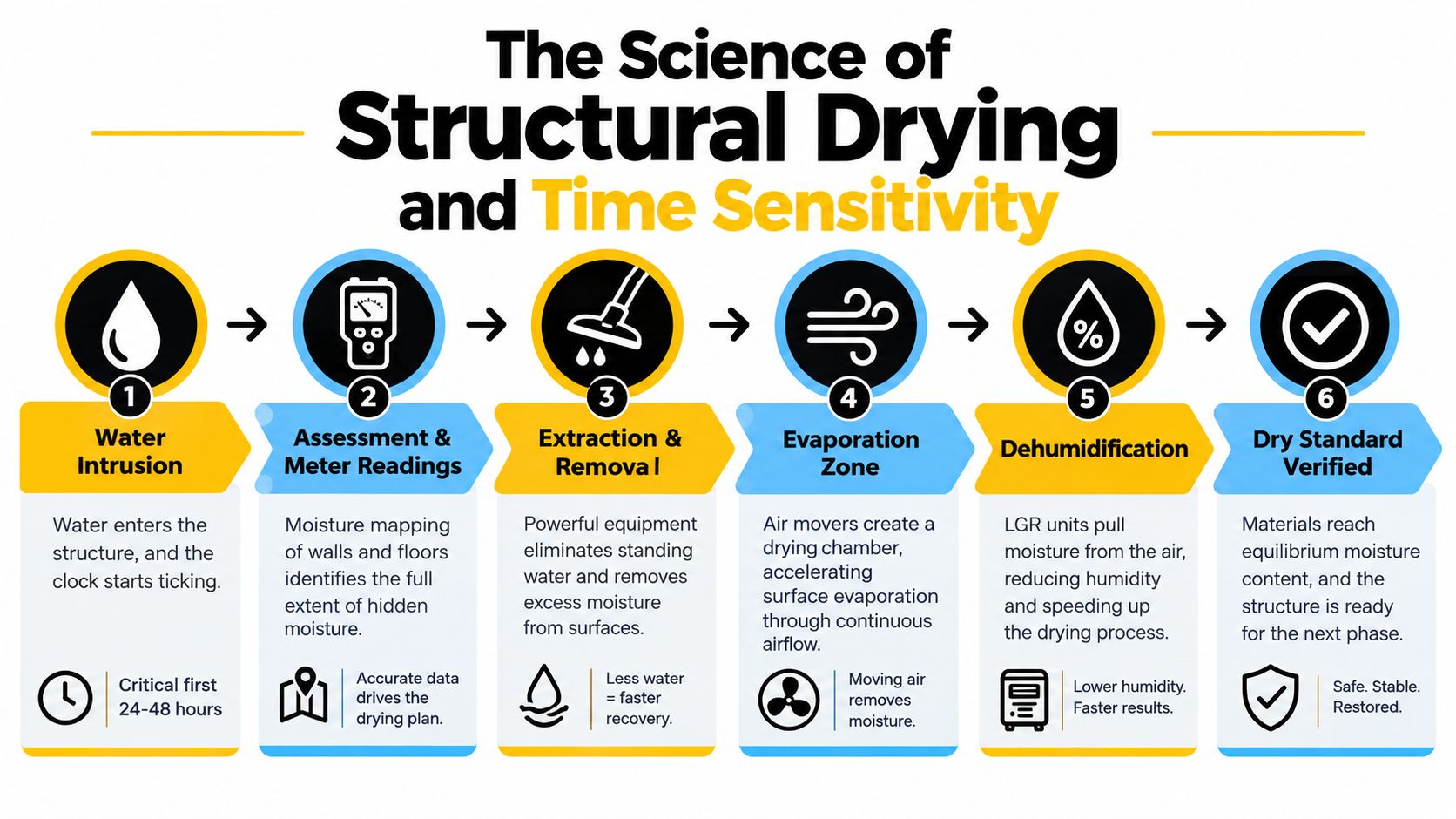
Time influences those decisions. Industry guidance aligned with IICRC principles states that if drying isn't initiated within 48 hours of the loss, or wet drywall isn't dried within 72 hours, replacement is generally recommended. See the published AS-IICRC S500 press release for that guidance.
What happens during drying
A competent drying plan usually moves through several connected actions:
- Map the moisture. Technicians use moisture meters to compare affected walls, floors, ceilings, and contents with similar unaffected materials.
- Remove bulk water. Extraction reduces the amount of water that must later evaporate into the indoor air.
- Create controlled airflow. Air movers help moisture leave material surfaces and enter the air.
- Control humidity. Dehumidifiers remove moisture from the air so materials can continue releasing it.
- Monitor progress. Technicians revisit readings and adjust equipment rather than leaving machines unattended until a preset date.
- Verify the dry standard. The team compares final conditions with an appropriate unaffected baseline and checks that the material isn't left at a level that could support microbial growth.
A practical benchmark cited in guidance aligned with IICRC principles is about 50% relative humidity at 70°F for stabilized interior conditions. That benchmark is part of a larger assessment, not a substitute for material readings. Temperature, humidity, material type, and the condition of unaffected areas all influence the interpretation.
The concept of a dry standard gives the project a measurable finish line. One industry explanation describes it as a reasonable approximation of a material's moisture level before the intrusion. It says technicians can compare affected materials with similar unaffected materials or historical regional data, and identifies an acceptable dry standard as within 10% of similar pre-loss materials. The industry explanation of acceptable drying conditions also notes that reaching equilibrium moisture content isn't enough if the material could still support microbial growth.
A dry standard is a comparison, not a guess. The technician should be able to explain what unaffected material or baseline supports the final reading.
Surface appearance can mislead you. A painted wall may feel dry while the back of the drywall, insulation, or framing remains wet. That's why daily documentation and repeated readings matter, especially when the crew is deciding whether to preserve an assembly or remove it.
For a closer look at the methods involved, this structural drying techniques resource discusses the practical side of controlled drying.
The Boundary Between Source Correction and Restoration
Many homeowners assume the restoration company will fix everything that caused the water loss. That assumption can delay the work. A technician may remove water from a room, but the plumber may need to replace the failed supply line, the roofer may need to repair the roof, or an appliance specialist may need to correct a defective machine.
The IICRC S500 standard explicitly distinguishes between restoration and source correction. It assumes that determining and correcting the underlying cause of the intrusion is the property owner's responsibility, although the owner can hire a restorer or another expert to perform that work. The standard's explanation of its scope and responsibilities appears on the IICRC S500 overview page.
Why the sequence matters
Think of the response as two connected tracks:
- Source correction: Stop the active intrusion and repair the failed component.
- Restoration: Extract water, control contamination, dry materials, clean affected contents, and document the condition.
Both tracks may operate at the same time, but nobody should treat drying as a replacement for stopping the leak. If water continues entering the structure, equipment may run without solving the underlying problem. The property owner should ask who has responsibility for the repair and whether the restoration team is coordinating with that specialist.
Questions to ask before work begins
Ask the contractor to explain:
- Whether the water source is still active.
- Which company or trade will correct the source.
- What areas the restoration scope includes.
- Whether the insurance adjuster will receive photos, moisture maps, equipment records, and work updates.
- What conditions will confirm that drying is complete.
- Which materials may require removal because of contamination, saturation, or inability to reach a safe dry standard.
This conversation prevents a common misunderstanding. A restoration contractor may manage mitigation and coordinate with a plumber or roofer, but the S500 framework doesn't make source repair part of every restoration assignment.
You can help by reporting the leak accurately, preserving photographs, keeping receipts for emergency steps, and telling the contractor about any prior moisture problems. If the source is a burst pipe, close the water supply when it's safe to do so. If electricity may be affected, avoid wet areas and contact a qualified electrician or emergency service rather than testing the circuit yourself.
What to Expect from an IICRC-Certified Local Contractor
A professional visit should feel organized even when the property doesn't. The contractor should begin with an inspection, identify the water category and drying class, document affected areas, and explain the immediate safety concerns. You should understand what the crew is doing today and what decisions will wait for moisture readings or source correction.
For a Phoenix metro property, a local team listed through a water damage restoration contractor resource should be able to explain its availability, service area, certifications, and emergency process before you authorize substantial work.
Signs of a disciplined project
Look for practical evidence rather than a logo alone:
- A written or clearly explained scope: The team identifies extraction, containment, drying, cleaning, demolition, and repair responsibilities.
- Moisture documentation: Technicians record readings and revisit affected materials as conditions change.
- Appropriate equipment: Air movers, dehumidifiers, extraction tools, and containment materials match the category, class, and building conditions.
- Clear insurance communication: The contractor explains what documentation it can provide and what decisions remain between you and your insurer.
- A completion explanation: The team tells you how it will verify drying and what happens if readings remain high.
A certified contractor shouldn't use equipment as decoration. Air movers and dehumidifiers change the environment, so technicians need to monitor how the building responds. For contaminated losses, the team should also explain worker protection, isolation, cleaning, and disposal procedures in language you can understand.
Ask whether the company handles residential, commercial, or institutional work if your property has special requirements. Ask who will communicate with the insurer and who will arrange repairs outside the drying scope. Good project management reduces surprises because the team defines decisions before hidden damage becomes an argument.
Protecting Your Property While Waiting for Help
Your first job is safety, not speed. If you can do so without entering danger, shut off the water source. Keep away from standing water near outlets, appliances, electrical panels, or damaged wiring, and contact an appropriate professional if electricity may be involved.
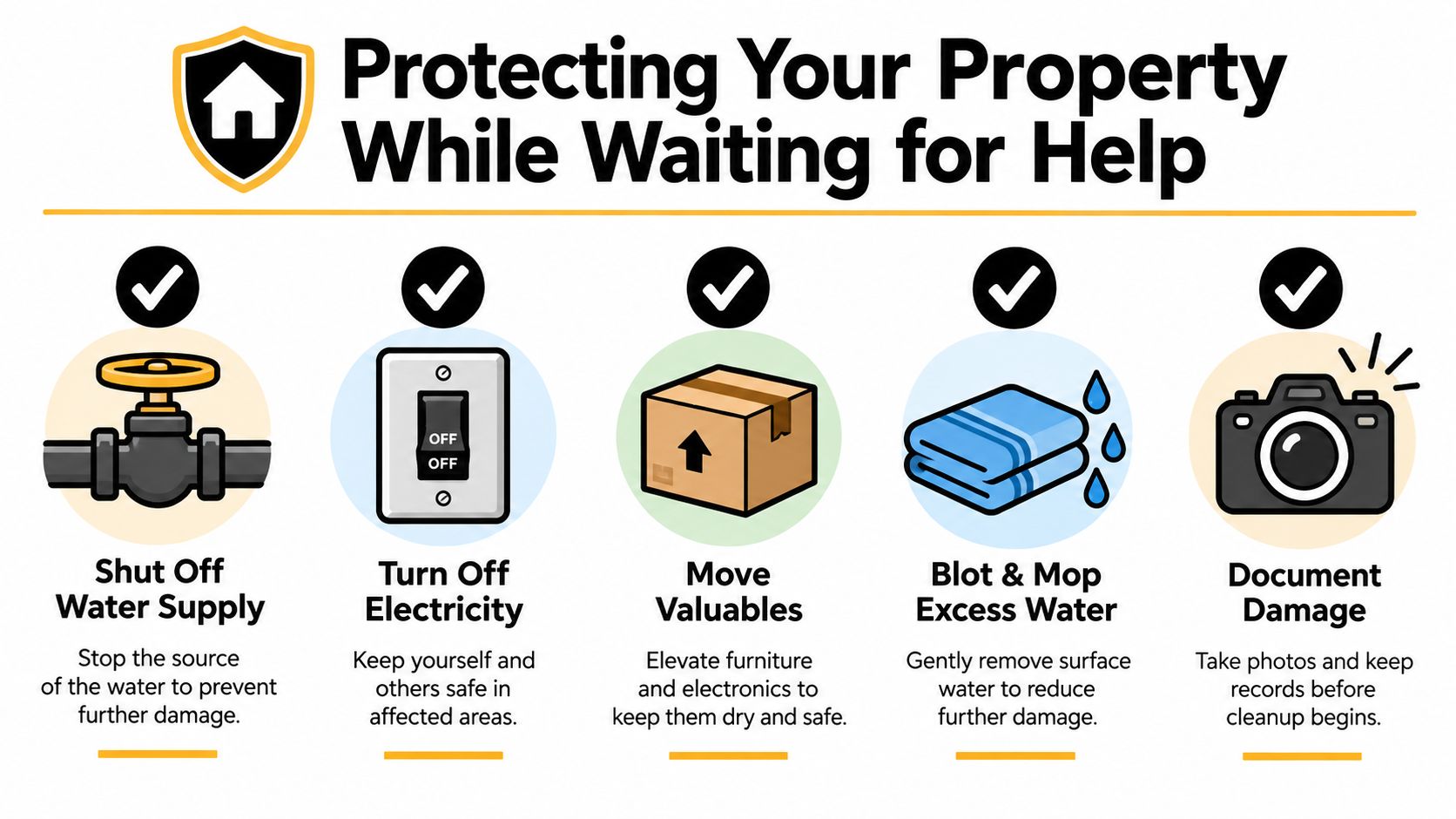
While waiting for a restoration team:
- Move small valuables: Remove portable items from the wet area if you can do so safely, and place furniture or contents where they won't continue absorbing water.
- Blot surface moisture: Use towels or a mop for accessible surface water, but don't push water into seams or wall edges.
- Avoid household vacuums: Standard vacuums aren't designed for standing water and may create an electrical hazard.
- Document the condition: Take photographs and note when you discovered the loss, where water appeared, and what actions you took.
- Preserve information: Keep appliance details, plumber invoices, photographs, and communication records for the contractor and insurer.
The faster a qualified team can assess the property, the sooner it can decide what to extract, contain, dry, clean, or remove. Ask whether the contractor follows IICRC procedures, how it measures moisture, and who will correct the source.
Restore Heroes offers 24/7 emergency water damage restoration in the Phoenix metro area, including water extraction, structural drying, dehumidification, sanitation, and coordination with insurance providers. Visit Restore Heroes to request help and discuss the next safe step for your property.