
You're standing in a Phoenix hallway, noticing a musty smell whenever the air conditioner starts. The baseboard feels swollen, the flooring has begun to cup, and a faint brown mark is spreading near the wall. You search for “residential mold remediation near me” because you want a contractor, but the first decision isn't which company to call. It's identifying where the water came from and whether your insurance policy may respond.
A monsoon storm can drive water through a stucco crack. A pinhole slab leak can drip behind baseboards until the smell reaches another room. Phoenix homes can also hide moisture around ducted returns in unconditioned spaces, under flooring, or near HVAC condensate lines. Mold may be the visible result, but water damage, warped materials, peeling paint, and earthy odors are usually the earlier warnings.
Small surface contamination and a contained remediation project aren't the same job. A homeowner may handle a limited spill on a hard surface, while wet drywall, carpet padding, wall cavities, or widespread growth call for controlled removal and drying. If you're still trying to determine whether a smell or stain points to a wall problem, this guide to signs of mold in walls can help you organize what you're seeing. For moisture that collects around windows, a practical window track cleaning service guide can also help you distinguish routine track buildup from a larger water-intrusion issue.
When Mold Shows Up in a Phoenix Home
The first clues usually involve water
A homeowner in North Phoenix notices a cool, damp patch beside a bedroom baseboard after a week of ordinary routines. There's no dramatic flood. A plumber later finds a small slab leak, but the homeowner had already seen the important clues: the flooring had lifted slightly, paint had blistered, and the hallway smelled earthy after the AC cycled.
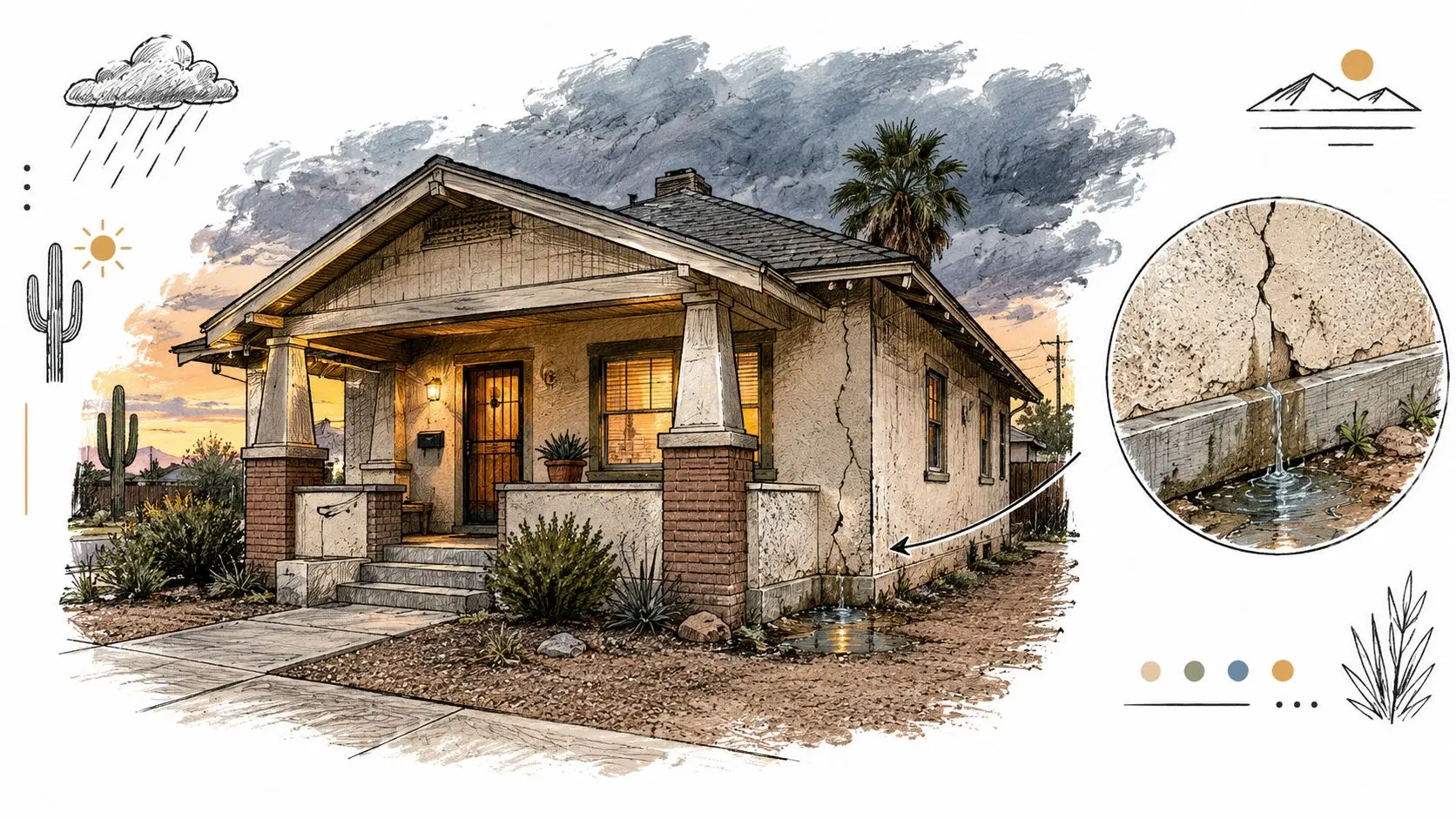
Another homeowner finds the problem after a monsoon microburst. Rainwater pushes through a crack near the stucco, dampens the wall assembly, and settles near the foundation. The house may look dry from the outside once the storm passes, yet the materials inside can remain wet.
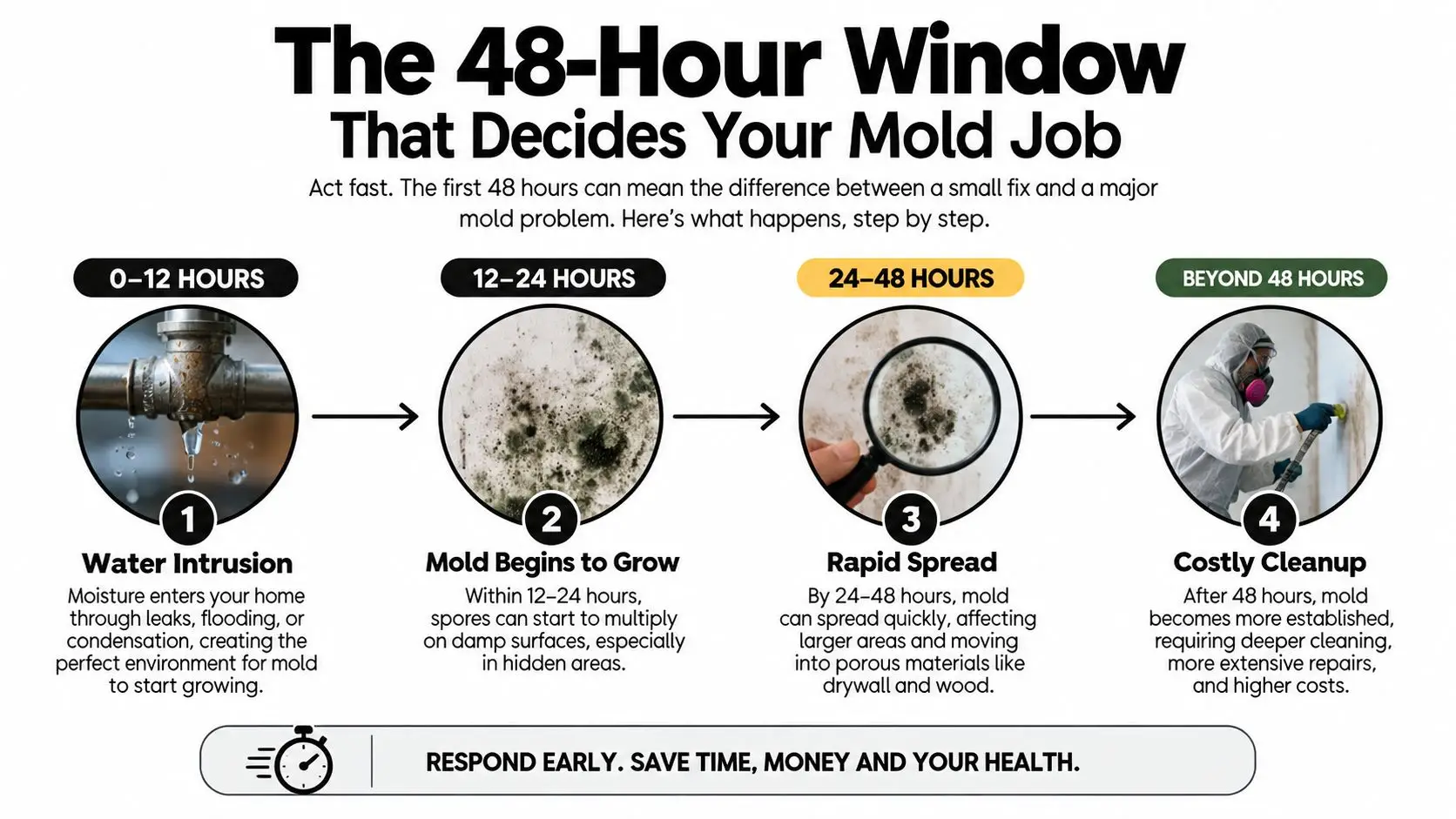
Mold can begin growing within 24 to 48 hours after water intrusion, according to EPA guidance on mold growth and water damage. That makes the timing of the leak more important than the color of the growth. A dark mark isn't automatically a large contamination event, and a mild smell doesn't prove the problem is minor.
Phoenix conditions can make judgment harder. Air conditioning may dry exposed surfaces while moisture remains behind drywall or below flooring. A sun-baked exterior doesn't correct a hidden plumbing leak. Closing a wet room and running the AC can also create a false sense of progress if the wall cavity never dries.
Small cleanup or contained remediation
The practical dividing line is the size and location of the affected area. The EPA generally recommends professional help when visible mold covers more than 10 square feet, roughly a 3-by-3-foot area, as explained in its mold remediation guidance. Materials, ventilation, and the moisture source matter just as much as the visible patch.
Practical rule: Treat the water source first. Cleaning visible growth before stopping the leak only resets the problem.
Mold exposure can cause allergic reactions and asthma symptoms in sensitive people. The National Center for Healthy Housing's mold guidance cites estimates that about 6% to 10% of the general population is allergic to mold, with the estimate rising to 15% to 50% among atopic individuals. That doesn't mean every homeowner will become ill, but it does explain why remediation focuses on moisture control and removal rather than cosmetic concealment.
The 48-Hour Window That Decides Your Mold Job
The first 24 to 48 hours after water intrusion often determine whether you're dealing with a limited cleanup or a larger remediation project. EPA guidance says water-damaged areas should be dried within that window to help prevent mold growth. The point isn't to panic. It's to act before wet materials become contaminated and harder to save.
Make the decision with area and material
For a small area under 10 square feet, where contamination is limited to hard, nonporous material and no saturated porous material remains, a homeowner can often scrub with detergent and water, dry the surface completely, and monitor it. A small spill on tile is a different situation from wet drywall behind a vanity.
Choose professional containment when:
- The area is larger: Visible growth exceeds the EPA's small-job threshold.
- Porous materials stayed wet: Drywall, carpet padding, ceiling tile, insulation, and similar materials can hold moisture internally.
- The room has HVAC connections: Air movement can spread contamination beyond the original surface.
- The water source is unresolved: A recurring leak makes cleaning temporary.
- The affected area is hidden: Odor, staining, or damage suggests a wall, floor, or ceiling cavity may be involved.
A surface can look dry while its interior remains damp. A restoration crew uses moisture meters to check framing, drywall, flooring, and other materials instead of relying on touch or appearance. EPA instructions for water-damaged materials also state that items dried within 24 to 48 hours usually won't become moldy, with carpet and backing requiring attention within that same window.
Don't confuse heat with drying
Phoenix sun can dry the outside of stucco while moisture remains inside the wall. Air conditioning can reduce room humidity without drying a saturated cavity. Fans help only when they move air across an accessible wet surface and the water source has already been controlled.
The sequence is simple:
- Stop the leak, shut off the supply, or correct the condensate problem.
- Photograph the damage before disturbing materials.
- Remove standing water and begin appropriate drying.
- Measure affected materials rather than guessing.
- Escalate when the area, material, or hidden moisture exceeds a small cleanup.
For broader water losses, water damage mitigation services address extraction and structural drying before mold work becomes more complicated. No cleaning product can compensate for an active leak.
What a Professional Mold Remediation Crew Actually Does
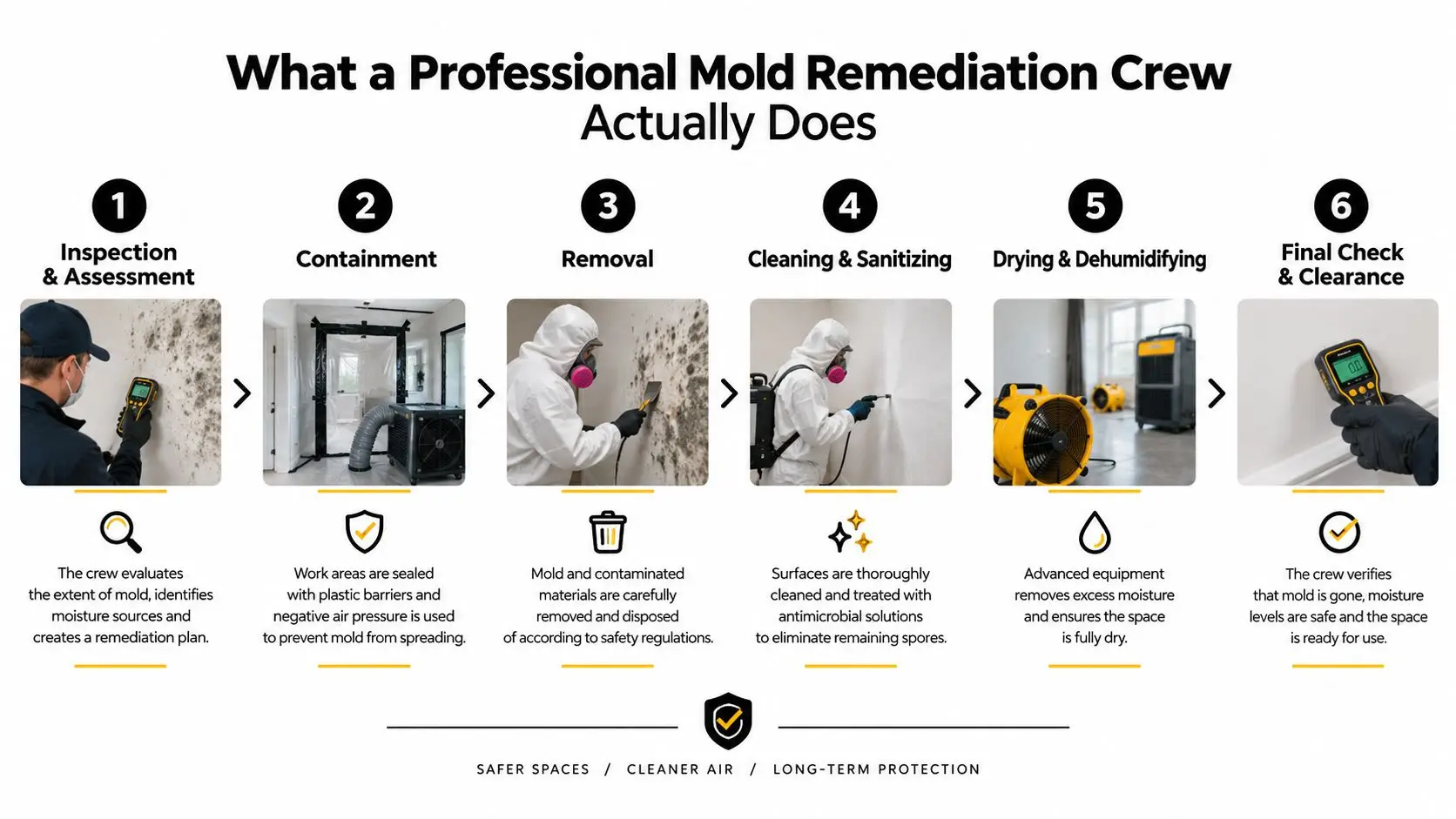
A credible remediation crew doesn't start by spraying the most visible stain. The crew first establishes the moisture path, limits cross-contamination, removes materials that can't be salvaged, and documents drying. That workflow reflects the principles in IICRC S520, a professional reference for mold remediation procedures and precautions.
Assessment comes before demolition
The first stage is source identification and moisture mapping. Technicians may use pin or pinless moisture meters, visual inspection, photos, and readings across adjacent materials. They're looking for the boundary of the problem, not just the darkest spot.
A homeowner can document the leak, move unaffected belongings away from the area, and wipe a small hard surface after the source is stopped. A homeowner shouldn't open a wall cavity casually when the extent of contamination is unknown. Demolition without a plan can spread dust and spores into clean rooms.
The next stage is containment. Crews commonly use 6-mil polyethylene sheeting, controlled entry, and negative-pressure air scrubbers. The HVAC system may be sealed or filtered so contaminated air doesn't circulate through the home.
Removal is different from treatment
Porous materials can absorb contamination into internal voids. Mold-penetrated carpet, insulation, ceiling tile, and damaged drywall may need disposal, while sound hard surfaces are generally cleaned in place. The EPA recommends double-bagging contaminated debris in 6-mil polyethylene bags or thicker when materials cannot be salvaged.
After removal, technicians typically HEPA-vacuum remaining structural surfaces and damp-wipe them. Antimicrobial products may have a role where appropriate, but application isn't a substitute for removing contaminated porous material or correcting moisture.
Drying has to be verified
Structural drying continues until readings support the conclusion that materials are dry, not merely until the room feels comfortable. Crews may use air movers, dehumidification, and repeated measurements. The common failure is closing the wall or replacing flooring while framing or subfloor materials remain damp.
Post-remediation work should confirm that the moisture source is fixed, visible mold and moldy odors are gone, and no new damage or regrowth appears. A local contractor such as Restore Heroes mold remediation specialists can be one option to evaluate when you need inspection, containment, material removal, drying, and documentation handled as one coordinated project.
Why Routine Mold Testing Usually Isn't Worth the Money
Routine sampling often answers a less useful question than homeowners think. It may identify what is in one air sample or on one swab, but it doesn't stop a leak, dry a wall, remove contaminated drywall, or explain moisture behind a cabinet.
The EPA's mold and moisture guide says sampling is generally not useful when visible mold is already present. There are also no federal airborne mold standards, so a laboratory result doesn't provide a universal pass or fail number for a home.
When testing adds little
If you can see growth and a technician confirms a water problem, the practical response is source correction, containment when appropriate, removal of unsalvageable materials, cleaning, and drying. Species identification rarely changes that work order.
A single negative swab proves very little. It may reflect the exact spot sampled, the timing of the sample, or the way the material was collected. It doesn't replace a moisture map or an inspection of adjacent materials.
More testing isn't automatically more protection. A good scope of work should explain what gets removed, what gets dried, and how completion will be verified.
Guidance discussed by NEHA on indoor mold concerns describes mold sampling as time-consuming and expensive, and notes that it often doesn't answer health-risk questions. That is why testing shouldn't be the first purchase for every musty smell or visible patch.
Three situations where sampling can help
Testing can earn its place when the decision is uncertain:
- Persistent odor without visible growth: Sampling may support an investigation after moisture sources have been checked.
- A real estate transaction: Buyers, sellers, and inspectors may want third-party documentation for a disputed condition.
- An insurance disagreement: An independent hygienist can provide clearance documentation or an opinion about unresolved contamination.
Testing should be ordered for a defined reason, with the report tied to a decision. Ask who will interpret the result and what action would change if the sample is positive or negative. The contractor's written scope, moisture findings, and documented work generally matter more to the cleanup than a lab label.
What Residential Mold Remediation Costs in 2026
Before comparing contractors, identify the moisture source and check how your insurance policy treats the loss. A leak from a sudden pipe failure may receive different coverage from long-term humidity, maintenance problems, or an unresolved leak. The cleanup price depends on how far water traveled, which materials absorbed it, whether HVAC components are involved, and whether rebuilding is included.
Recent 2026 market data places many residential jobs around $1,200 to $3,750, with national averages near $2,300 to $2,400. Larger projects can reach $3,500 to $9,000 or more, according to this 2026 mold remediation cost overview. For a fuller breakdown of line items and regional pricing, see our mold remediation cost guide.
Phoenix estimates vary with access, containment, demolition, and rebuilding. Use these ranges to plan, not as a promised quote.
| Job size | Typical cost range | Primary cost drivers |
|---|---|---|
| Small contained area | $1,200 to $2,500 | Limited square footage, hard-surface cleaning, minor material removal |
| Mid-range remediation | $3,500 to $9,000 | One or two rooms, porous-material removal, containment, possible HVAC involvement |
| Larger or whole-home work | $9,000 or more | Drywall, subfloor, cabinetry, multiple areas, complex containment, rebuilding |
What changes the invoice
Square footage matters, but access can matter more. A small wall cavity may require more labor than a larger open-room surface. Porous materials such as drywall, carpet, insulation, and cabinetry often need removal instead of wiping. HVAC contamination adds isolation, filtration, and inspection requirements. Containment complexity rises when workers must protect occupied rooms or work around return-air pathways. Reconstruction adds drywall, flooring, paint, cabinets, and finish work.
Review charges for antimicrobial application, HEPA negative-air equipment, debris hauling, testing, clearance, and rebuild coordination. Each line should explain the work it covers.
Ask your plumber to document the source and timing. A moisture-source letter can strengthen the claim record, but it does not guarantee coverage. Some policies cap mold-related payouts around $5,000 to $10,000 per occurrence. Confirm the limit, deductible, and covered cause of loss before approving work.
Questions to Ask Before Hiring a Mold Remediation Contractor
Use the phone call to test the contractor's process, not just the quoted price. A company that can't explain how it will find the moisture source, isolate the work area, and document drying hasn't given you a meaningful scope.
Credentials and protection
Ask these questions before authorizing work:
- Who leads the project? Ask whether an IICRC AMRT or Council-Certified Mold Remediator is on staff and who will be physically responsible for the job.
- Is the company licensed? Verify its current Arizona Registrar of Contractors license.
- What insurance applies? Request evidence of general liability and pollution-occurrence insurance.
- Can you provide recent references? Verify references from the last 90 days, focusing on projects similar to yours.
Credentials don't replace a written plan, but they help you identify whether the crew understands containment, removal, and drying.
Process and completion criteria
Ask whether the crew will use negative air, HEPA exhaust, sealed containment, and documented moisture readings. Request the product labels for any antimicrobial application, and ask what happens if the crew finds additional affected material behind the wall.
You also need a clear definition of completion. The contractor should explain how it will confirm that the moisture source is corrected, visible contamination is gone, odors have been addressed, and no new damage or regrowth is evident.
If the contractor can't explain how it will prove the structure is dry, the estimate is incomplete.
Insurance coordination
Request an itemized estimate formatted for Xactimate if your carrier uses that system. Ask whether the contractor can communicate with your adjuster, meet the adjuster on-site, and provide photographs, readings, disposal records, and clearance documentation.
Be cautious if a company quotes sight-unseen, demands a large upfront deposit, or pushes demolition and remediation before the scope is approved. Don't pay to clean an active leak. Confirm the plumber's repair or the HVAC correction is documented before demolition starts.
Your Next Steps After Reading This Guide
Start with the moisture source, not the contractor search. Shut off the supply line if a plumbing leak is active, schedule a plumber for a suspected slab leak, or have the HVAC condensate line cleared when condensation is involved. Source control is the essential first move because every later decision depends on whether new water is still entering the structure.
Then create a record. Photograph and video each affected surface, room corner, baseboard, cabinet edge, and visible flooring change. Timestamp the files and store copies somewhere other than your phone. If a technician has a moisture meter in view, photograph the reading and the material being measured.
Work through the claim carefully
Call your homeowners insurance carrier and open a claim when the loss may be covered. Ask specifically how the policy treats sudden water events, long-term leaks, mold limits, testing, drying, demolition, and code-upgrade endorsements that may apply to the property.
Don't order routine testing just because it sounds official. If the problem is visible and moisture is confirmed, put your money toward source repair, containment when needed, removal, and verified drying. Use third-party testing when you have a defined purpose, such as unresolved odor, a real estate dispute, or insurance clearance.
Get a written scope before work begins
Contact several qualified Phoenix-area companies and compare scopes rather than slogans. Ask for the lead technician's credentials, containment plan, moisture map, demolition limits, equipment list, disposal method, completion criteria, and line-item estimate.
For a local option, contact Restore Heroes at its Phoenix office and request a free inspection, an IICRC AMRT or WRT-certified lead, a written scope of work, and line-item pricing. The company states that it provides residential mold inspection, containment, removal of contaminated materials, cleaning, deodorizing, drying, and restoration coordination through its residential mold remediation services. Make sure the proposed scope matches your actual loss rather than accepting a generic package.
Plan for temporary displacement if containment affects living areas. Request post-remediation clearance documentation for your insurance file, and keep every invoice, photograph, moisture reading, plumber report, and adjuster communication together. The right contractor is the one who can show where the water came from, what was affected, what was removed, and why the home is ready for the next repair stage.
If a leak, musty odor, or visible growth has disrupted your Phoenix home, Restore Heroes offers local inspection, containment, mold removal, structural drying, and restoration coordination. Visit the site to request an inspection and ask for a written scope that starts with the moisture source, not a spray-and-go cleanup.