
You come home to a damp hallway, a soggy living room edge, or a ceiling stain that finally gives way and drops water onto the carpet. The first reaction is usually the same. You stare at the floor, reach for towels, and start searching your phone while hoping the mess is smaller than it looks.
Carpet water damage restoration rewards speed, but only if you spend that speed on the right things. The visible carpet is rarely the whole story. The pad and subfloor decide whether this is a salvage job or a replacement job, and the water category decides how aggressive you need to be from minute one.
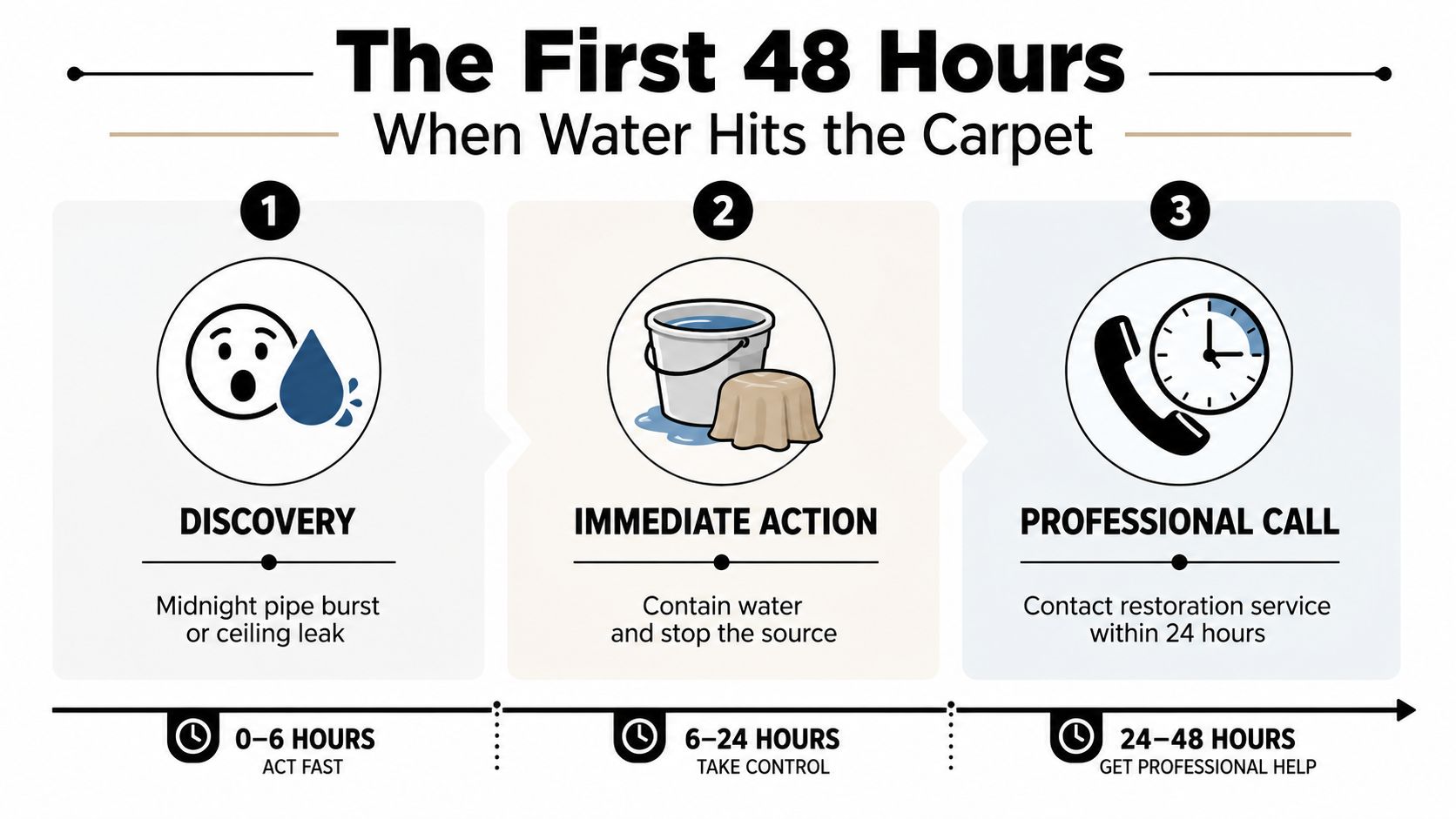
The First 48 Hours When Water Hits the Carpet
A burst pipe at midnight is loud and obvious. A dishwasher leak is worse in a different way, because it can sit until morning and spread under cabinets, baseboards, and carpet edges before anyone notices. Either way, the first move is the same, stop the source if you can, cut power to the affected zone if water is near outlets or equipment, and get people out of the wet area.
That first hour is not for guessing. It is for control. Move furniture and valuables onto dry surfaces, photograph the room before you touch much, and keep people off saturated carpet so you do not push dirty water deeper into the pad.
Practical rule: if the water is still coming in, your cleanup plan is still incomplete.
The first 24 to 48 hours decide whether carpet stays in play or gets written off. Water-damaged carpet is typically dried in about that same span, while padding can take 3 to 5 days, and that gap is why speed matters so much worldmetrics.org home water damage statistics. Wait too long, and the job shifts from remediation to replacement. That cost gap is real, since professional restoration often runs at 40 to 60% of full replacement when the carpet can still be saved, while padding replacement alone can add $500 to $2,000 worldmetrics.org home water damage statistics.
A slab leak in Phoenix is a good example of why the first 48 hours matter. Water can move quickly across a slab, but the room may still be salvageable if extraction starts right away. A homeowner who calls a plumber and a restoration crew immediately has a much better shot at saving the carpet face, because the pad has not sat wet long enough to ruin the system. For a local plumbing resource on that kind of leak, Piper Plumbing for slab leaks is a useful place to start.
Waiting for the carpet to “air out” is the wrong move. A dishwasher failure that sits through a weekend changes the outcome, because the water keeps moving under the carpet and into the pad while nobody is watching. If you need a practical drying sequence for the first few hours, this fast-drying guide gives you the right order of work.
A homeowner who acts in the first hour buys options. A homeowner who waits until the next day usually buys demolition.
Identifying the Water Category Before You Touch Anything
The water category decides the rest of the job. Don't start mopping, renting equipment, or scrubbing carpet until you know whether you're dealing with supply-line water, appliance overflow, or contaminated water from outside the home.
Category 1 clean water
This is water from a broken supply line, a pressurized pipe, or another sanitary source. It's the easiest category to salvage if you get to it fast, because the problem is moisture, not contamination. A supply-line leak under a sink still causes damage, but it doesn't automatically force replacement.
Category 2 gray water
Dishwasher overflow, washing machine discharge, and similar appliance water usually falls here. The issue is contamination. It isn't sewage, but it's not clean enough to treat casually either. In practice, gray water often means the carpet face may be salvageable, while the pad gets treated much more aggressively or removed if it stayed wet.
Category 3 black water
This includes sewage, floodwater, and water that has sat long enough to become biologically risky. It's the category that changes the conversation immediately. The University of Colorado Anschutz remediation standard draws a hard line here, carpet exposed to Category 3 water must be removed, and the subfloor must be sanitized before any new floor system goes back in CU Anschutz water damage remediation standard.
If you don't know the source, treat the water as suspicious until proven otherwise.
That's why source identification comes first in a real response. Roof intrusion, appliance failure, and outdoor flooding all change the salvage decision. If you need a deeper breakdown of contaminated losses, this Category 3 water damage guide is the right anchor point.
A quick five-minute filter is enough for most homeowners. Ask three questions. Where did the water come from, what touched it, and how long has it been sitting? If any answer points to sewage, outdoor flooding, or long delay, stop treating this like a simple carpet cleanup.
Extraction and Drying the Right Way
The work starts with extraction, not fans. Professional guidance describes the sequence clearly: first remove standing water, then separate the carpet from the pad and subfloor, then dry the structure while monitoring moisture until the materials are dry EngineerFix carpet restoration guide.
A strong extraction step matters because weighted extraction can remove up to 95% of water from carpet fibers before drying equipment is even turned on Advanced DRI carpet water damage restoration. That doesn't make the job finished. It just means you're no longer wasting time trying to dry a soaked surface by brute force.
What the equipment is doing
Air movers push air across the carpet surface and underneath it. Dehumidifiers pull moisture out of the room air so evaporation keeps happening instead of stalling. Moisture meters tell the crew whether the carpet, pad, and subfloor are reaching acceptable levels, instead of merely feeling dry to your hand.
Practical rule: dry to the touch isn't dry enough. The meter decides.
A homeowner rental fan rarely moves enough air for a saturated room. It can help with a small spill, but it won't replace a proper structural drying setup. If the pad stayed soaked, the crew has to lift the carpet, expose the hidden layers, and keep air moving under the material until the readings stabilize.
Here's the failure pattern I see too often. Someone sets a couple of fans, opens a window, and skips dehumidification because the room seems “pretty dry” by day two. The carpet surface looks better, but the baseboards swell and the hardwood at the edge cups because moisture kept migrating into adjacent materials. That's not bad luck. That's incomplete drying.
If you want a visual on the equipment side, this fan guide gives a practical look at the airflow piece without making it more complicated than it needs to be.
Drying is a process over several days, not a feeling after lunch. The goal is dry material, not a room that smells less wet.
Restore or Replace: What Decides It
The restore-or-replace call comes down to four variables, and none of them is the carpet's color. Water category, elapsed time, carpet condition, and what happened under the pad decide the outcome.
The hidden layers matter more than the face
NC State Extension says the pad should be removed if it's wet, and the subfloor has to be completely dry before carpet goes back down NC State Extension water-damaged carpets and rugs. That is the part homeowners miss. The carpet can look decent while the pad underneath stays wet and drives odor or microbial growth.
A peer-reviewed study on Category 1 water intrusion found that the industry's 72-hour carpet pad salvage window is likely too long, because bacterial amplification during in-place drying happens fast enough that the proper response time for salvage is considerably shorter PubMed study on category 1 water intrusion. Waiting to see whether the pad dries on its own is a bad bet.
Restore Versus Replace at a Glance
| Situation | Likely outcome | Reason |
|---|---|---|
| Clean water, extracted quickly | Restore if the pad and subfloor are sound | Moisture is the main issue, not contamination |
| Gray water, limited exposure | Possible restore with sanitizing, but pad is often replaced | Contamination risk rises fast |
| Category 3 water | Replace | The carpet and pad are not worth salvaging |
| Pad soaked through | Replace or remove pad at minimum | Wet padding holds water and drives odor |
| Subfloor damaged or still wet | Hold off on reinstalling | The base must be dry and stable first |
The decision at home is blunt. If the water was dirty, sat too long, or soaked the pad through, replacement starts looking smarter than salvage. If it was clean water and you got to it fast, the carpet may still have a real chance.
If odor is already part of the picture, use this wet-carpet smell guide to separate surface odor from a deeper moisture problem. For odor control products, homeowners sometimes try to shop EcoQuest Purifiers ozone units, but ozone is not a shortcut for wet padding or a wet subfloor, and it does nothing if the source is still under the carpet.
Sanitation, Odor Control, and Mold Prevention
A carpet can feel dry and still be unfinished. Once the visible water is gone, the primary job shifts to sanitation, odor control, and making sure moisture is not still trapped under the carpet, in the pad, or in the subfloor.
What a thorough cleanup includes
For salvageable Category 1 or Category 2 losses, carpeted areas should be steam cleaned and sanitized before reinstalling. That guidance matches the CU Anschutz water damage remediation standard. Clean-looking carpet can still carry residue in the backing and pad, and that residue is what keeps problems alive after the surface dries.
Odor is the warning sign homeowners should trust. If a musty smell shows up after drying, treat it as a moisture problem, not a fragrance problem. That smell usually means water is still trapped somewhere, or the padding has already started to break down. If the room smells worse after drying, stop masking it and recheck the carpet, pad, and base material.
HEPA air scrubbing helps during the cleanup because it reduces fine airborne debris while the area is being dried and sanitized. Keeping the A/C running also helps in a hot climate, since lower indoor humidity makes drying easier and slows the kind of stale odor that hangs around wet materials. For a focused odor walkthrough, this wet-carpet smell guide gives a practical way to separate surface odor from a deeper moisture issue.
If you want to try odor control products, shop EcoQuest Purifiers ozone units only after the moisture source is fixed and the wet material is out of the room or fully dry. Ozone does not replace extraction, drying, or sanitizing contaminated carpet, and it will not solve a wet pad or a damp subfloor.
Don't chase the smell first. Chase the wet material under it.
Mold prevention is mostly about speed and access. Wet carpet and padding do not need days of neglect to become a problem. A few hours of delay and a little trapped moisture are enough to turn a cleanup into a mold job.
Documentation, Photos, and Working with Your Insurance Company
The people who handle water claims well are usually the ones who document first and argue later. Start with photos before cleanup begins, then keep a plain record as the work moves ahead. If you need a model for organized visual records, AI photo documentation for paving follows the same basic rule, consistent images and timestamps make the file easier to read.
What to capture first
Photograph the standing water, the room from several angles, the visible source if there is one, and any damaged belongings near the wet area. Get close-ups of stained baseboards, saturated pad edges, and anything that shows how far the water moved. If a ceiling leak caused the carpet damage, shoot the stain overhead before it dries and changes shape.
What to write down
Record the time you found the leak, the time you shut off water or power, who you called, and what was said. Keep a running note of mitigation steps, equipment placed, and any changed conditions. That log matters because memory gets fuzzy fast once the room is full of fans and dehumidifiers.
Professional photo documentation helps here more than most homeowners expect. Water damage and freezing accounted for 22.6% of all homeowners insurance claims in 2023, so adjusters see these files constantly and respond better to clean documentation Zipdo water damage restoration industry statistics. The claim process goes smoother when your records already tell the story.
What matters most to the insurer
- Photos and videos: show the condition before and after mitigation.
- Receipts and invoices: capture equipment, labor, and any temporary repairs.
- Moisture readings and scope notes: show what was affected and when it dried.
- Contact log: records the sequence of calls and decisions.
If you want a practical claim checklist, these insurance claim tips give you the right order of operations. Keep the paperwork simple, but keep it complete.
Knowing When to Call a Certified Restoration Pro
Call a certified crew when the water is contaminated, the pad is saturated, the smell won't quit after drying, or the loss covers more than a small isolated area. At that point, DIY stops being thrift and starts becoming a gamble.
An IICRC-certified team brings truck-mounted extraction, commercial dehumidifiers, moisture mapping, and antimicrobial application that a homeowner usually can't match. One example is Restore Heroes, which offers water extraction, structural drying, sanitation, and insurance coordination for Phoenix-area properties. That kind of response matters most when the water has spread under walls, into adjacent flooring, or across multiple rooms.
A typical first visit should include an on-site inspection, moisture readings, a written scope, and a plan for the next 24 to 72 hours. If the crew can't tell you what category of water you have, what got wet underneath, and what has to come out, they're not far enough into the problem.
A good inspection identifies the hidden damage before it turns into a second repair.
Don't wait for the carpet to look ruined. By then, the decision has usually already been made under the pad.
If your carpet got wet in the Phoenix area, get a real assessment before you start guessing about drying, sanitation, or replacement. Restore Heroes handles water extraction, structural drying, odor removal, and documentation for insurance, so you're not trying to manage the whole job in the middle of a stressful loss. Visit Restore Heroes and get the next step handled before the hidden damage spreads.