
You've got a fire loss in a Phoenix commercial property. The fire department has cleared the scene, employees are waiting for instructions, tenants are asking when they can return, and the visible damage seems limited to one room. Then someone opens a ceiling panel and finds soot in the plenum. The HVAC system has already carried smoke into areas that never burned.
That's the operational reality behind a search for commercial fire damage restoration near me. The fastest-looking repair isn't always the safest path. Business continuity depends on controlling migration, documenting the loss, separating safe zones from contaminated ones, and building a reopening plan that insurance, facility staff, and occupants can all follow.
The Hidden Complexity of Commercial Fire Recovery
At 7 a.m., a facility manager may see charred shelving, wet flooring, broken glass, and a blackened doorway. By noon, the larger problem may be somewhere else. Smoke has moved through return-air grilles, ceiling plenums, elevator shafts, and shared corridors. A neighboring tenant may have no visible burn damage but still have residue on workstations, inventory, electronics, and supply-air components.
That's why commercial fire restoration is less about the size of the burn mark and more about the behavior of the building. In a multi-tenant property, one affected air-handling system can turn a contained fire into a wider contamination event. Cleaning only what looks dirty often leaves odor, fine soot, and corrosive residue behind.
The risk is substantial. In the United States, nonresidential building fires averaged about 108,500 incidents per year from 2017 to 2019, causing roughly 90 deaths, 1,125 injuries, and $2.8 billion in annual property loss. Those fires represented about 20% of the total dollar loss from all fires, according to USFA commercial fire statistics summarized by Get Safe and Sound. Stores and offices represented 17% of nonresidential fires, while storage facilities represented 15%, together accounting for 32% of incidents.
Why visible damage misleads facility owners
A burned suite can be structurally stable while surrounding spaces remain unsuitable for occupancy. Smoke residue may settle on hidden horizontal surfaces, inside electrical equipment, or on HVAC dust films. Fire suppression water adds another layer of risk, especially where moisture reaches insulation, flooring assemblies, documents, or stored goods.
A competent project manager maps the building before deciding what gets cleaned, isolated, removed, or rebuilt. That assessment should identify affected zones, shared mechanical systems, tenant boundaries, access restrictions, contents exposure, and areas where employees or customers could encounter residue.
Practical rule: Treat the entire airflow path as a potential work area until testing and inspection show otherwise.
Owners also need a clear way to coordinate damage scopes, roof or envelope concerns, and contractor estimates when the fire affects multiple building systems. A commercial estimating platform for roofers can be useful when roof damage, weather exposure, and restoration pricing must be tracked together rather than handled as disconnected tasks.
For a broader local response covering structural and contents concerns, review commercial property damage restoration in Phoenix. The right starting point isn't aggressive cleaning. It's controlled assessment, source isolation, and a plan that protects both the property and the business.
Critical First Steps and Site Security Protocols
The first priority after the fire department releases the property is not making the space look presentable. It's making the site safe, secure, and defensible for the claim. Internal employees should stay out of affected areas until the owner, fire officials, utility providers, and qualified restoration personnel establish safe access.
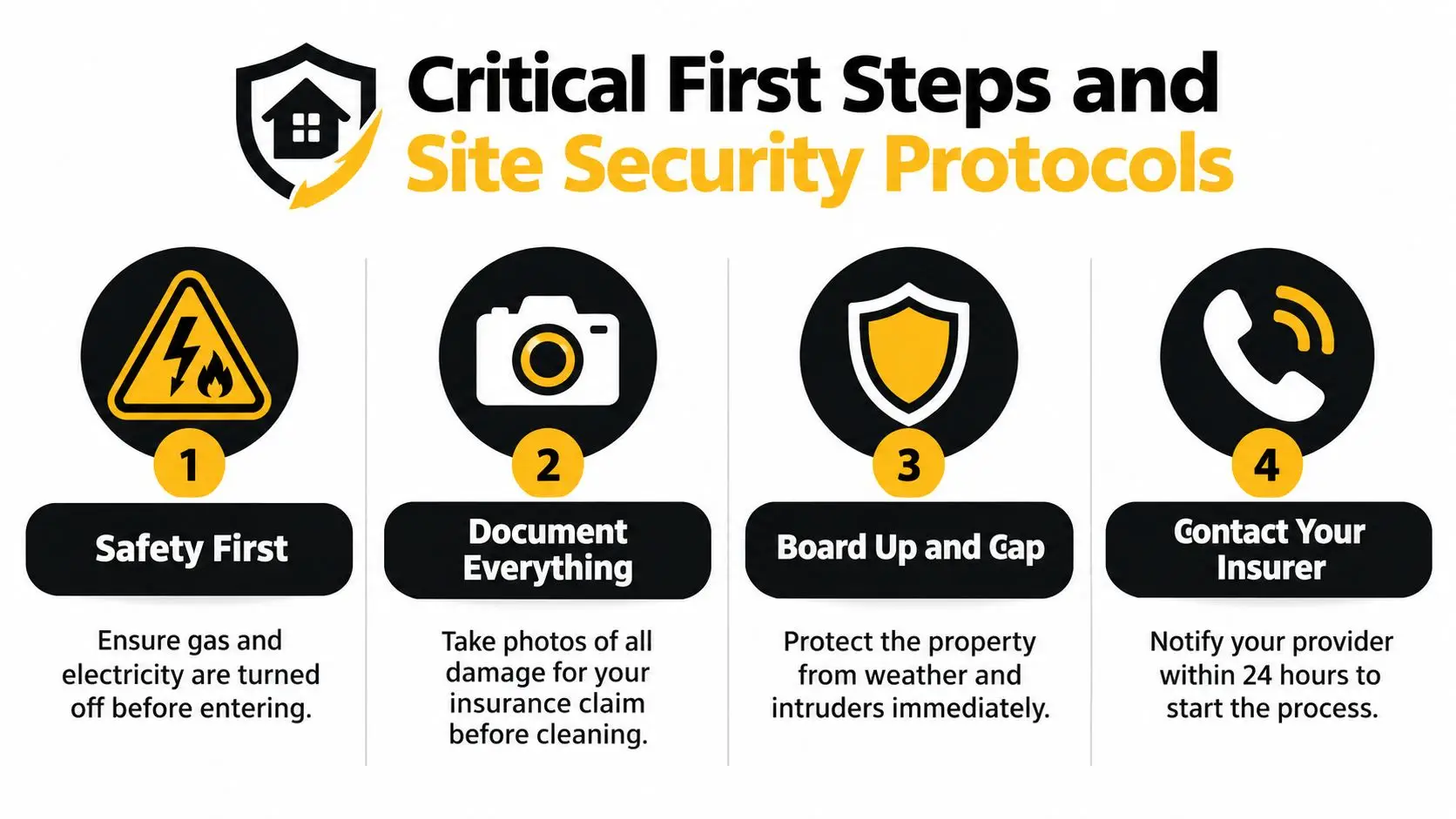
The first response sequence
Confirm life safety and utilities. Do not re-enter areas with suspected structural instability, exposed wiring, gas concerns, or standing water near electrical equipment. Utility shutoffs should be handled by authorized personnel, not improvised by staff.
Control access. Establish a perimeter, record who enters, and keep tenants, vendors, and curious employees away from contaminated or unstable areas. A sign-in record becomes useful when contents, documents, or inventory later require a chain-of-custody review.
Document before disturbing. Photograph and video rooms, equipment, stock, ceilings, mechanical spaces, water damage, and exterior openings. Capture wide views first, then close details. Don't sweep, hose, wipe, or discard material before the condition is recorded.
Protect the building. Board broken openings, cap vulnerable penetrations, and protect exposed areas from weather and unauthorized entry. Arrange emergency board-up services when the property needs immediate stabilization.
Notify the insurer and restoration coordinator. Give the carrier a factual first report, identify the affected operations, and preserve all fire department documentation, alarm records, maintenance records, and vendor communications.
Commercial claims can include building damage, business personal property, inventory losses, smoke and soot contamination, debris removal, and decontamination, as explained in this commercial fire insurance claims overview. Policyholders are generally expected to take reasonable steps to prevent additional damage while documenting the scene before cleanup.
The most common early mistake is sending maintenance staff in with household cleaners. Dry soot can smear into porous wallboard, textiles, and unfinished wood. Wet wiping can push residue into seams and equipment. Secure the property, preserve evidence, and let the remediation team choose the cleaning sequence.
A video can help managers visualize the immediate priorities, but it shouldn't replace a site-specific safety assessment.
The Science of Soot Migration and Remediation
Soot behaves like a moving contamination source, not a stain confined to the fire room. Heated smoke rises, cools, mixes with condensation, and follows pressure differences through return-air pathways, ceiling plenums, ductwork, door gaps, and vertical shafts. In a large Phoenix facility, the HVAC system can spread fine particles into adjacent suites before anyone notices a smell.
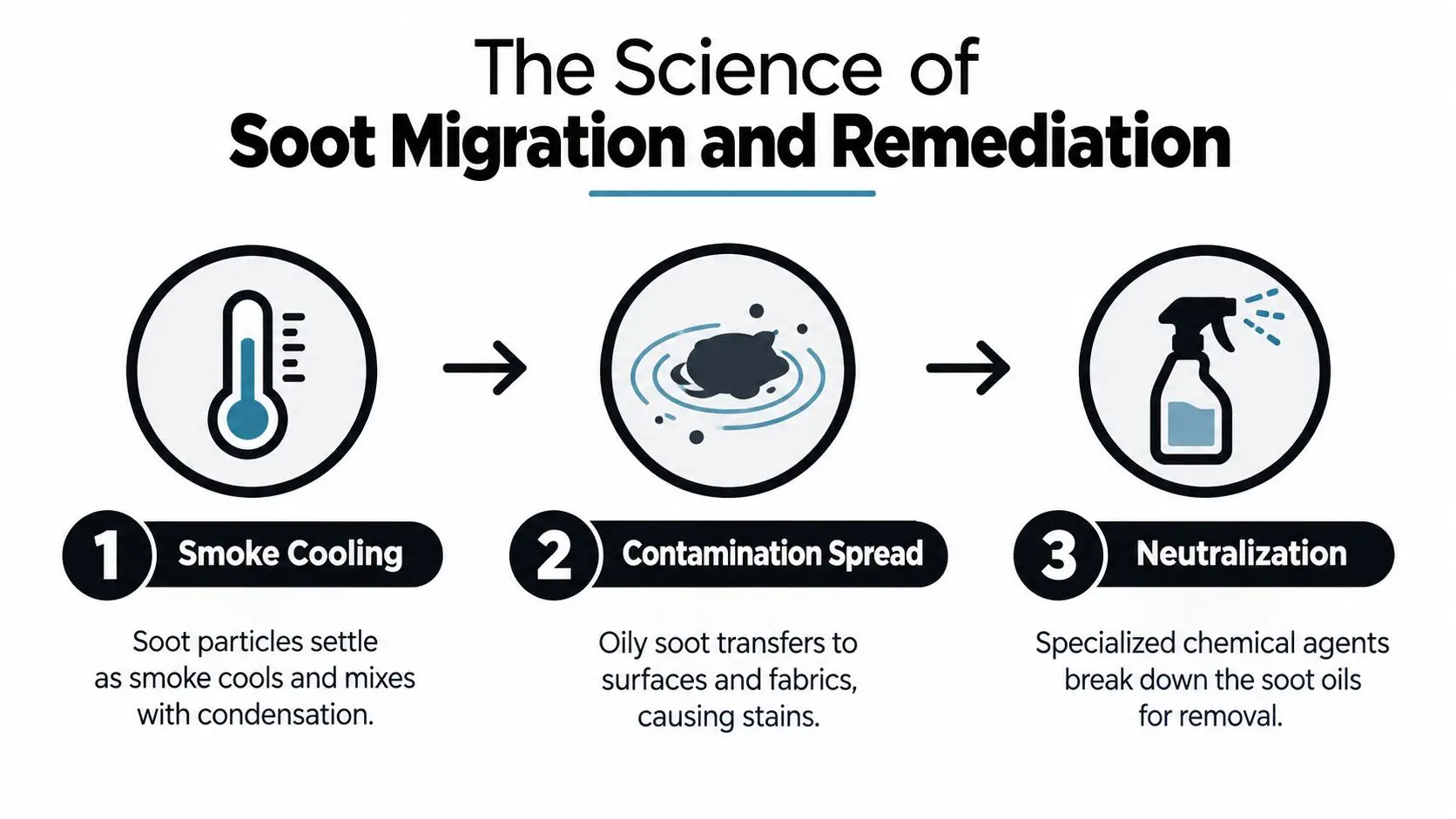
The particle size matters. Soot can include carbonaceous particles and other combustion byproducts, with reported particle sizes from roughly 0.01 to 10 microns. The smaller fraction can penetrate porous materials and HVAC dust films farther than visible debris, according to technical guidance on smoke and soot damage restoration.
Dry removal comes before wet cleaning
A professional sequence usually begins with source control and containment. Technicians may isolate affected zones, shut down or manage air-handling equipment, deploy HEPA filtration, and monitor particulate levels before they disturb settled residue. This prevents a cleaning crew from redistributing contamination into previously unaffected areas.
The first physical cleaning stage generally uses HEPA vacuuming and dry chemical sponges. These methods lift loose particles without immediately adding moisture that could dissolve and spread oily residue. Only after the loose material is removed should the team select wet or solvent-based agents matched to the surface and smoke type.
Dry soot from a high-oxygen fire often behaves differently from greasy wet smoke produced by a low-oxygen burn. A porous ceiling tile, a painted metal cabinet, and a circuit board each require a different risk assessment. The wrong cleaner can smear residue, trap odor, damage coatings, or accelerate corrosion on conductive surfaces.
What IICRC S700 changes in practice
The governing U.S. technical standard is IICRC S700, an ANSI-approved consensus standard for residential and commercial fire restoration. It addresses structural surfaces, contents, and mechanical systems affected by soot, char, combustion byproducts, and fire-suppression residues.
That standard matters because it pushes the project beyond cosmetic cleaning. The scope should identify what was inspected, what was contaminated, what was cleaned, what was removed, and what remains inaccessible or requires reconstruction. Before-and-after photographs provide a record for the owner, insurer, occupants, and future maintenance personnel.
A practical soot plan should answer four questions:
- Where did the smoke travel? Map air paths, pressure zones, plenums, ducts, and shared equipment.
- What residue is present? Separate loose particulate from oily or chemically active deposits.
- What can be cleaned safely? Test materials before applying moisture, solvents, agitation, or deodorizing products.
- How will the team verify the result? Use visual inspection, particulate controls, odor evaluation, and documented completion criteria.
For a local option focused specifically on residue removal, see soot cleaning services in the Phoenix area. The important distinction is not whether a surface looks clean after wiping. It's whether the team has controlled the migration path and removed the residue without damaging the asset.
Realistic Timelines and Phased Reopening Strategies
A commercial fire can leave the visible burn area contained while soot continues moving through return-air paths, shared corridors, and occupied workspaces. That mismatch often controls the schedule. The owner and restoration team should divide the property into operational zones, then assess each zone for structural condition, air quality, contents exposure, utilities, and safe access.
A minor fire may allow reopening within days. Moderate commercial losses often take 4 to 12 weeks, while major structural fires can require 3 to 6 or more months, according to commercial fire restoration timeline guidance. These ranges are planning references, not promises. HVAC contamination, equipment cleaning, permits, and insurer decisions can extend the work even when the damaged room appears small.
Build the reopening plan by zone
Start with the building's actual operating pattern. An office wing with an independent HVAC system may reopen while a damaged warehouse remains under containment. A retail tenant may stay closed because a shared corridor or air system is contaminated, even when the sales floor looks unaffected. A manufacturing area may remain offline until equipment cleaning, electrical inspection, and process safety checks are complete.
A workable phased plan identifies:
- Occupied zones: Areas where employees, tenants, customers, or contractors may work.
- Controlled work zones: Areas under containment, with restricted entry and active remediation.
- Mechanical dependencies: HVAC units, electrical panels, plumbing, fire protection, and access controls serving multiple zones.
- Business substitutes: Temporary offices, alternate inventory storage, remote work, or redirected customer traffic.
- Release criteria: The documented conditions required before each zone returns to use.
HVAC decisions deserve early attention. If a shared air-handling unit circulated soot across a floor, cleaning one office does not make that floor ready for occupancy. The team may need to isolate the system, protect clean areas, clean accessible components, and verify conditions before restarting airflow. Keeping the system offline can protect occupants, but it may also remove cooling, ventilation, or process control from areas the business hoped to reopen.
Smoke migration, sprinkler water, permits, insurance approval, and the ability to separate occupied areas can all extend a project. A small burn area does not guarantee a short closure if the affected air system serves the entire floor.
Reopening should be treated as a sequence of controlled releases, not a single date on a calendar.
Facility managers should hold a daily coordination meeting during active work. Review containment boundaries, HVAC status, access changes, contents decisions, insurer requests, permit progress, and the next zone that may be released. This discipline supports operational continuity without rushing people into contaminated areas or forcing a second closure.
Navigating Commercial Insurance Claims and Coverage
A facility can be physically safe yet financially exposed if the claim file does not show what happened, what was removed, and why operations remained restricted. Commercial fire claims become difficult when documentation is treated as paperwork instead of project control. The adjuster needs a defensible record of the property condition, salvage decisions, mitigation work, and operational impact.
Fire claims also tend to take longer to resolve than water claims. Independent industry data cited in insurance restoration statistics places average resolution at 21 days for fire claims versus 14 days for water claims. That difference makes early organization important, especially while the business continues paying expenses during a closure.
Keep the claim organized from day one
Create one controlled claim file, whether digital, physical, or both. Assign one person to communicate with the insurer and another to manage the restoration project. Keep messages factual and timestamped. Do not authorize disposal of damaged contents solely because they appear unsalvageable.
The pack-out decision involves a practical trade-off. Onsite cleaning can reduce handling and preserve workflow, but it may be unsuitable when odor, fine soot, security concerns, or mechanical contamination affects the area. Offsite cleaning can protect contents from continued exposure, yet it requires a detailed inventory, photographs, labels, transport records, and a clear custody process.
Use this checklist to keep the claim moving:
| Category | Required Documentation | Purpose |
|---|---|---|
| Building | Photos, videos, fire department records, repair estimates, engineer or inspection reports | Establishes the physical scope and safety issues |
| Contents | Room-by-room inventory, serial numbers, purchase records, condition photographs | Supports salvage, cleaning, replacement, or write-off decisions |
| Inventory | Stock lists, invoices, damaged-unit counts, freeze or hold records | Separates business personal property from saleable goods |
| Mitigation | Work authorizations, daily logs, equipment records, containment diagrams | Shows what actions reduced further damage |
| Operations | Closure dates, restricted zones, relocation costs, payroll and continuing-expense records | Supports business interruption analysis |
| Communications | Adjuster instructions, approvals, denial letters, vendor correspondence | Creates a traceable decision history |
Track business interruption separately
Business interruption coverage may impose a waiting period before benefits begin. It may also address continuing expenses such as payroll, rent or mortgage payments, loan obligations, taxes, and utilities. Policy language controls, so confirm the terms directly with the broker or carrier before relying on a coverage assumption.
Track the financial impact daily. Record which departments stopped, which employees relocated, which orders were delayed, and which expenses continued. If a zone reopens in stages, document each change rather than treating the property as wholly open or closed.
For help organizing the property-side workflow, owners can review commercial property insurance claims support. A restoration contractor can document physical conditions and mitigation work, but the policyholder remains responsible for understanding approvals, exclusions, deductibles, waiting periods, and business interruption requirements.
Evaluating Local Restoration Certifications and Standards
When searching for commercial fire damage restoration near me in the Phoenix metro area, compare technical capability rather than response slogans. A general contractor may be valuable during reconstruction, especially for framing, finishes, electrical work, or permitted improvements. That doesn't automatically mean the contractor has the equipment or procedures to map smoke migration, clean HVAC systems, handle contaminated contents, or document remediation performance.
A specialized restoration firm should be able to explain its process before you sign a broad authorization. Ask how the company will isolate unaffected areas, manage air movement, protect inventory, clean mechanical systems, handle suspected hazardous materials, and coordinate with the adjuster.
General contractor or restoration specialist
| Evaluation point | General contractor | Commercial restoration specialist |
|---|---|---|
| Primary role | Rebuilds and repairs damaged assemblies | Stabilizes, cleans, decontaminates, dries, documents, and may rebuild |
| Smoke assessment | May focus on visible surfaces | Maps migration through spaces and mechanical systems |
| Contents | Often removes items for disposal or storage | Develops salvage, pack-out, inventory, and custody procedures |
| Emergency controls | May mobilize after scope approval | Typically starts with stabilization and containment |
| Claim documentation | Provides construction estimates | Maintains mitigation records, photographs, scopes, and progress documentation |
The governing standard, IICRC S700, sets procedural requirements and performance objectives for commercial fire restoration. It covers structural surfaces, contents, and mechanical systems affected by soot, char, combustion byproducts, and suppression residues. It also expects written scope documentation and before-and-after photographic records, as detailed in this explanation of the IICRC-certified restoration standard.
Questions worth asking before authorization
- Who will manage the project? Get the name and role of the person coordinating tenants, vendors, insurers, and facility staff.
- What equipment is available? Ask about HEPA filtration, particulate monitoring, containment, contents handling, extraction, drying, and odor-control systems.
- How are records produced? Confirm that the team supplies photographs, daily logs, moisture or particulate readings where relevant, equipment records, and a written scope.
- Who handles reconstruction? Determine whether the restoration company performs the rebuild or coordinates a separate licensed trade partner.
- How are unsafe materials managed? Ask how the firm escalates suspected asbestos, lead, biohazards, unstable structures, or contaminated contents.
A provider's license, bond, insurance, relevant certifications, and commercial references should be verifiable. You can also review IICRC-certified restoration company services as part of your comparison, but still ask for a property-specific plan rather than relying on a credential alone.
Securing Your Phoenix Property for Long-Term Recovery
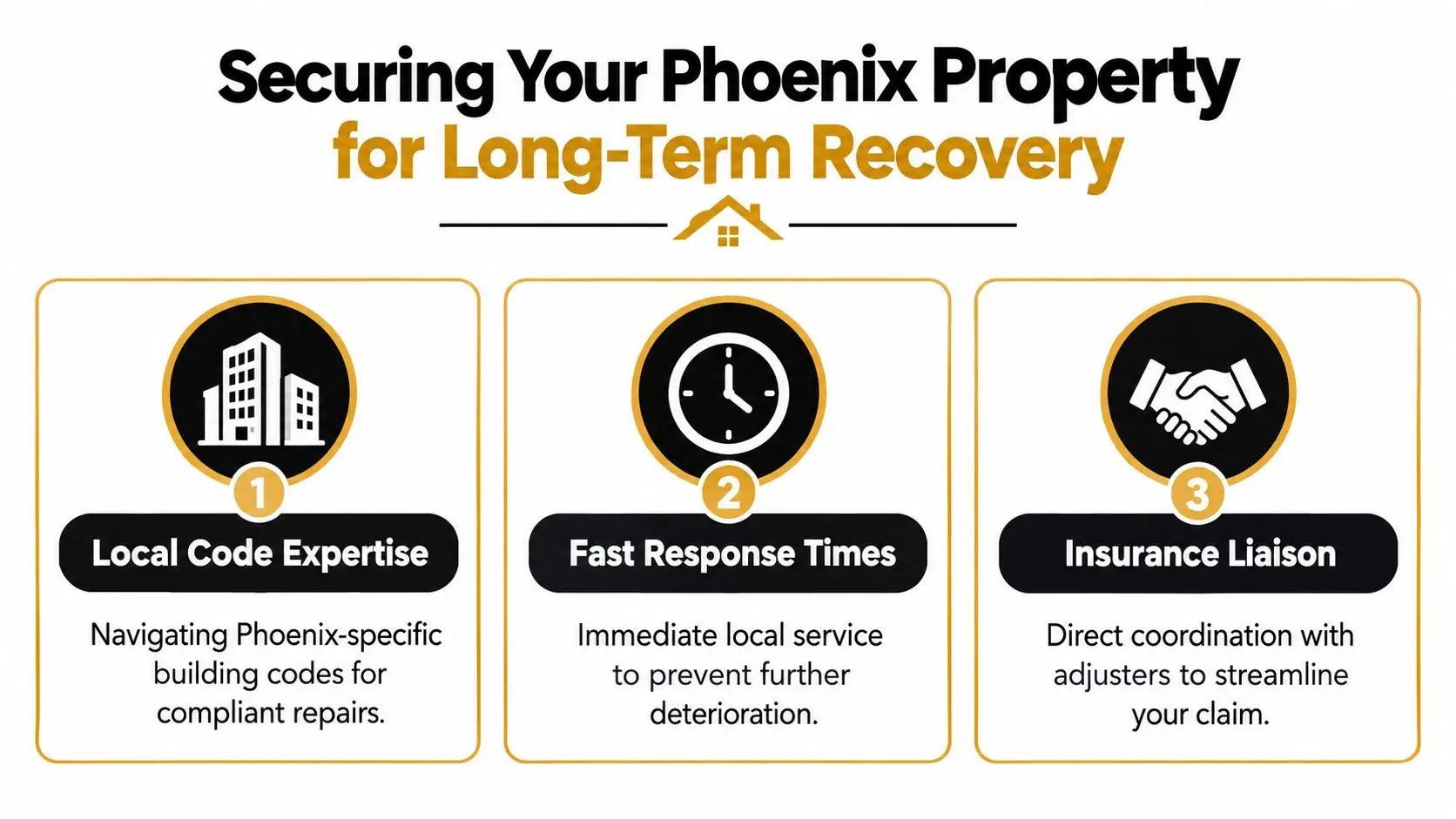
The strongest recovery plan connects emergency stabilization to final maintenance. A local team can coordinate access, understand the property's operating constraints, communicate with Phoenix-area trades, and keep the work aligned with the building's permits and repair requirements. Local familiarity doesn't replace technical competence, but it can reduce coordination friction when several systems and stakeholders are involved.
A commercial owner should expect the recovery plan to address more than soot removal. It should cover structural stabilization, suppression water, HVAC contamination, contents, odor, electrical and mechanical systems, tenant communication, insurance documentation, reconstruction, and final verification.
A practical owner checklist
Before work begins, confirm that the site is secure, utilities are controlled, the scene is documented, and the initial scope identifies affected air paths and occupied zones.
During mitigation, require daily communication about containment, access, HVAC operation, contents handling, equipment placement, and decisions that could affect the claim or reopening schedule.
Before each phased reopening, verify that the zone has an approved use plan, safe access, appropriate mechanical conditions, completed cleaning, and documented release criteria. Don't let schedule pressure turn an unresolved air-quality or residue issue into an employee or tenant complaint.
At closeout, collect the final scope, photographs, cleaning records, contents disposition, repair documentation, warranties where applicable, and recommendations for inspecting HVAC systems and vulnerable equipment after occupancy resumes.
The restoration market is established and substantial. An IBISWorld estimate cited by Proofco's state of restoration overview projects US damage restoration services revenue at about $7.7 billion in 2026, with industry revenue growing at a 4.1% CAGR and about 57,615 businesses operating nationwide. The same source cites US Fire Administration estimates of about 110,000 nonresidential building fires in 2023 and roughly $3.2 billion in direct property losses.
Those figures explain why owners have many vendors to choose from, but selection should still come down to process. Choose the team that can show how it will control migration, preserve evidence, manage contents, coordinate with the insurer, and release safe zones without guessing.
If your Phoenix commercial property has fire, smoke, soot, or suppression-water damage, Restore Heroes provides emergency assessment, stabilization, cleaning, odor removal, contents handling, and restoration coordination for commercial facilities. Contact the team to discuss the affected zones, HVAC concerns, documentation needs, and the next practical step for your recovery plan.