
Water on a commercial floor changes the conversation fast. One minute you're dealing with a maintenance issue. The next, you're deciding whether tenants need to leave, whether computers can stay powered, and how much of the building can keep operating today.
When people search for commercial water damage restoration near me, they usually aren't just asking who can extract water. They're asking a harder question: How do I stop this from turning into days of disruption? That's the right question. The building matters, but payroll, customers, deliveries, tenant access, and insurance timelines matter too.
A solid restoration response does two jobs at once. It dries and repairs the property, and it protects business continuity as much as the site conditions allow. The fastest cleanup plan isn't always the smartest one. The best plan is the one that stabilizes risk, documents the loss, and restores critical operations in the right order.
Your First Steps After Discovering Commercial Water Damage
The first hour matters because bad decisions in that window can make the loss larger, less safe, and harder to document. Your job is not to start tearing out materials. Your job is to control the scene.
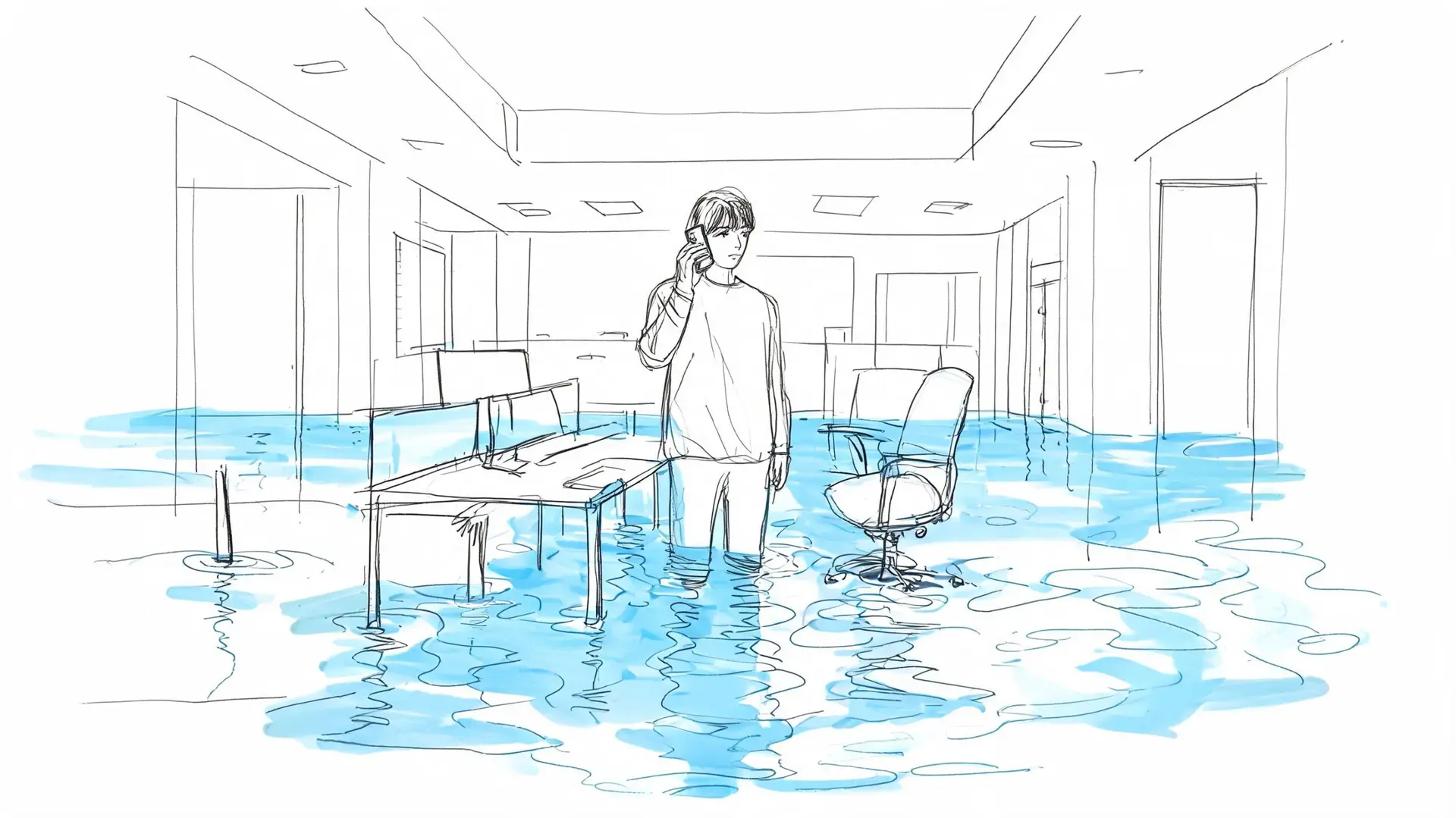
Make the area safe first
If water is near outlets, power strips, panels, equipment, or hardwired machinery, treat it as an electrical hazard. Restrict access immediately. If you can safely isolate power to the affected area, do that. If you can't do it safely, keep people out and wait for qualified help.
Then identify whether the source is still active. A broken supply line, failed appliance connection, roof intrusion, sprinkler discharge, or overflowing fixture each calls for a different response. If you can stop the flow safely, shut off the local valve or building water supply.
Practical rule: Don't let staff wade in, unplug devices, or move heavy equipment through standing water unless the area has been made electrically safe.
Control spread, not cleanup
Once the source is stopped or isolated, keep the damage from moving into unaffected areas.
Start with these priorities:
- Protect people: Move employees, tenants, and visitors away from wet flooring, sagging ceiling areas, and rooms with active leaks.
- Protect operations: Relocate servers, POS devices, boxed inventory, paper records, and portable electronics to dry zones.
- Protect access paths: Keep exits, stairwells, and common corridors clear if water is moving across them.
- Protect evidence: Take quick photos and videos before furniture, stock, or equipment is shifted.
This is also the point to call an emergency mitigation team. If you need a plain-language overview of what immediate mitigation includes, this guide on emergency water mitigation services is useful.
Set up the handoff before the crew arrives
Assign one person to meet responders and one person to gather building information. That prevents confusion on arrival.
Have these details ready:
- Source of loss if known: pipe, roof, sprinkler, drain backup, appliance, or unknown.
- Affected areas: suites, hallways, storage rooms, break rooms, restrooms, or warehouse sections.
- Operational priorities: what must stay online today.
- Access issues: locked rooms, elevator limits, loading dock access, alarm procedures.
If this incident came from a frozen or failed line, it's worth reviewing this facility-focused piece on preventing commercial pipe bursts once the emergency is stabilized. Prevention planning usually starts making sense right after a loss, when the weak points are finally obvious.
The Professional Restoration Workflow from Start to Finish
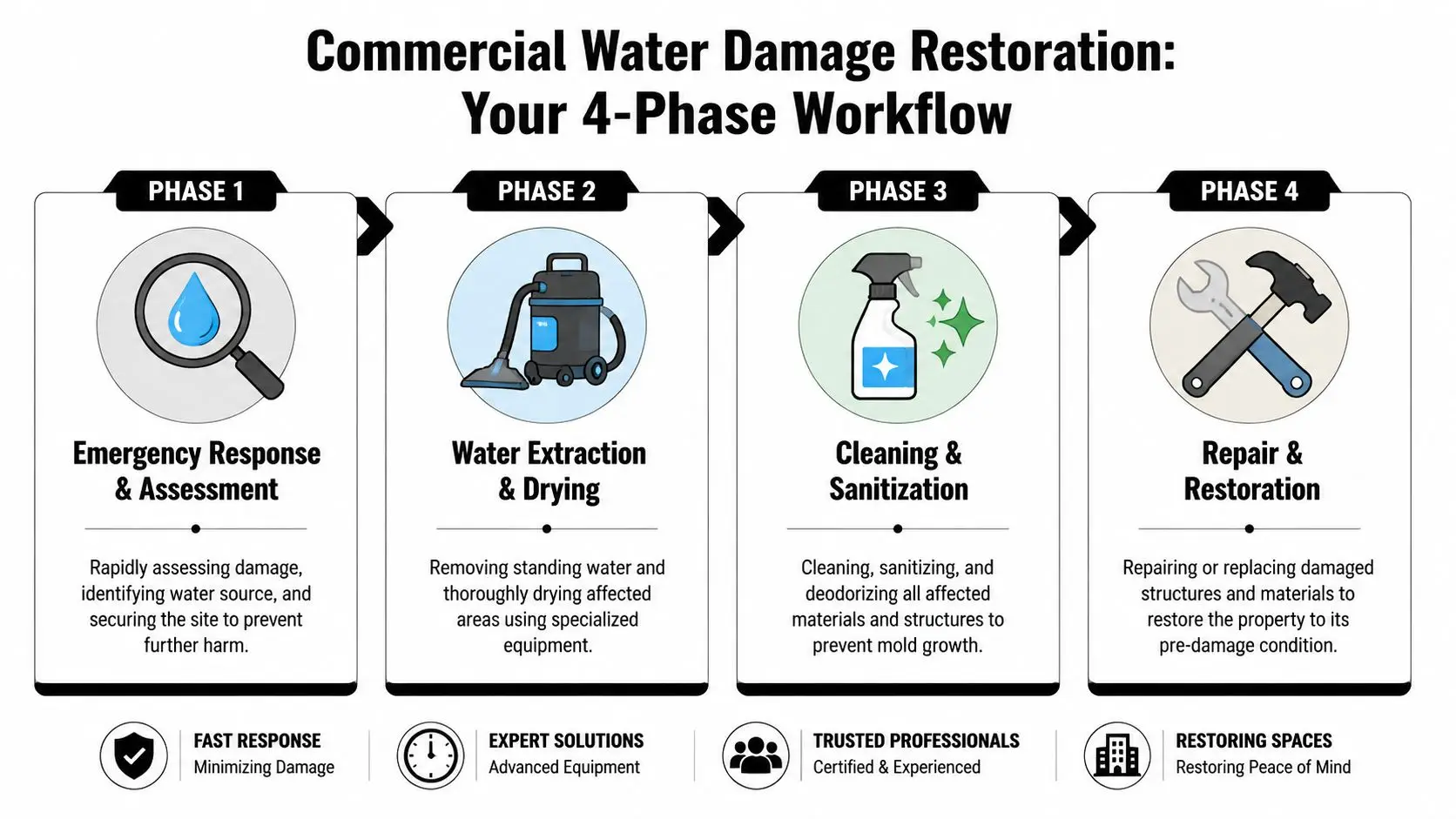
Once the crew is on site, the project should stop feeling chaotic and start feeling structured. Good teams work in phases for a reason. Drying a building without a clear workflow often leaves hidden moisture behind, creates insurance friction, or forces rework later.
Phase one assessment and moisture mapping
The first phase is inspection, scope definition, and hazard review. That includes identifying the water source, checking how far the loss traveled, and deciding what can be saved, dried in place, removed, or isolated.
Advanced thermal imaging has changed this stage in a practical way. It helps technicians find moisture behind walls and beneath floorboards without opening everything up. That precision is important because hidden moisture can lead to secondary damage like mold if it's missed during the first pass, as described in this review of thermal imaging in commercial damage restoration.
One of the most useful early questions isn't “How wet is it?” It's “What business functions sit inside the wet zone?”
Phase two extraction and stabilization
Extraction is the urgent labor. Crews remove standing water, pull moisture from carpet and pad where salvageable, and start protecting materials that will deteriorate if they stay saturated.
This phase should also include operational thinking. In a commercial setting, that may mean separating public areas from work zones, keeping one entrance open, or sequencing extraction around a tenant's critical hours. A contractor who only talks about machines and not occupancy planning may still dry the building, but they may not protect your day-to-day operations well.
For a broader look at the scope of work a restoration firm typically handles, this page on what a restoration company does lays it out clearly.
The right early question is not just “How fast can you start?” It's “How will you stage this job so my building can function while you work?”
Phase three drying and verification
This is usually the longest phase. Air movers, dehumidifiers, moisture meters, and daily monitoring do most of the heavy lifting here. Materials can look dry on the surface while still holding moisture deeper inside drywall, framing, insulation, or concrete.
Professional teams don't guess at this step. They track readings, adjust equipment placement, and verify progress. If they skip that discipline, the space may reopen too early and then need another round of work.
Phase four cleaning and repair
After moisture goals are met, the job turns toward sanitizing, deodorizing where needed, and repairing damaged finishes or assemblies. Depending on the loss, that can mean ceiling tile replacement, drywall repairs, base trim, flooring sections, cabinetry, paint, or more involved reconstruction.
The smartest projects keep mitigation and rebuild connected. That reduces handoff delays and makes it easier to move from “stop the damage” to “restore usable space” without losing momentum.
How to Choose the Right Restoration Contractor
A stressed property owner can hire the wrong company in a hurry. That happens most often when the decision is based on who answers first instead of who can manage a commercial loss cleanly from mitigation through documentation and repair.
The market is crowded. As of 2025, there are 62,582 damage restoration services businesses in the U.S., a 4.3% increase from 2024, according to IBISWorld industry data on damage restoration businesses. That makes credential checks more important, not less.
What matters more than marketing
Look for IICRC certification, commercial project experience, and a clear explanation of how the contractor handles moisture mapping, documentation, containment, and communication. A residential-only mindset can create problems in offices, medical suites, retail centers, schools, and industrial spaces because occupancy and access are more complicated.
This is also where local response matters. In Phoenix-area commercial losses, travel time, local subcontractor coordination, and knowledge of common building types all affect the pace of work. One local option property managers may review is Restore Heroes' commercial water damage contractor services, along with other qualified vendors in the area.
If mold becomes part of the conversation during vetting, this independent guide on how to find mold remediation companies can help you separate general cleanup claims from actual remediation capability.
Essential Questions for a Restoration Contractor
| Question Category | What to Ask |
|---|---|
| Credentials | Are you IICRC-certified, and which certifications apply to commercial water losses? |
| Commercial experience | What types of commercial properties do you work on most often? |
| Emergency response | How do you handle after-hours arrivals, site access, and stabilization on the first visit? |
| Moisture detection | What tools do you use to find hidden moisture and verify drying progress? |
| Containment planning | How do you separate work zones from occupied areas? |
| Documentation | What photos, moisture logs, and reports do you provide for the claim file? |
| Reconstruction | Do you manage repairs after mitigation, or will another contractor take over? |
| Insurance coordination | How do you communicate with adjusters and document changes in scope? |
Hiring mistake to avoid: Don't settle for a contractor who gives vague promises but no process. In commercial work, process is what protects your timeline.
Navigating Insurance Claims and Documentation
Water losses turn into paperwork fast. If you don't document early and clearly, the claim gets harder to support later. That matters because the average cost of a single commercial water damage loss can reach $89,000, and water damage and freezing account for about 23% of all property damage insurance claims, according to ATI's whitepaper on water damage and insurance implications.
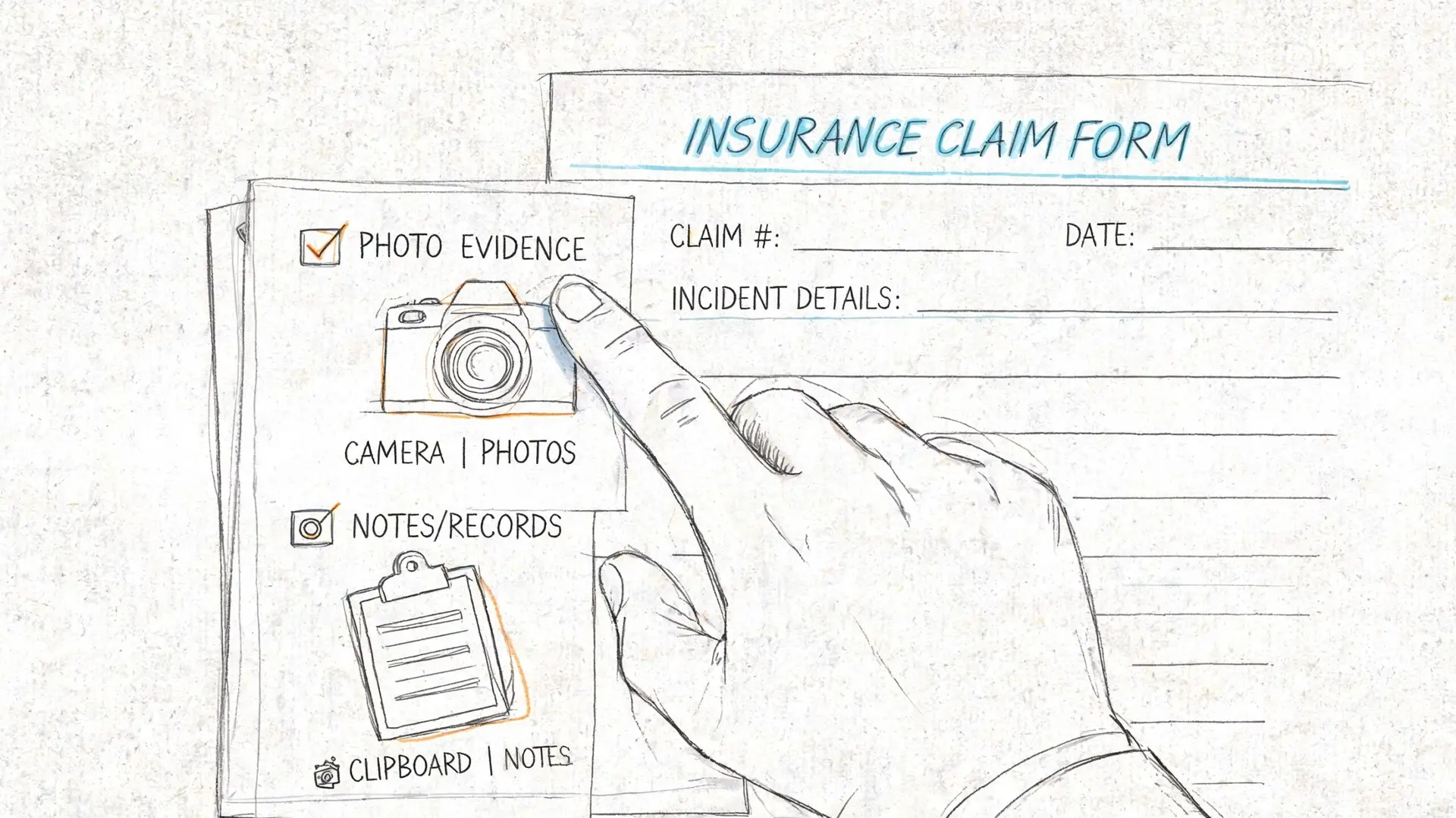
What to document before anything moves
Photograph the loss wide, then close. Start outside the affected area and work inward so the sequence makes sense later. Capture room identifiers, suite numbers, damaged materials, wet contents, ceiling impacts, floor conditions, visible source points, and any standing water.
Don't rely on memory for inventory. Write down what was affected by room and by function. “Office contents” is weak documentation. “Suite 204 copy room, lower cabinets, boxed paper stock, and base of west wall” is better.
Use this checklist:
- Wide shots: Show how the damage relates to entrances, hallways, workstations, and neighboring rooms.
- Close shots: Capture warped materials, staining, wet inventory, damaged electronics, and any visible leak source.
- Video walkthrough: Narrate what you're seeing, including date, time, and area names.
- Contents notes: Record what was moved, what stayed in place, and what appears unsalvageable.
- Incident log: Note when the loss was discovered, who responded, and what actions were taken.
A detailed guide on water damage insurance claim tips can help you organize this without slowing down the emergency response.
What not to throw away too soon
Keep damaged materials and contents until the insurer or adjuster has had a fair chance to review them, unless removal is necessary for safety or mitigation. If emergency disposal is necessary, photograph the item first and note why it had to go.
This short video gives a practical overview of the claims side of water damage:
How the restoration company supports the claim
A good restoration file does more than show that damage exists. It shows scope, cause indicators, moisture conditions, mitigation steps, and drying progress. Those records help the carrier understand why certain materials were removed, why equipment stayed on site, and why rebuild work may be necessary.
If your contractor communicates well, the claim process usually feels less scattered. If they document poorly, you may spend weeks reconstructing the story after the fact.
Estimating Timelines and Minimizing Business Interruption
The question clients ask first is usually “How long will this take?” The better question is “What has to happen before this part of the building can safely reopen?” That shift matters because a building can be in restoration while part of the operation is already back online.
According to Advanced DRI's breakdown of the water damage restoration process and timeline, rapid professional response can lead to a 3 to 5 day restoration for clean water damage, while moderate damage affecting multiple spaces often requires 1 to 2 weeks. The same source notes that drying and dehumidification is the longest part of the process.
What actually controls the schedule
A fast timeline depends on several moving parts:
- Water category: Clean water is simpler than contaminated water.
- Affected footprint: One suite moves differently than several connected spaces.
- Material type: Carpet, drywall, insulation, wood trim, and concrete all dry differently.
- Hidden moisture: Water inside walls, under flooring, or above ceilings slows decisions.
- Occupancy limits: Work in an active office or retail site often has to be staged around people.
The schedule also changes when the building can't fully shut down. Night work, contained work zones, elevator restrictions, shared corridors, and tenant access rules all add complexity.
How good teams reduce downtime
Business continuity doesn't happen by accident. The contractor needs a plan for what stays open, what gets isolated, and what gets restored first.
That usually includes:
- Prioritizing critical spaces: server rooms, reception, sales floors, treatment rooms, shipping areas, or tenant entrances.
- Building containment: temporary barriers help separate wet work from occupied zones.
- Sequencing by business function: dry and repair revenue-critical areas before less urgent back-of-house spaces.
- Working around operating hours: some tasks are better done early, late, or in phases.
For owners comparing options, this page on how long water damage restoration takes is a practical reference.
If your contractor can't explain which parts of the building may stay operational, they're giving you a drying plan, not a business continuity plan.
What doesn't work
What fails most often is the “all areas are equal” approach. They aren't. A wet storage room and a wet customer-facing entrance do not carry the same operational cost.
Another common mistake is reopening too early because surfaces look dry. Commercial losses punish that shortcut. If moisture is still trapped behind finishes or under flooring, the disruption comes back later, usually at a worse time.
Frequently Asked Questions About Commercial Water Damage
Can my maintenance staff handle the cleanup?
Sometimes they can handle the first control steps. They can shut off water, block access, move light contents, and document the loss. They should not take on contaminated water, major extraction, hidden moisture assessment, demolition decisions, or drying verification unless they have the right training and equipment.
For commercial properties, DIY cleanup usually breaks down when the problem is larger than what's visible.
What are the different categories of water?
In practical terms, contractors separate water by contamination level.
- Clean water: usually from a supply line or similar source at the start of the loss.
- Gray water: may contain contaminants from appliances, drains, or used water systems.
- Black water: heavily contaminated water, including sewage-related sources or serious flood contamination.
Category affects worker protection, disposal, cleaning standards, and what materials can be saved.
What does IICRC certification mean to me as the client?
It means the company has technicians trained to work to recognized restoration standards. That matters because commercial losses require more than machines. They require correct moisture assessment, documentation, containment, safety decisions, and cleaning methods.
If a contractor gets vague when you ask about certification, training, or drying verification, keep asking.
Can part of my building stay open during restoration?
Often yes, but only if the conditions allow it. That decision depends on contamination, electrical safety, access paths, air quality controls, noise, and whether crews can isolate the damaged area without creating new risks.
Occupied restoration is possible on many jobs. It has to be planned, not assumed.
What if mold is found during the water loss?
The job changes. The contractor has to address not just water mitigation but mold conditions, containment, and proper removal methods. That can affect access, demolition scope, cleaning procedures, and the return-to-service timeline.
The key is not to panic and not to ignore it. Mold discovered during drying needs a direct response, not a cosmetic one.
Should I move inventory and equipment before the crew arrives?
Move what you can safely move without creating injury, contamination spread, or documentation gaps. Prioritize electronics, paper records, boxed goods, and anything that supports immediate operations. Photograph first when possible.
If the space is unsafe, wait for trained help.
What should I ask when I call a company for commercial water damage restoration near me?
Ask three things right away: how they'll stabilize the site, how they'll document the loss, and how they'll help you keep critical business functions operating if possible. Those answers tell you a lot about whether they understand commercial work.
If you need help evaluating an active loss in the Phoenix area, Restore Heroes is one company that handles commercial water mitigation, drying, documentation, and related restoration work for local properties. The most useful next step is to get the site assessed quickly, define what's wet, and build a plan around both the damage and your operating priorities.