
After a fire, the first question on every property owner’s mind is the same: "What's this going to cost me?" It's the big, scary unknown. The truth is, the average fire damage restoration cost can swing wildly, from a few thousand dollars for a small kitchen flare-up to well over $50,000 if there's serious structural harm.
The final price tag really comes down to how bad the damage is and what it will take to make your home safe and sound again.
What Is the Average Fire Damage Restoration Cost?
Trying to figure out the cost after a fire can feel just as stressful as the fire itself. I like to compare it to a medical emergency. A minor kitchen fire that was put out quickly is like a small cut—it might just need some professional cleaning and patching up. But a major blaze that tears through multiple rooms is like major surgery, requiring a whole team of specialists and a long recovery.
The scope of the work is the number one thing that drives the cost. A small fire might only call for soot removal and getting rid of the smoke smell. A more destructive fire, on the other hand, kicks off a much bigger project.
That process often includes:
- Emergency board-up to secure your property from the elements and intruders.
- Water removal and drying out everything soaked by the firefighters' hoses.
- Deep cleaning of soot and smoke from every single surface.
- Structural repairs, which could mean rebuilding walls, floors, or even parts of the roof.
- Content restoration for your furniture, clothes, and other personal items.
- Odor removal using specialized equipment like ozone generators to effectively treat the smell.
Cost Estimates by Damage Level
To give you a better handle on what you might be facing, we can break costs down by how severe the damage is. Every fire is different, of course, but these general ranges are a good starting point. The only way to know for sure is to have a professional come out and see it in person.
The table below provides a general idea of what to expect based on national averages. Keep in mind that costs in the Phoenix area can vary based on local labor and material prices.
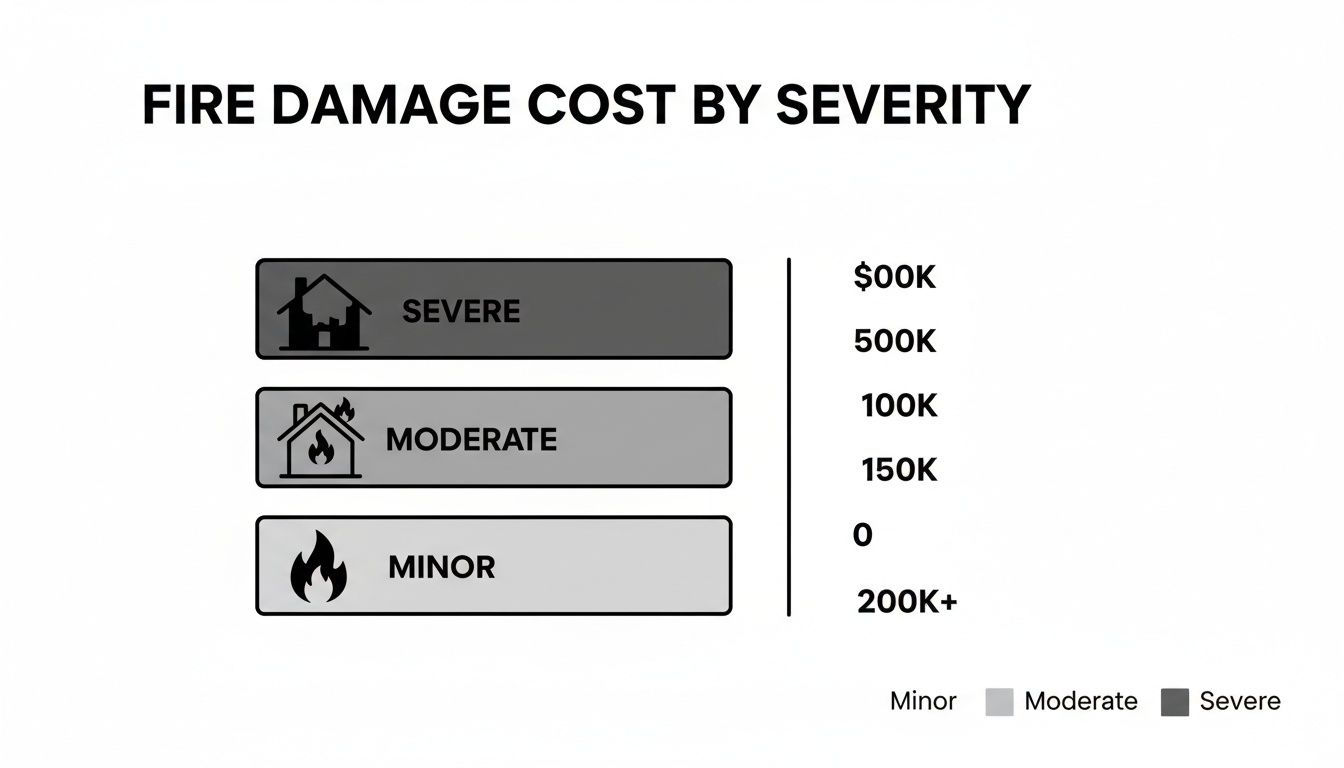
Estimated Fire Damage Restoration Costs by Severity (2026)
| Damage Severity | Description of Damage | Estimated Cost Range |
|---|---|---|
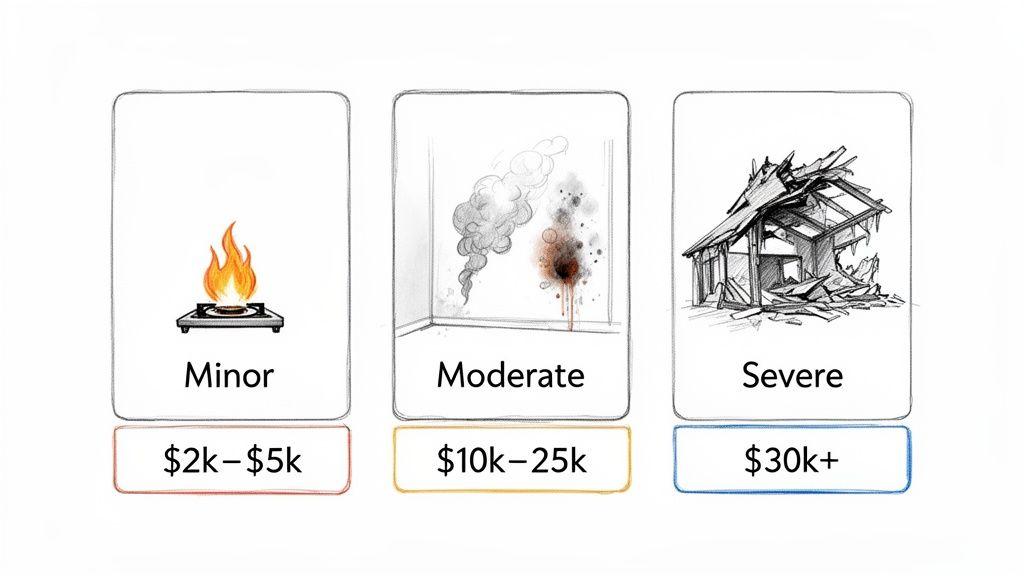
| Minor | Small, contained fire (e.g., kitchen stovetop). Minimal smoke, limited to one room. No structural issues. | $3,000 – $7,000 |
| Moderate | Damage affects several rooms. Significant smoke and soot. Minor structural repairs to drywall or flooring needed. | $7,000 – $25,000 |
| Severe | Widespread structural damage affecting walls, roof, or foundation. Extensive water damage from firefighting. | $25,000 – $75,000+ |
As you can see, the costs climb quickly as the damage gets worse, which is why a fast, accurate assessment is so important for planning your next steps.
The longer you wait, the worse it gets. Soot is acidic and can permanently stain surfaces in a matter of days, and lingering moisture leads to mold. Acting fast is key to keeping costs from spiraling.
Getting a Precise and Transparent Estimate
Knowing the potential cost is the first step toward getting your life back. Because no two fires are alike, you can’t trust a generic online calculator to give you an accurate number. It just doesn't work that way.
At Restore Heroes, we provide a free, no-obligation onsite inspection for property owners all over the Phoenix metro area. This lets our certified experts see the full extent of the fire, smoke, and water damage with their own eyes.
This hands-on evaluation is how we build a detailed, line-by-line estimate that shows you exactly where the money is going. It gives you the solid information you need to work with your insurance company and move forward with confidence. To see what happens after that initial visit, you can learn more about our complete fire damage restoration process and what to expect.
What Goes Into Your Restoration Bill? A Line-by-Line Breakdown
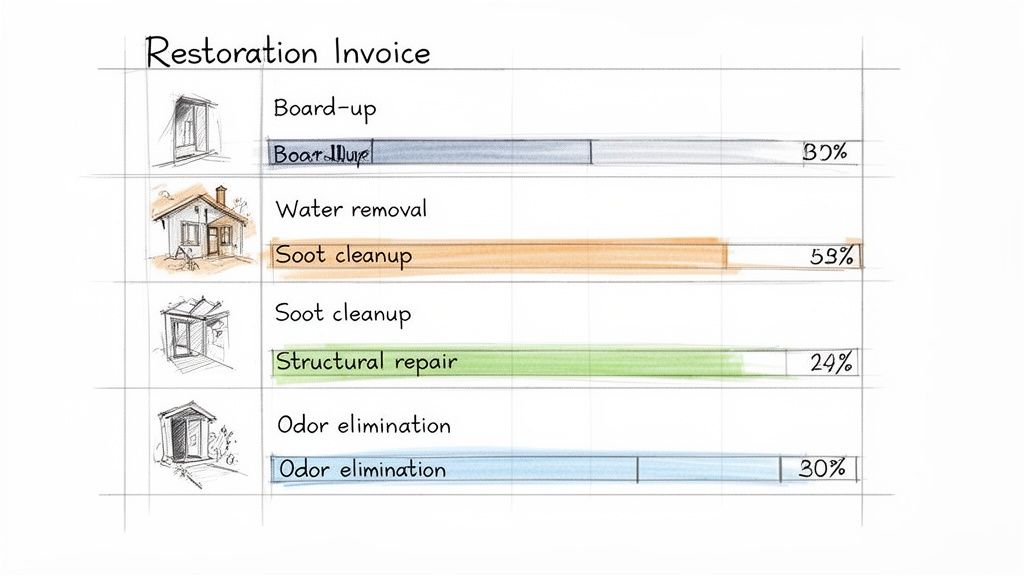
Ever wonder why one fire restoration job might cost $5,000 while a seemingly similar one down the street tops $50,000? It all comes down to the individual tasks required to make your property whole again. Your final bill isn't just one line item for "fire damage repair." It’s a detailed list of every single service needed to bring your home back to the way it was before the fire.
Think of it this way: when you take your car to a mechanic, you don't get a bill that just says "fixed car." You see charges for new brake pads, an oil filter, and the hours of labor to install them. Fire restoration works the exact same way. The total cost is simply the sum of all the necessary parts and labor.
Emergency Services and Water Removal
The moment the fire department leaves, a new clock starts ticking. The very first charges you'll see on an invoice are for immediate, critical actions to prevent the damage from getting worse. These aren't optional—they are essential for securing the property and stopping a cascade of new problems.
- Emergency Board-Up: A fire can easily shatter windows, burn through doors, or open up holes in the roof. Openings may need to be boarded up right away to keep out rain, pests, and vandals.
- Water Extraction: It takes a lot of water to put out a fire, and all of it ends up soaking your floors, walls, and belongings. Powerful, truck-mounted pumps and vacuums are used to get that water out fast, preventing further structural damage and stopping mold in its tracks.
Getting these first steps done immediately is crucial. Hesitation here can cause the scope of work—and the final bill—to grow significantly.
The Challenge of Soot and Smoke Cleanup
Here’s something most people don’t realize: not all smoke damage is the same. The type of soot left behind depends entirely on what burned, and that directly impacts how difficult and expensive the cleanup will be.
A fire that burns natural materials like wood or paper leaves a dry, powdery soot. But a fire involving synthetics—like plastics, rubbers, or upholstery foam—creates a greasy, oily residue that’s incredibly stubborn and smears easily. This oily soot is much harder and more time-consuming to clean, requiring special chemical sponges and solvents.
In a place like Phoenix, the intense sun can literally bake this residue onto the outside of your house, making it even tougher to remove. A professional crew knows exactly which cleaning methods to use for each type of soot, so they can get it all off without smearing it or damaging the surface underneath. You can get a better sense of this by reading our guide on what a restoration company does to tackle these different challenges.
Structural Repairs and Reconstruction
After the property is boarded up, dried out, and cleaned of soot, we get to the heart of the project: rebuilding. This phase is often the biggest ticket item on the invoice because it involves the actual construction work to repair your home.
The extent of the repairs depends entirely on how hot and how long the fire burned.
- Minor Repairs: This could be as simple as cutting out and replacing some drywall, repainting a room, or putting in new carpet.
- Major Repairs: In a severe fire, we might be looking at replacing charred roof trusses and wall studs, running all new electrical wiring, or re-installing plumbing systems.
This is where skilled tradespeople—carpenters, electricians, plumbers—come in. Their work is vital to ensuring your home is not just repaired, but is safe and up to current building codes.
Advanced Odor Removal and Content Restoration
Even when a home looks perfectly clean, a fire leaves behind an invisible problem: the smell. Smoke particles are microscopic, and they work their way deep into porous materials like wood, drywall, carpet, and furniture. Just wiping down the surfaces won't get rid of the odor.
To truly eliminate the smell for good, we use advanced techniques:
- Thermal Fogging: We use a machine that heats a deodorizing agent into a fine mist, or "fog." This fog expands into the same tiny cracks and crevices the smoke did, neutralizing the odor particles at their source.
- Ozone Treatment: In some cases, we use industrial ozone generators. Ozone is a powerful oxidizing agent that breaks down any lingering odor-causing molecules in the air and embedded in materials.
These services are what make a house feel like a home again. On top of that, the cost often includes content restoration—the painstaking process of cleaning, deodorizing, and trying to salvage your personal items. For Phoenix homeowners, our dry climate can actually make fire risk higher, and these numbers show why moving fast is so important. Waiting just a few days can increase total costs by 20-30% as smoke sinks deeper into materials and the structure weakens.
How to Navigate Your Insurance Claim After a Fire
After a fire, the last thing you want to deal with is a mountain of insurance paperwork. The process can feel intimidating, full of jargon and confusing steps, but you don't have to go through it alone. Let's break down what to expect in plain English so you can feel more in control.
Think of your insurance policy as the rulebook for your recovery. It spells out what's covered, what you'll have to pay, and the maximum amount the policy will cover. You'll hear two terms right away: deductible and coverage limits. Your deductible is simply the amount you pay out-of-pocket before your insurance starts paying. The coverage limits are the ceiling—the absolute most your policy will pay for specific damages.
Your First Steps and the Role of the Adjuster
Once you report the fire, your insurance company will assign a claims adjuster to your case. The adjuster works for the insurance company. Their job is to investigate the fire, assess the damage, and calculate a settlement amount based on your policy. It's crucial that you give them detailed and organized proof of everything that was damaged or destroyed.
This is where having a professional restoration company in your corner makes a world of difference. A certified team can create an incredibly detailed, itemized estimate using the same industry-standard software that adjusters rely on. When they see a professional estimate, it speaks their language and helps get everyone on the same page quickly. For a more detailed look at the entire claims journey, this is a great resource: Master the Home Insurance Claims Process.
Important Takeaway: Think of your restoration company as your advocate. While the adjuster represents the insurer, a professional restoration team works for you. Their job is to make sure every bit of damage is documented so your property can be properly restored to its pre-fire condition.
The Power of a Professional Partnership
Trying to manage an insurance claim by yourself, especially while you’re still processing the shock of a fire, is incredibly tough. When you partner with an experienced restoration company like Restore Heroes, we can shoulder some of that burden. We’ve worked with every insurance provider out there and know how to communicate directly with adjusters to keep the process moving.
Here’s how having us on your side helps:
- Finding All the Damage: We use specialized equipment to find all the damage, not just what’s easy to see. This includes hidden problems like smoke that has seeped into wall cavities or moisture from firefighting that could lead to mold. This helps create a complete and accurate scope of work for your insurer.
- Speaking the Insurance Language: We build our estimates using Xactimate, the same software that over 90% of insurance carriers use. This creates a transparent, line-item-by-line-item estimate that helps avoid disputes and speeds up claim approval.
- Handling the Headaches: We can take over much of the back-and-forth communication with your adjuster, providing the technical details and documentation they need. This frees you up to focus on what really matters—your family.
This partnership levels the playing field. You get a team of certified experts advocating for the complete and proper restoration of your home. The claims process has a lot of moving parts, and a clear action plan is your best friend. For a simple, step-by-step guide, check out our post on what to do after a house fire.
Ultimately, a successful claim comes down to clear communication and meticulous documentation. While no one can guarantee how an insurance company will decide, bringing in a professional partner who knows the system inside and out gives you a powerful ally. That support is invaluable for cutting through the stress and uncertainty, helping you move forward with confidence.
What a Phoenix Fire Restoration Job Actually Looks Like
It’s one thing to see a list of services and costs, but it’s another thing entirely to understand what a restoration project actually involves. The best way to get a feel for the real-world fire damage restoration cost is to walk through a few scenarios we see all the time here in the Phoenix area.
Every fire leaves a unique footprint, and the recovery plan has to be tailored to the specific damage. These examples show how the scope, materials, and complexity of a job directly impact the final bill and how long it takes to get your life back to normal.
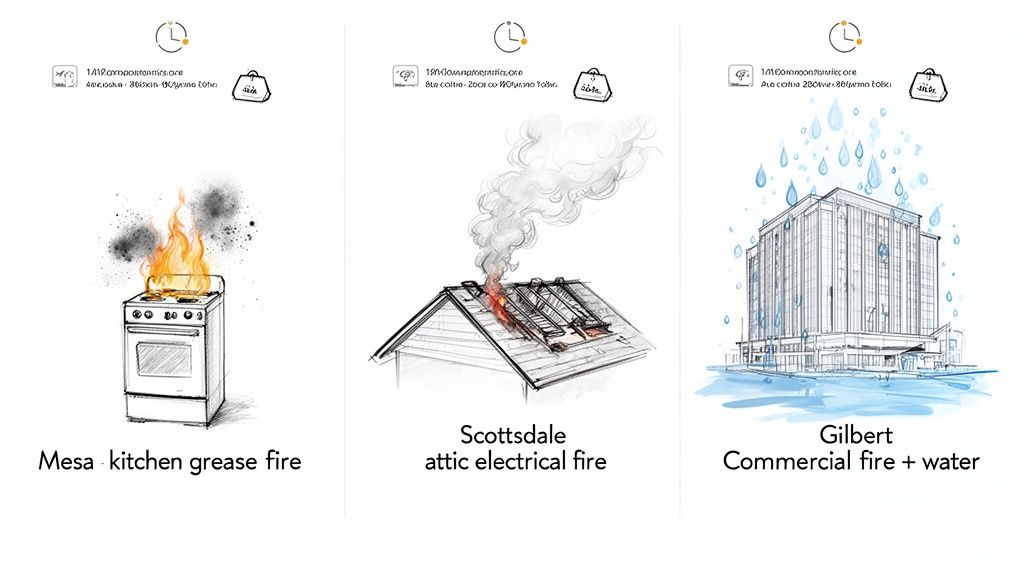
Scenario 1: The Mesa Condo Kitchen Fire
Picture this: a small grease fire flares up on the stovetop in a Mesa condo. The owner is quick with a fire extinguisher, but not before the flames have scorched the cabinets and sent a plume of greasy smoke rolling through the kitchen and into the living room. At first glance, the damage seems small, but the real problem is the invisible residue left behind.
This kind of fire leaves a sticky, oily soot that’s a nightmare to clean. The job would look something like this:
- Targeted Soot Removal: We’d use special chemical sponges to lift the oily soot off walls and ceilings without smearing it, which would only make things worse.
- Cabinet and Appliance Triage: Our technicians would inspect the cabinets to see if they can be deep-cleaned and refinished or if they’re too charred and need to be replaced. We’d also test the stove, microwave, and fridge to see if they were damaged by the heat or the extinguisher chemicals.
- Deodorizing the Space: To get rid of that lingering smoke smell, we’d likely use thermal fogging. This process neutralizes odor particles that have soaked into the drywall and furniture in the adjoining living area.
A contained fire like this one usually takes about one to two weeks to fully restore. The final cost would likely land somewhere between $4,000 and $8,000, with the biggest variable being whether the cabinets and appliances are salvageable.
Scenario 2: The Scottsdale Attic Electrical Fire
Now let’s imagine an electrical fire sparks in the attic of a single-family home in Scottsdale. It smolders undetected for a while, causing serious damage to the roof structure and insulation. To put it out, firefighters had to cut holes in the roof for ventilation and drench the attic with thousands of gallons of water.
This is a much more complex, multi-layered problem. The restoration process is intense and has to happen in a specific order.
First, we have to get all that water out—fast. We’d bring in powerful extractors and drying equipment to handle the water in the attic and any that seeped into the rooms below. This is priority number one to prevent mold and stop the saturated drywall from collapsing.
Next comes the structural work. Any charred roof trusses and rafters have to be surgically removed and replaced by skilled carpenters to meet current building codes. After that, we’d tear out all the wet, smoky insulation and damaged drywall, replacing it all. Finally, since the smoke was likely pushed through the home’s HVAC system, the entire house and all its ductwork would need a top-to-bottom deep cleaning and deodorization.
A project of this magnitude could easily take four to eight weeks. The cost often falls in the $25,000 to $50,000 range, sometimes more, largely because of the high cost of lumber for the structural repairs and the sheer amount of labor needed.
Scenario 3: The Gilbert Commercial Property Fire
For our last scenario, consider a large commercial warehouse in Gilbert where a fire was made worse by a roof leak during a monsoon storm. This combination of fire, smoke, and massive water intrusion is a restorer’s worst nightmare and a business owner’s biggest challenge.
For context, wildfires in areas near Phoenix already have average restoration costs over $45,600 per claim, and that figure can easily double when firefighting water leads to widespread mold.
Restoring a commercial property like this is a whole different ballgame. You’re not just repairing a building; you’re dealing with business-critical issues like lost inventory, damaged machinery, and getting operations back online as quickly as possible.
As you navigate the aftermath of a major disaster, it’s helpful to understand how Able And Ready Construction helps fire survivors rebuild, as they provide the kind of large-scale expertise required. Here, the focus shifts to industrial-grade mitigation with massive dehumidifiers, heavy equipment for debris removal, and a full-scale reconstruction of entire sections of the building. You can read more about our specific approach on our commercial fire damage services page.
A project this large and complex will almost certainly take several months and could easily cost $100,000 or more, all depending on the size of the warehouse and what was inside.
Taking Control: How to Manage Costs Without Cutting Corners
It’s completely normal to feel overwhelmed and powerless about the final bill after a fire. But you have more control than you think. There are smart, strategic ways to manage your fire damage restoration cost without ever compromising the quality or safety of the work. The most critical one? Acting fast.
Honestly, the longer you wait, the more expensive the project gets. Soot isn't just dirty; it's acidic and starts to permanently stain and etch surfaces. Meanwhile, all that water from firefighting efforts is creating the perfect breeding ground for mold. Calling a 24/7 certified professional the moment the fire department gives the all-clear is the single best way to stop this secondary damage from inflating your final bill.
Hire Certified Professionals, Not Just the Cheapest Bid
When you’re stressed and facing a huge expense, it's tempting to just go with the cheapest quote you can find. I've seen this backfire too many times. A company without the right training might use the wrong cleaning agents, smearing soot deeper into your walls, or they might fail to dry the structure completely, leading to hidden mold that causes major problems months later.
You could end up having to hire a second, reputable company to come in and fix the first one's mistakes. To avoid this costly nightmare, always work with a restoration company that is IICRC-certified. The IICRC (Institute of Inspection, Cleaning and Restoration Certification) is the gold standard in our industry. It's your proof that the technicians are properly trained in the latest, most effective methods for fire, smoke, and water damage, helping ensure the job gets done right the first time.
Get Your Paperwork in Order for the Insurance Claim
Think of thorough documentation as your best friend during the insurance process. Your claim settlement is built on the proof of loss you provide, so being meticulous here is key to getting the coverage you're entitled to without a major headache. A good restoration company will do the heavy lifting for you, but it’s always smart to be involved.
Work alongside your restoration team to:
- Build a detailed list of every single damaged personal item. Note its approximate age, condition before the fire, and what it would cost to replace.
- Take tons of photos and videos of the damage from every possible angle before anything is moved or cleaned up.
- Save every receipt for any out-of-pocket expenses you have, like a hotel stay, meals, or buying essential supplies.
This organized approach gives your insurance adjuster the clear, undeniable evidence they need to approve and process your claim efficiently.
The reality of a fire's impact goes far beyond one family's home. Picture a commercial property in Gilbert completely gutted by a fire—they're not just dealing with repairs but lost inventory and business interruption. It's a massive challenge, and it's happening more often. The global fire and water restoration market is projected to hit $35 billion by 2025 and is expected to grow at a 6.5% CAGR through 2033, fueled by a rising number of disasters that require professional help.
Make Smart, Tough Choices About Your Belongings
One of the hardest parts of this whole ordeal is deciding what happens to your personal belongings. You have to find a balance between an item's sentimental value and the practical cost of saving it. The tough truth is that some things may be too damaged to save, and replacing them will be cheaper than a complex, expensive restoration attempt.
A great restoration company will guide you through these difficult choices. They can assess what can be successfully cleaned and deodorized and give you a straight-up cost comparison for restoring versus replacing. For example, trying to salvage intricate electronics or heavily smoke-damaged upholstered furniture can sometimes cost much more than just buying new. For some more specific tips, see our guide on how to clean soot from walls.
Finally, ask if the company offers direct insurance billing. This is a huge help. It means they invoice your insurance provider directly for all the covered services. This can help you avoid paying massive amounts out of your own pocket and waiting for reimbursement, which really helps you manage your cash flow during an incredibly stressful time.
Frequently Asked Questions About Fire Restoration
When you're dealing with the aftermath of a fire, your head is probably spinning with questions. We get it. Here are some straightforward answers to the most common things we're asked by property owners about the process, the timeline, and the costs.
How Long Does Fire Damage Restoration Usually Take?
This is often the first question on everyone's mind, and the honest answer is: it truly depends on how bad the damage is. There's a huge difference between a small fire and a major one.
For a minor kitchen fire that was put out quickly, we might have everything cleaned, repaired, and deodorized in just a few days to a week. On the other hand, a fire that causes serious structural damage could easily take several months to rebuild properly. The key to shortening any timeline is getting a professional crew on-site right away to stop secondary damage in its tracks.
Can I Clean Up Minor Fire Damage Myself to Save Money?
I know it’s tempting to try and save on the fire damage restoration cost by tackling the cleanup yourself, but this is one area where DIY can backfire, badly. Soot isn't like regular dust—it’s an acidic, greasy substance that can permanently stain surfaces if you use the wrong cleaning methods.
Even worse are the invisible smoke particles. They get deep into porous materials like drywall, wood, and your furniture. Without professional-grade equipment, you can't remove them, meaning that awful smoke smell will keep coming back. More importantly, breathing in those fine particles can be a serious health hazard.
A professional's toolkit includes thermal foggers and ozone generators—advanced equipment designed to neutralize odor-causing molecules at their source. This is a critical step that household cleaners simply cannot replicate, helping ensure the persistent smoke smell doesn't return.
Does Homeowners Insurance Cover All Restoration Costs?
In most cases, yes. A standard homeowners insurance policy is designed to cover damage from a fire. This usually includes the cost to repair the structure itself, replace your damaged belongings, and even cover additional living expenses (ALE) if you have to move out during the restoration.
The key thing to remember is that your coverage will have limits, and you will have to pay your deductible. Always pull out your policy and review the details. An experienced restoration company can be a huge help here, as we document every bit of damage to build a solid, detailed claim for your insurance adjuster.
What Should I Do Immediately After a Fire?
Once you're certain everyone is safe and the fire department says it's okay, your first phone call should be to a 24/7 emergency restoration company. I can't stress this enough: time is critical.
Getting a team there immediately lets them board up broken windows and holes, assess the full extent of the damage (including water damage from the fire hoses), and start the mitigation process. A fast response is the single most effective way to keep the final fire damage restoration cost from spiraling.
If your Phoenix-area property has suffered fire damage, don’t wait. The experts at Restore Heroes are available 24/7 to provide an immediate response and a free, no-obligation onsite inspection. We accept all insurance and work to restore your property and your peace of mind. Learn more and get help now.