
A lot of homeowners find carpet mold the same way. You notice a stale, earthy smell that won't leave the room. Then you spot discoloration near a baseboard, under a bed, or beside a window. By the time you start searching how to get mold out of carpet, you're usually dealing with two problems at once: visible growth on top, and hidden moisture underneath.
That's why carpet mold needs a different approach than a countertop spot or bathroom grout. Carpet is porous. The fibers hold moisture, the backing traps it, and the pad can stay damp long after the surface feels dry. If you only clean what you can see, there's a real chance the smell and growth will come back.
In Phoenix, this catches people off guard. A monsoon leak, an AC condensation issue, or a small plumbing drip can leave just enough moisture under carpet to create a problem in a sealed, air-conditioned home. If the room still smells off after a spill or leak, it's worth taking seriously. If you're also dealing with lingering odor from wet flooring, this guide on how to eliminate wet carpet smell can help you separate simple moisture odor from something more serious.
That Musty Smell Your First Sign of Carpet Mold
A musty odor is often the first warning, not the stain.
Homeowners expect mold to look dramatic. Sometimes it does. More often, carpet mold starts subtly under a dresser, along a tack strip, inside a closet, or beneath an area rug where airflow is poor. You may only notice that one room smells “off” every time the AC kicks on or the door has been closed for a while.
What that smell usually means
That odor matters because carpet mold rarely stays only on the surface. Moisture moves downward. It reaches the backing, then the pad, and sometimes the subfloor. By the time the smell is obvious, the question often isn't just how to clean it. The better question is whether the carpet is still worth saving.
Here's the practical mindset to use:
- If it's a small, recent issue, the carpet may be salvageable.
- If the smell is deep and persistent, the pad or backing may already be involved.
- If the water source is still active, cleaning won't solve the problem.
Practical rule: Treat carpet mold as a moisture problem first. Surface cleaning only works when the material underneath can also be dried and verified.
The decision most DIY guides skip
Most online advice jumps straight to sprays and scrubbing. That's backward. The first real decision is save it or toss it.
That decision depends on what got wet, how far the moisture traveled, whether the carpet dried quickly enough, and whether the growth is limited to one manageable area. If the backing or padding is moldy, DIY cleaning becomes much less reliable. If the problem shows up in multiple places, replacement often makes more sense than trying to rescue material that's already compromised.
The rest of this guide walks through that decision in a practical order. First, identify what you're looking at and protect yourself. Then handle small, contained spots correctly. And if the carpet is past the point where cleaning makes sense, you'll know the signs.
Is It Mold or Just a Stain Identification and Safety First
Before you scrub anything, identify it. Homeowners waste time on carpet mold because they treat it like a spill stain, pet spot, or tracked-in dirt. Mold behaves differently.
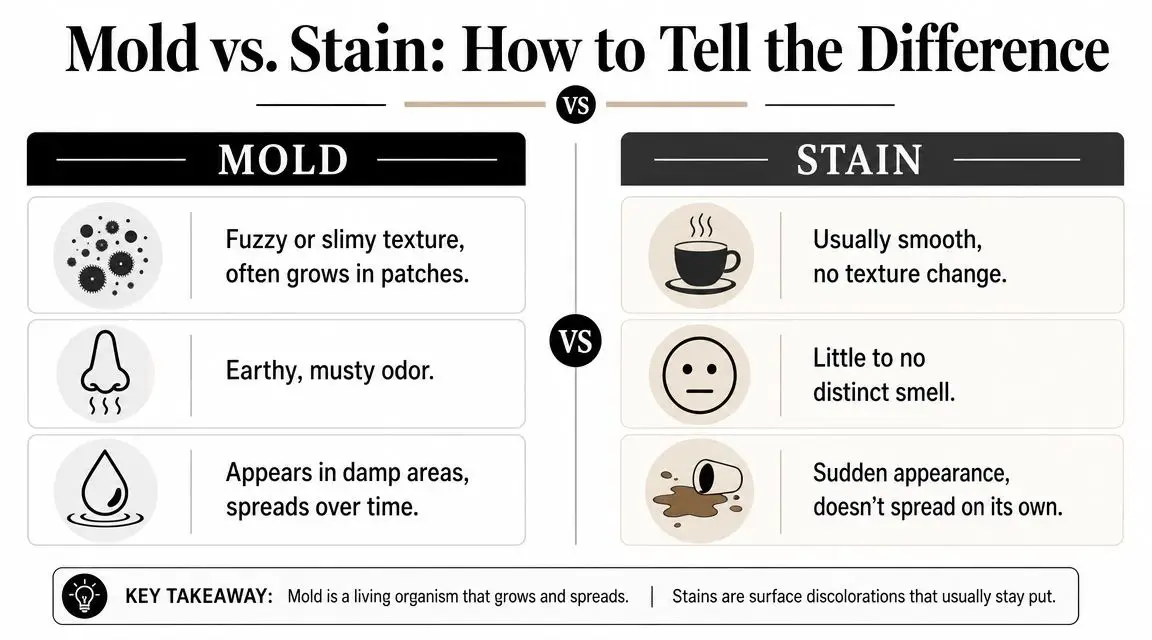
Signs that point to mold
Look for a combination of texture, smell, and location.
| Feature | More likely mold | More likely stain |
|---|---|---|
| Texture | Fuzzy, powdery, or slimy | Flat or crusted |
| Smell | Musty, earthy, damp | Often little odor, or an odor tied to the spill |
| Pattern | Irregular patches that may spread | Defined spot from a single event |
| Location | Damp edges, under furniture, near leaks, closets | Anywhere a spill happened |
| Change over time | Can grow or reappear | Usually stays the same unless re-soiled |
A stain usually tells a simple story. Something spilled, it dried, and it left color behind. Mold tells a moisture story. It appears where water sat, humidity stayed high, or airflow was poor.
If you're comparing carpet issues to wall issues in the same room, this guide on what mold looks like on drywall can help you spot related damage nearby.
Why safety comes first
The EPA notes that porous materials like carpet can be very difficult to clean completely because mold grows into the fibers and backing, which is why DIY cleanup should start with assessment, containment, and often HEPA vacuuming before liquids are applied, according to the EPA's mold cleanup steps.
That matters because disturbing mold can spread spores into the air and into other rooms.
Use basic protective gear before you touch the area:
- Mask: An N95 mask is the minimum practical choice for a small cleanup.
- Gloves: Nitrile or other waterproof gloves protect your skin from mold and cleaning agents.
- Eye protection: Safety glasses or sealed goggles reduce splash and dust exposure.
- Clothing: Wear clothes you can wash right away.
How to contain the area
Containment doesn't have to be complicated for a small patch, but it should be deliberate.
- Close interior doors if the room has them.
- Open windows if outdoor conditions allow.
- Use airflow carefully. Move air out of the room when possible, not across the house.
- Keep people and pets out until cleanup and drying are done.
- Avoid a standard vacuum at this stage. If you vacuum loose growth, use HEPA filtration.
Disturbing mold without containment can turn a local carpet problem into a whole-room air problem.
A quick field check
If you want a practical homeowner test before deciding on DIY cleanup, ask these questions:
- Is the area small and limited to one spot?
- Is the carpet only lightly affected on the surface?
- Can you inspect underneath without finding wet or moldy padding?
- Has the leak or moisture source already been fixed?
If the answer to any of those is no, slow down before you start spraying cleaners. The smartest next move may be inspection, not cleaning.
Your Complete DIY Mold Removal Action Plan
If the mold is limited, the moisture source is fixed, and the backing and pad still look salvageable, you can try a careful DIY cleanup. The key is to work in a way that removes contamination without soaking the carpet again.
Start with your tools, not your cleaner.
Gather the right equipment
For a small carpet mold cleanup, assemble these items first:
- HEPA vacuum: For loose spores and dry surface debris.
- Spray bottles: One for cleaner, one for light rinse water if needed.
- Stiff-bristle brush: To agitate the fibers without shredding them.
- White towels or disposable cloths: To blot and lift residue.
- Wet/dry vacuum: To extract liquid after treatment.
- Fans and a dehumidifier: For immediate drying.
- Trash bags: For contaminated cloths or removed padding.
This visual lays out the workflow in a simple sequence.
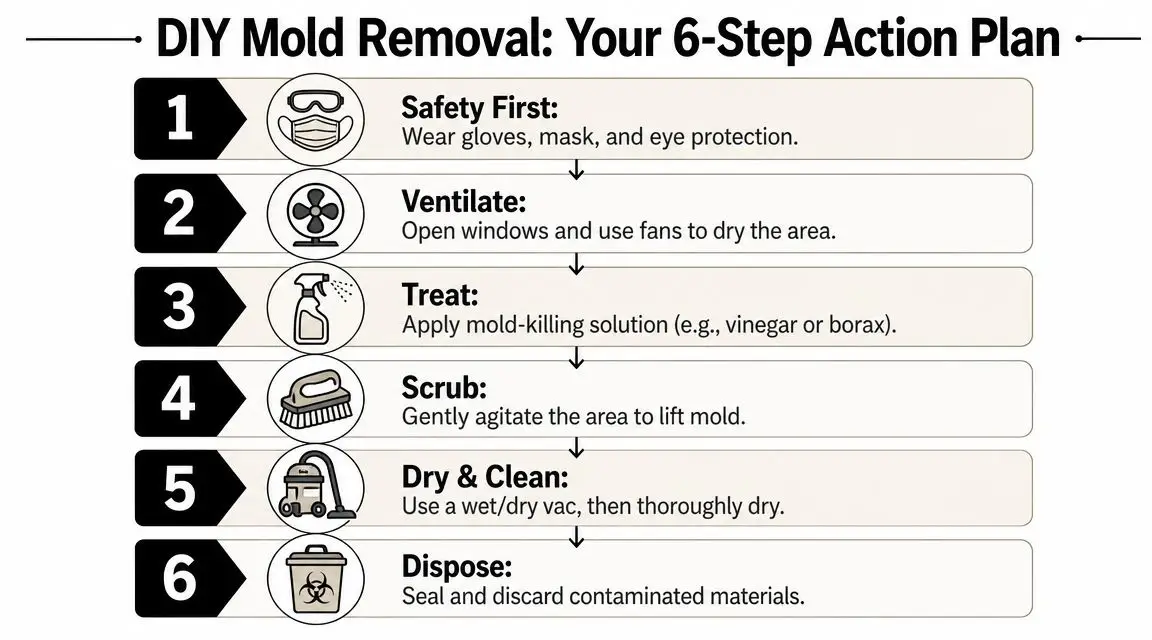
Step one remove the moisture source
Don't clean first if the carpet is still getting wet.
If the mold started after a leak, fix the leak. If the issue came from a plumbing failure, outside help for the source repair may be the most useful first step. A practical example is this breakdown of Eastbourne water leak repair, which shows the kind of plumbing response homeowners often need before any drying or remediation can work.
If moisture is still entering the room, cleaning becomes cosmetic.
Step two inspect the underside
Pull back a corner if you can do it safely without tearing the carpet. Check the backing, the padding, and the floor below.
You're looking for three things:
- Wet pad
- Visible mold below the face fibers
- Dark staining or odor on the subfloor
If the pad is wet or moldy, don't plan on saving it. In practice, padding is usually the first material that gets removed once mold reaches below the carpet face.
Step three remove loose contamination
Use a HEPA vacuum to collect loose, dry surface debris before applying any liquid. This reduces how much material gets driven deeper when you scrub.
Don't use a standard household vacuum unless it has proper HEPA filtration. Standard machines can spread what you're trying to remove.
Step four choose a cleaner and test first
A practical expert method treats carpet mold as a moisture-removal problem, not just a stain-removal one. After using a cleaner such as diluted white vinegar, hydrogen peroxide, or a detergent-based product and scrubbing, the key is extracting the moisture with a wet-vac so dampness isn't left in the backing or pad, as described in this carpet mold cleanup guide.
Before wider use, test the cleaner on an inconspicuous area and wait about 24 hours if you're using a stronger product, to make sure it doesn't discolor or damage the carpet fibers. That benchmark is included in the EPA-aligned guidance summarized above.
Use enough cleaner to work the fibers. Don't saturate the carpet.
Step five scrub with control
Work in a small section at a time.
Use a stiff-bristle brush to agitate the affected fibers. The goal is to loosen growth from the carpet face, not grind moisture deeper into the structure.
A controlled process looks like this:
- Mist the area lightly with your chosen cleaner.
- Scrub the fibers enough to break up visible growth.
- Blot or extract immediately instead of letting liquid sit.
- Repeat only as needed until visible residue is removed.
Field note: Homeowners often lose the battle here by overspraying. The carpet looks cleaner for the moment, but the pad ends up wetter than when they started.
Step six extract and dispose properly
Once scrubbing is done, use a wet/dry vacuum to pull out as much liquid as possible. This step is more critical than commonly realized. If liquid stays in the backing, mold can return even when the top fibers look clean.
Bag contaminated cloths, disposable brushes, or removed pad sections and take them out promptly. Don't leave damp debris sitting indoors.
When DIY is still reasonable
DIY cleanup is usually most realistic when all of these are true:
- The growth is small
- It appears limited to one area
- The pad is dry and not moldy
- The subfloor isn't affected
- The room can be dried aggressively after cleaning
If any of those conditions aren't met, the cleanup starts to shift from household cleaning into restoration work.
The Critical Drying Process to Stop Regrowth
Cleaning removes visible mold. Drying determines whether it comes back.
That's the part many homeowners underestimate. Carpet can feel dry on top while the backing and pad still hold moisture below. That hidden dampness is what restarts the problem.
Why drying matters more than the cleaner
Experts stress that carpet, padding, and the floor beneath them need to dry very quickly to limit regrowth. They also caution that standard vacuums can spread spores, which is why HEPA filtration during cleanup and strong ventilation and dehumidification afterward matter so much, as explained in this guide on drying and containing carpet mold.
A homeowner can scrub away the visible spot and still fail the job if the pad stays damp.
If you remember one thing, remember this. A carpet that looks clean but stays damp is still a mold problem.
What effective drying looks like
Drying works best as a combined system, not a single tool.
Pull moisture out of the material
Use a wet/dry vacuum first. That removes liquid from the carpet body before you try to dry the room air.
Move air across the surface
Place fans so they move air across the carpet, not straight down into one wet point. Good air movement helps evaporate trapped moisture more evenly.
Lower the room humidity
Run a dehumidifier in the same room. Fans alone move moisture around. A dehumidifier removes it from the air so the carpet can keep releasing moisture.
If you need a more detailed walkthrough, this guide on how to dry wet carpet fast is useful for the extraction and airflow side of the job.
Check the layers nobody sees
Drying is incomplete until you inspect below.
Pull back the carpet edge if possible and check:
- The carpet backing
- The pad
- The tack strip area
- The subfloor surface
If the pad is still cool, damp, stained, or musty, the job isn't done. If you can't dry it fully, replacement is usually the safer call.
The most common drying mistakes
| Mistake | Why it fails |
|---|---|
| Drying only the surface | Moisture remains in the backing or pad |
| Using too much cleaner | Adds water to an already compromised material |
| Relying on smell alone | Odor may fade before the material is actually dry |
| Closing the room too soon | Traps humidity and slows evaporation |
A dry carpet should not just feel dry under your hand. It should also pass the underside inspection, with no lingering dampness, no musty odor from below, and no cool, wet pad.
When to Call a Pro Signs Your Carpet Must Be Replaced
This is the decision point most homeowners need help with. Not every moldy carpet should be cleaned. Some carpet should be removed, bagged, and replaced because the contamination has moved beyond a practical or safe DIY repair.
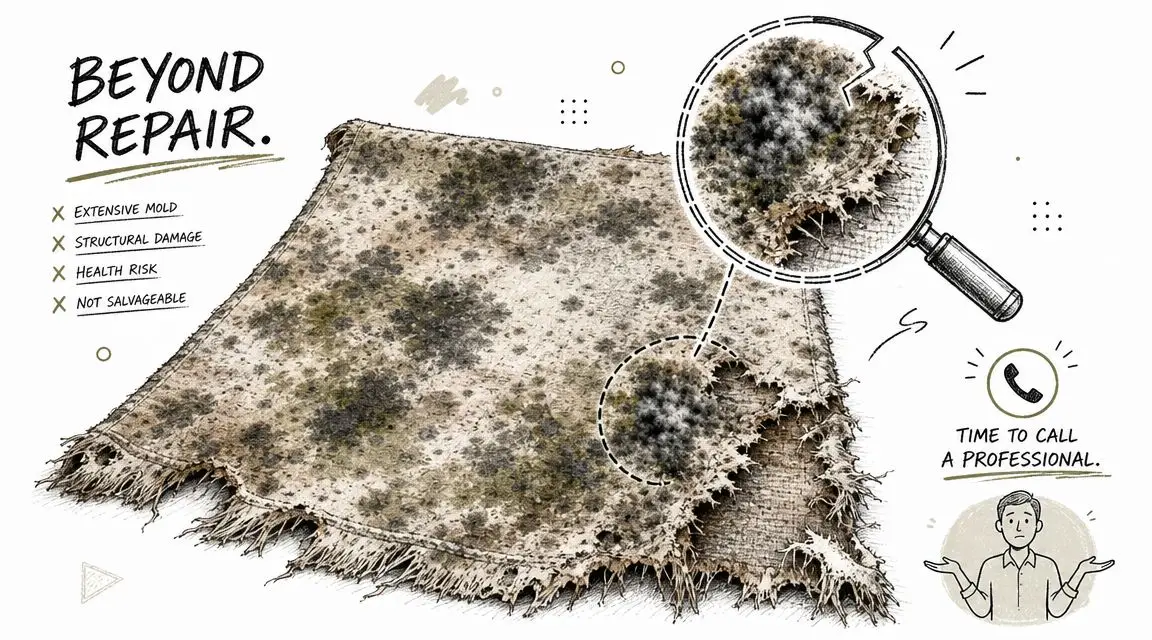
The clearest replacement rule
InterNACHI's mold guidance says that if mold has grown on more than one area of the carpet, or if the affected area is large, the carpet will probably need to be replaced rather than cleaned. That rule of thumb appears in their guidance on carpet mold cleanup and replacement.
That's a practical trade-off, not scare talk. Once growth shows up in multiple places, the problem usually isn't isolated to one surface patch anymore.
Signs the carpet is no longer a good DIY candidate
Look at the problem like a restoration technician would. The carpet is much less likely to be salvageable when any of these are true:
Mold has reached the backing or pad
If you lift the carpet and find mold below the face fibers, cleaning the top won't solve it. The pad is especially hard to recover once it's moldy.
The odor stays after cleanup and drying
A smell that returns after cleaning usually means one of two things. Moisture is still present, or contamination remains in a lower layer.
Growth appears in more than one spot
Multiple areas suggest a bigger moisture pattern. That could be widespread humidity, a leak path, or hidden water migration under the carpet.
The water source was contaminated
If the carpet got wet from sewage or heavily contaminated water, replacement is the safer route. In those situations, the issue isn't just mold. It's broader contamination.
Mold keeps coming back
Recurring growth tells you the root cause hasn't been solved, or the original cleanup never reached the underlying source area.
Decision shortcut: If the pad is moldy, the smell is deep, or the growth is widespread, replacement usually beats repeated cleaning attempts.
What a professional actually does
Professional help isn't just “stronger cleaner.” Proper remediation usually involves moisture mapping, controlled demolition where needed, HEPA filtration, structural drying, and disposal of unsalvageable material.
That's where a restoration company can add value as one option among others. For example, Restore Heroes mold removal services are built around inspection, moisture detection, drying, and removal of affected materials when cleaning alone isn't enough.
A practical save or toss framework
| Condition | More likely save | More likely replace |
|---|---|---|
| Location | One small area | Multiple areas |
| Depth | Surface fibers only | Backing or pad involved |
| Moisture source | Fixed and contained | Ongoing or unknown |
| Odor after drying | Gone | Persistent |
| Recurrence | First-time issue | Repeated return |
Insurance and documentation
If you're dealing with a leak-related mold issue, document the scene before removing materials. Take photos of the visible growth, the wet areas, the underside of the carpet, and any nearby leak source. Keep notes on when you first noticed the smell or dampness.
Coverage depends on the cause of loss and the details of your policy, so it's smart to ask your carrier specific questions before assuming anything is covered.
Long-Term Mold Prevention for Phoenix Homes
Phoenix homeowners don't usually think of carpet mold as a humidity problem until they've dealt with it once. But sealed homes, AC use, surprise roof leaks, and monsoon-driven water intrusion can leave the right conditions behind.
The EPA recommends drying wet materials within 24 to 48 hours to help prevent mold, and for prevention they advise keeping indoor relative humidity below 60%, ideally 30% to 50%, according to the EPA's mold and moisture guidance.
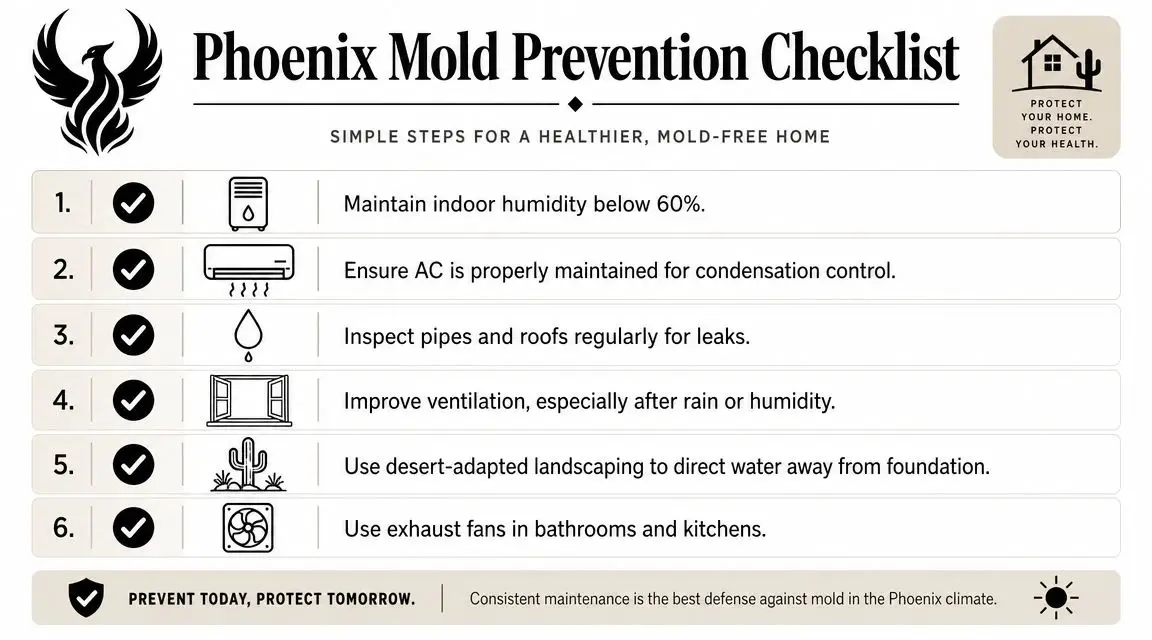
What prevention looks like in a Phoenix house
Watch humidity indoors
If a room feels muggy, smells stale, or has condensation issues, check the humidity. Carpet holds moisture longer than hard flooring, so a room can support mold even when nothing looks obviously wet.
Respond fast to leaks and spills
A small appliance leak or window intrusion can do real damage if moisture sits under carpet. Don't wait to “see if it dries on its own.”
Improve airflow in moisture-prone rooms
Bathrooms, laundry areas, and rooms with poor circulation are frequent trouble spots. Use exhaust fans where available and don't block supply or return vents with furniture or rugs.
Focus on hidden trouble spots
The problem areas in Phoenix homes are often predictable:
- Closets on exterior walls
- Bedrooms with heavy furniture pressed against carpet
- Rooms near aging windows or sliding doors
- Areas below roof leak paths after storms
- Spaces near AC condensate lines or plumbing fixtures
Inspect those areas after storms, plumbing issues, or any event that leaves carpet damp.
Build a prevention routine
A simple routine prevents a lot of expensive guesswork later:
- Check after monsoons: Walk perimeter walls and smell for mustiness.
- Look under furniture occasionally: Low airflow creates hidden damp zones.
- Maintain drainage outside: Water should move away from the foundation.
- Dry wet carpet immediately: Don't assume AC alone will handle it.
If your home has already had a flood or leak event, this resource on how to prevent mold after a flood adds a solid prevention checklist for the days right after water exposure.
Frequently Asked Questions About Carpet Mold
Can I use bleach to get mold out of carpet
Usually, that's not the first choice for carpet. Bleach can discolor fibers, and it doesn't solve the bigger issue if moisture remains in the backing or pad. Carpet mold cleanup works better when you focus on controlled cleaning and complete drying.
How can I tell if the mold is completely gone
You're looking for three things together. No visible growth, no musty odor, and no hidden dampness underneath the carpet. If the carpet looks clean but the smell returns, or the underside still feels damp, the problem likely isn't finished.
Does homeowners insurance cover mold removal
Sometimes it can, depending on what caused the damage and how your policy handles water loss and mold-related remediation. Don't assume coverage either way. Take photos, save notes, and ask your carrier how they handle your specific cause of loss.
Does the HVAC system make carpet mold worse
It can. Poor airflow, condensation issues, or humidity control problems can keep rooms damp enough for mold to persist. If one part of the house always feels clammy or smells musty, it may help to look into expert Phoenix Metro HVAC solutions to improve airflow and moisture control at the system level.
Is carpet padding usually worth saving
If the pad is wet or moldy, replacement is often the cleaner and safer choice. Padding holds moisture easily and is hard to dry thoroughly once contamination sets in.
What if I clean the carpet and the smell comes back
That usually points to one of two things. Either the moisture source wasn't fully corrected, or the contamination extends below the surface into the backing, pad, or subfloor. At that point, inspection matters more than another round of cleaner.
If you're dealing with a musty carpet, visible mold, or a leak that may have spread below the flooring, Restore Heroes can inspect the damage, identify whether the carpet can be saved, and help with drying, removal, and remediation when DIY cleanup isn't enough.