
You found a dark patch behind a dresser, or you keep catching a musty smell when the AC kicks on. In Scottsdale, that can feel confusing. Desert air makes many homeowners assume mold isn't likely here, so the first reaction is often to wipe the spot, spray something from the hardware store, and hope it goes away.
Sometimes that works for a very small, isolated issue. Often, it doesn't.
Scottsdale homes deal with a specific mix of conditions that can support mold growth indoors. Air conditioning units run hard for much of the year. Monsoon season brings moisture spikes. Condensation forms where cool air meets warm surfaces. Poor ventilation traps that moisture in closets, wall cavities, bathrooms, and duct-adjacent areas. That combination is why mold removal in Scottsdale, AZ has to be approached differently than generic online advice suggests.
A proper response starts with one question. Is the visible mold the actual problem, or just the place where the hidden moisture problem finally showed itself?
Recognizing You Have a Mold Problem in Scottsdale
A lot of Scottsdale mold jobs start with something that looks minor. A stain near a supply vent. Speckling on drywall behind a bed frame. A closet wall that smells earthy even after cleaning. The problem isn't just the visible mark. The problem is what allowed it to grow.
Local guidance for Scottsdale homes specifically points to air conditioning units, monsoon humidity, condensation, and poor ventilation as common mold triggers, even in a desert climate, and it also stresses that the moisture source must be eliminated or mold returns (Scottsdale-area mold causes).
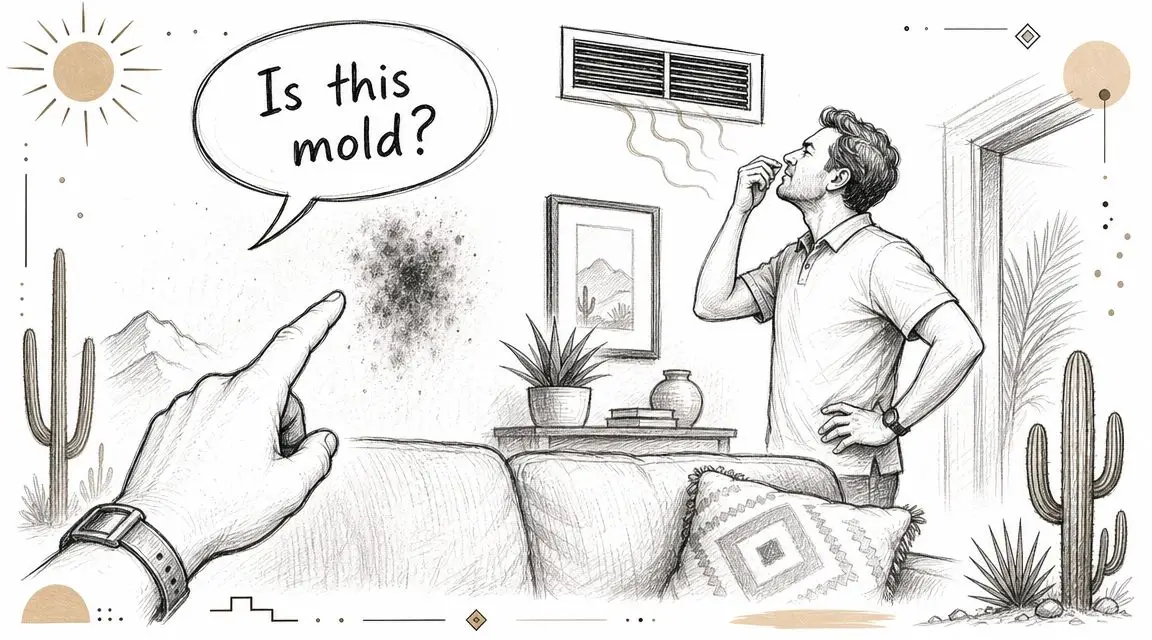
What Scottsdale homeowners usually notice first
The first signs are usually practical, not technical:
- A musty odor near vents: This can point to moisture around HVAC components, insulation, or nearby framing.
- Discoloration that keeps coming back: If you clean a spot and it reappears, the material may still be damp underneath.
- Peeling paint or bubbling texture: Moisture often shows up before visible fungal growth spreads.
- Condensation patterns: Window frames, supply registers, and cooler exterior-facing walls can collect moisture over time.
If you're already doing detailed home cleaning, simple maintenance helps you spot early issues faster. For example, learning how to clean window tracks can make it easier to notice recurring condensation, grime buildup, or dark residue that shouldn't be ignored.
What looks small can point to a larger issue
Mold doesn't need a dramatic flood event to become a problem. In Scottsdale, I often see growth linked to slow leaks, AC condensate problems, or moisture trapped in a wall cavity after humid weather. The visible area may be small while the hidden dampness extends farther.
Practical rule: If you see mold around an AC vent, on baseboards below a bathroom wall, or behind furniture placed against an exterior wall, don't assume surface cleaning solved it. Check what fed it.
If you're unsure whether what you're seeing fits a common hidden-growth pattern, this guide on signs of mold in walls is a useful reference point.
The Health and Structural Risks of Mold Exposure
Most homeowners don't call because they're interested in mold as a building science topic. They call because something feels off in the house. The air smells stale. A family member feels irritated in one room. A patch on the wall keeps spreading. Those concerns are reasonable.
Mold affects homes in two ways at the same time. It can irritate the indoor environment, and it can break down materials that were never meant to stay damp.
What people may experience indoors
Reactions vary from person to person. Some people notice very little. Others are more sensitive to airborne particles and disturbed dust from contaminated materials. The issue isn't only what you can see on a wall. When mold growth is active, especially near airflow pathways, spores and fragments can move through the living space.
Common homeowner complaints include:
- Nasal or throat irritation: Often more noticeable in rooms with poor airflow.
- Coughing or congestion: Especially when the HVAC system starts moving air.
- Eye irritation: A frequent complaint in rooms with musty odor and visible growth.
- Worsening allergy-type symptoms: Some people react more strongly than others.
That doesn't mean every dark stain is a health emergency. It does mean persistent mold shouldn't be treated like ordinary dust.
What mold does to building materials
Drywall, insulation, carpet backing, wood trim, and paper-faced building materials all give mold something to hold onto. Once those materials stay damp long enough, cleaning the surface may not reach what's embedded deeper in the material.
Think of it this way. Surface mold is often the part you can photograph. The actual damage may be in the drywall paper, the insulation behind it, or the wood that has been staying humid for weeks.
Mold doesn't have to cover an entire room to create an expensive repair. It only needs the right moisture conditions and enough time.
Why delay makes the project harder
A small, isolated cleanup is one kind of job. A remediation project involving wall cavities, insulation, trim removal, HVAC cleaning, and reconstruction is another. The longer moisture stays in place, the more likely the work shifts from cleaning to demolition and rebuilding.
That shift matters for resale, habitability, and day-to-day comfort in the home. If the contamination is in a lower level, utility space, or enclosed storage area, this overview of dangerous molds in basements can help you compare risk patterns, even though Scottsdale homes often see hidden mold in different parts of the structure.
Professional Mold Inspection and Testing Explained
Homeowners often hear three terms used as if they mean the same thing: inspection, testing, and remediation. They aren't the same, and mixing them together creates confusion.
A visual inspection answers basic job-scope questions. A testing plan looks for evidence in a more formal way. Remediation is the actual cleanup and source removal work. Knowing where one ends and the next begins helps you make better decisions.
Visual inspection versus formal testing
A visual inspection usually includes checking the suspected area, looking for moisture paths, identifying likely affected materials, and deciding whether the contamination appears isolated or more widespread. On many jobs, that's enough to start building a remediation plan.
Formal testing is different. It may involve air sampling, surface sampling, moisture mapping, or a more detailed environmental assessment. Scottsdale and Phoenix providers increasingly advertise unbiased testing and post-remediation clearance assessments, which reflects a broader consumer push for evidence-based verification rather than a simple sales opinion (unbiased mold testing and clearance in Scottsdale).
Here's a simple comparison:
| Service type | What it helps answer | Best use case |
|---|---|---|
| Visual assessment | Is there visible growth, moisture, or material damage? | Obvious mold, known leak, clear source area |
| Environmental testing | Is there evidence of hidden contamination or airborne impact? | Confusing symptoms, real estate concerns, disputed scope |
| Post-remediation clearance | Was the cleanup successful enough to move forward? | Larger projects, sensitive occupants, documentation needs |
When testing is worth paying for
Testing isn't mandatory on every job. If drywall is visibly colonized around a confirmed leak and the affected materials clearly need removal, formal sampling may not change the work plan much.
Testing becomes more valuable when:
- The source isn't obvious: You smell mold but can't see where it's coming from.
- The HVAC system may be involved: Air movement can spread particles beyond the visible area.
- You want independent documentation: Useful for property transactions, landlords, tenants, or insurance discussions.
- You need post-remediation confidence: Especially after a larger containment-based project.
Independent testing can reduce conflict. The company doing cleanup shouldn't be the only voice telling you whether the problem is solved.
For homeowners who want to know what a competent on-site evaluation should cover, this mold inspection checklist is a practical benchmark.
Why third-party clearance matters
Post-remediation clearance has become more important because homeowners want proof, not reassurance. That's a healthy shift. A good remediation contractor should be comfortable with independent verification when the project warrants it.
In practical terms, clearance testing can help answer three concerns:
- Was the contaminated material removed?
- Was the work area cleaned well enough before containment came down?
- Has the indoor environment improved enough for normal occupancy and reconstruction?
Not every small project needs that level of documentation. But when the affected area is larger, hidden, or tied to family health concerns, objective verification is often money well spent.
The IICRC Standard Mold Remediation Process
Professional remediation isn't a glorified cleaning appointment. It works more like controlled contamination removal. The goal is to stop active growth, prevent spore spread, remove unsalvageable material, and leave the structure dry enough that mold doesn't re-establish itself.
The core logic is straightforward. First identify the moisture source. Then isolate the affected area. Then remove or clean based on what the material can realistically tolerate.
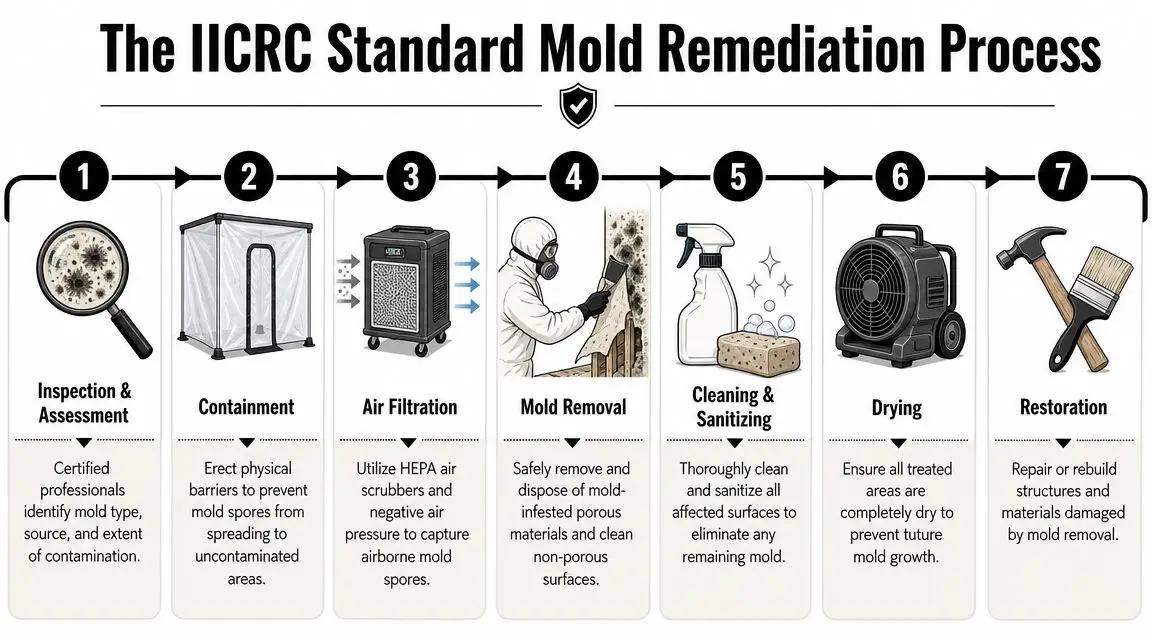
Scottsdale service guidance aligned with the IICRC process emphasizes identifying the moisture source first, then using containment plus HEPA air filtration and vacuuming so spores aren't redistributed during disturbance (IICRC-style remediation steps).
Step one is always moisture control
If a contractor starts talking about sprays before talking about moisture, that's a warning sign.
A proper job starts with questions like these:
- Where did the water or humidity come from?
- Is the source active, intermittent, or historical?
- Are materials still wet or just previously damaged?
- Is HVAC condensation, a plumbing leak, or a ventilation problem involved?
If the answer is "we'll just clean the mold and see," the job is being under-scoped.
Containment changes everything
Containment is what separates professional remediation from ordinary cleaning. When moldy drywall, insulation, or dust is disturbed, spores can spread into clean rooms if the area isn't isolated correctly.
A standard containment setup may include:
- Critical barriers: Poly sheeting and sealed openings to isolate the work zone.
- Controlled entry: A limited path in and out for workers and debris.
- Negative-air setup: Equipment arranged to keep contaminated air from drifting outward.
- HEPA filtration: Air scrubbers and vacuums designed to capture fine particles.
This is why DIY demolition often backfires. A homeowner tears out damp drywall, carries debris through the house, and unknowingly seeds other areas.
Here's a short walkthrough of the process in action:
What gets removed and what gets cleaned
Not every material can be saved. The decision usually depends on porosity, depth of growth, and whether the material can be cleaned thoroughly enough to support a stable result.
| Material | Typical approach |
|---|---|
| Drywall with embedded growth | Often cut out and discarded |
| Insulation | Commonly removed if contaminated or damp |
| Framing lumber | Usually cleaned if structurally sound |
| Tile or metal surfaces | Often cleaned and detailed rather than removed |
| Carpet and pad | Depends on extent, moisture history, and contamination level |
The cleaning stage is detail work
After selective demolition, crews clean the remaining structure. That can include HEPA vacuuming, damp wiping, detail cleaning of framing and sheathing, and attention to settled dust in the containment zone. Depending on the situation, technicians may also address fixtures, registers, and adjacent surfaces that picked up contamination.
Experience matters. Over-cleaning can damage finishes. Under-cleaning leaves dust and residues that create odor, appearance, or clearance problems later.
A good remediation project doesn't just make the stain disappear. It changes the environment that allowed the stain to exist.
Drying and verification before rebuild
Once contaminated materials are removed and the structure is cleaned, the area has to be dry before reconstruction starts. Rebuilding over damp framing or wall cavities is one of the fastest ways to repeat the problem.
Depending on scope, a homeowner may also choose independent clearance before repairs begin. That can be especially helpful when the affected area involved bedrooms, HVAC pathways, or a larger sealed containment zone.
One Scottsdale-area option among many is Restore Heroes, which provides mold-related restoration services in the Phoenix metro. More important than any brand name, though, is that the contractor follows containment, removal, filtration, and drying steps in the right order.
Understanding Mold Removal Costs and Insurance in Arizona
Mold pricing frustrates homeowners because two jobs that both get called "mold removal" can be completely different in scope. Wiping a small exposed area is one thing. Setting containment, removing drywall, cleaning framing, filtering the air, drying materials, and documenting the work is another.
The cost usually follows the complexity of the work, not just the presence of mold.
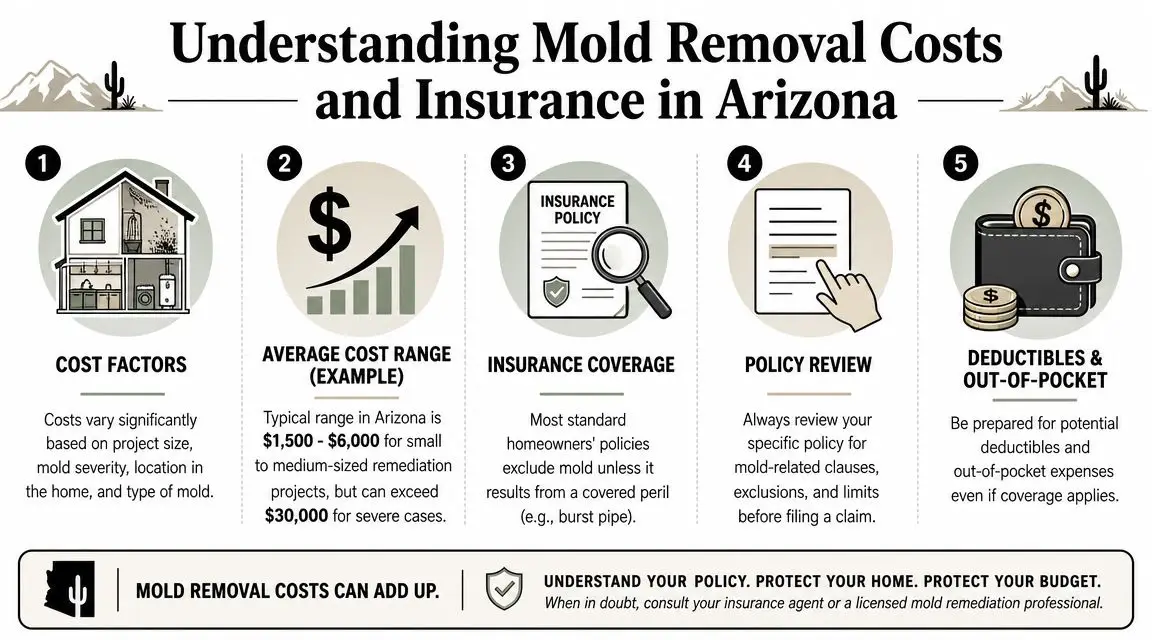
Local price ranges and what they mean
For Scottsdale, one estimate places average mold removal at $1,801 to $1,968, with a broader range of $1,718 to $2,051, and an estimated cost of about $4.06 per square foot for a 500-square-foot project. That same guidance also uses the 10-square-foot threshold as a practical benchmark for when homeowners generally shouldn't attempt removal themselves because labor, containment, and equipment needs increase (Scottsdale mold removal cost benchmarks).
What usually pushes a quote up or down
A fair estimate usually reflects several job-specific factors:
- Affected square footage: More area means more labor, more containment, and more cleanup time.
- Material type: Removing drywall, insulation, or carpet is different from cleaning non-porous surfaces.
- Access difficulty: A mechanical closet, attic chase, or behind-cabinet wall cavity takes more effort.
- Moisture source complexity: HVAC condensation and hidden leaks often require more diagnosis.
- Post-remediation needs: Clearance testing, reconstruction prep, and documentation can affect total cost.
A pricing page can help you understand the moving parts before you request an estimate. This overview of how much mold remediation costs gives homeowners a useful framework for comparing scopes of work.
Insurance questions to ask early
Coverage depends on the policy language and the cause of loss. In general, insurers look closely at what caused the moisture, how long it was present, and whether the damage stemmed from a covered event or a maintenance issue.
Ask your adjuster these questions as early as possible:
- What part of the loss is considered the covered cause?
- Does the policy treat mold as resulting damage or as an exclusion?
- What documentation do you want from the remediation contractor?
- Do you need photos, moisture readings, or a written scope before work begins?
The smoother claims usually involve fast reporting, clear photos, documented moisture source findings, and a written scope that explains what had to be removed and why.
No ethical contractor should promise insurance approval or exact final cost before the site conditions are understood. The right approach is documentation, clear communication, and a scope that matches the actual contamination.
How to Choose Your Scottsdale Mold Removal Contractor
Choosing a contractor gets easier once you know what the job should involve. You're not hiring someone to spray and wipe. You're hiring someone to control contamination, remove damaged material when needed, and solve the moisture problem that caused it.
That means your screening process should be practical, not based on whoever answers the phone first.
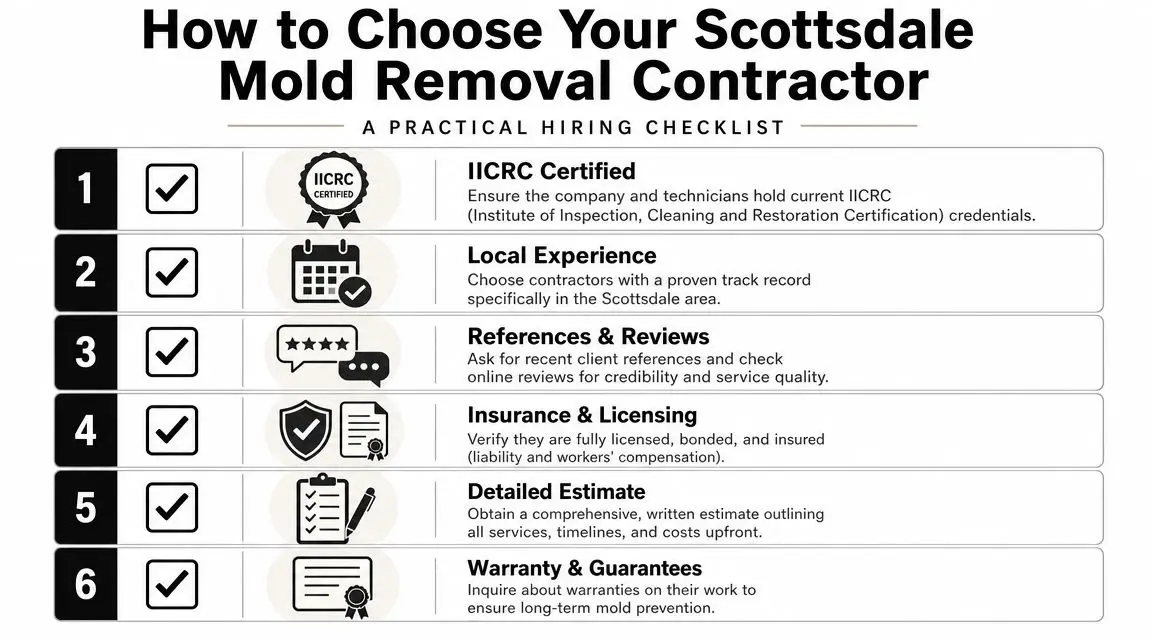
Start with the non-negotiables
Ask direct questions. A qualified contractor shouldn't hesitate.
Look for:
- IICRC training and mold-specific process knowledge: They should be able to explain containment, HEPA filtration, removal criteria, and drying.
- Arizona licensing, bonding, and insurance: Verify this before work starts.
- A written scope: You want to know what will be removed, what will be cleaned, and how the area will be dried.
- Local experience: Scottsdale homes have recurring patterns involving HVAC systems, condensation, and monsoon-related moisture.
Scottsdale remediation guidance also notes that when porous materials are colonized beyond salvage, standard practice is removal and disposal of carpeting, drywall, and insulation, followed by cleaning of structural elements. That source removal is the benchmark approach to help prevent regrowth (Scottsdale remediation standards for porous materials).
Read reviews with a filter
Online reviews help, but they only help if you read them critically. A company may have glowing comments about friendliness while doing weak technical work. Focus on reviews that mention communication, containment, cleanliness, follow-through, and whether the company handled a complex issue properly.
If you want a good primer on how local review credibility works online, this piece on getting Google reviews in Scottsdale explains why review patterns matter and what makes them more trustworthy.
A quick comparison checklist helps:
| What to ask | Why it matters |
|---|---|
| How will you contain the work area? | Prevents contamination from spreading |
| What materials might need removal? | Shows whether they understand salvage limits |
| How do you handle HVAC-related concerns? | Important in Scottsdale homes |
| Do you recommend third-party clearance when needed? | Signals transparency |
| Will I get a written scope and photos? | Helps with decisions and claims |
Know when not to DIY
The practical line many homeowners use is the 10-square-foot threshold discussed earlier in the cost section. Beyond that, a professional approach is usually the safer choice because the work can involve containment and selective demolition, not just cleaning.
If you're comparing local options, this guide to mold removal companies near me can help you build a better shortlist.
Scottsdale Mold Removal FAQs
Is black mold always more dangerous than other mold?
Homeowners often use "black mold" as a catch-all term for any dark growth. Color alone doesn't tell you the full risk or the correct cleanup method. What matters more on the job site is where the mold is growing, how much material is affected, whether moisture is still present, and whether contaminated porous materials need to be removed.
Can I stay in the house during remediation?
Sometimes yes, sometimes no. It depends on the work area, how isolated it can be, whether HVAC pathways are involved, and whether anyone in the home is especially sensitive to dust or airborne irritants. On a small, well-contained project, staying may be possible. On a larger project involving major demolition or ventilation concerns, temporary relocation is sometimes the more practical choice.
How long does mold remediation take?
There isn't one universal timeline. A small, accessible area with a known source can move much faster than a project involving hidden wall cavities, AC-related moisture, or reconstruction planning. The best timeline is the one that allows proper containment, removal, cleaning, drying, and verification.
Does mold always need testing first?
No. If contamination is visible and the affected materials clearly need remediation, a visual assessment may be enough to start. Testing is more useful when the source is unclear, when hidden contamination is suspected, or when you want independent pre- or post-remediation documentation.
How can I reduce the chance of mold returning?
Focus on moisture control. Scottsdale-specific guidance emphasizes keeping indoor humidity below 60% and addressing leaks quickly. Local cost research also shows how broadly remediation expenses can range, from $500 to $8,400, with more typical jobs often falling between $1,000 and $3,500, depending on severity and affected area, which is one reason prevention matters so much (Scottsdale mold cost and prevention guidance).
If you're comparing how local companies build trust online while you research options, this overview of boosting local business rankings gives useful context for why some contractors are easier to evaluate than others.
If you're dealing with a musty room, visible mold, or a moisture issue tied to your AC system, a site-specific assessment is the safest next step. Restore Heroes serves Scottsdale and the Phoenix metro with licensed, bonded, insured, IICRC-certified restoration services, and they can evaluate the affected area, explain the likely scope, and help you understand what professional remediation would involve in your home.