
You're probably reading this while the house still smells like smoke, your phone is full of photos, and everyone keeps asking what happened. That first stretch after a fire is disorienting. Even a “small” kitchen fire can leave you with soot in cabinets, water on the floor, and real uncertainty about what's safe to touch.
A proper fire damage assessment gives you a starting point. It turns a chaotic scene into a documented plan. Instead of guessing what can stay, what must go, and what your insurer will want to see, you get a structured look at safety hazards, hidden damage, contamination, and the work required to move forward.
After the Fire Your First Steps and What to Expect
Most homeowners expect the damage to be limited to the room where the fire started. Then they notice the smoke odor in bedrooms down the hall, soot film on light fixtures, and damp drywall from suppression efforts. That's normal after many residential losses, especially when the fire is controlled quickly but the byproducts spread far beyond the flame line.
The scale of this problem is bigger than many people realize. The U.S. Fire Administration estimates 344,600 residential building fires in 2023, and says cooking caused 48.7% of home fires that year, according to USFA residential fire statistics. That matters because fire damage assessment isn't just for catastrophic losses. It's also critical after the smaller incidents that still leave smoke, soot, odor, and water damage behind.
What the first day usually looks like
In the first 24 hours, most homeowners are dealing with four things at once:
- Safety questions like whether the structure is stable, whether power should stay off, and whether air quality is safe.
- Documentation pressure because the insurer will want a clear record of the loss.
- Urgency around secondary damage such as wet materials, soot transfer, and odor spread.
- Decision fatigue because every object suddenly feels important.
That's why the assessment matters so early. It isn't just an inspection. It becomes the roadmap for cleanup, salvage, demolition, drying, odor treatment, and repair.
Practical rule: In the first day, your job is to protect people, document conditions, and avoid making the damage harder to evaluate.
What to expect from the process
A good assessment starts with immediate hazards and then broadens into scope. The technician or adjuster isn't only looking for blackened framing. They're looking at where smoke traveled, which porous materials absorbed odor, whether suppression water moved into wall cavities, and whether hidden systems need further review.
If you need a simple step-by-step list while things are still happening, keep a copy of this what to do after a house fire checklist. It helps homeowners stay organized when decisions need to happen fast.
After you're through the emergency phase, it's also worth reviewing prevention basics before power is restored and temporary equipment starts showing up. For electrical risk reduction, Jolt Electric's fire prevention guide is a useful refresher.
How Certified Professionals Evaluate Fire Damage
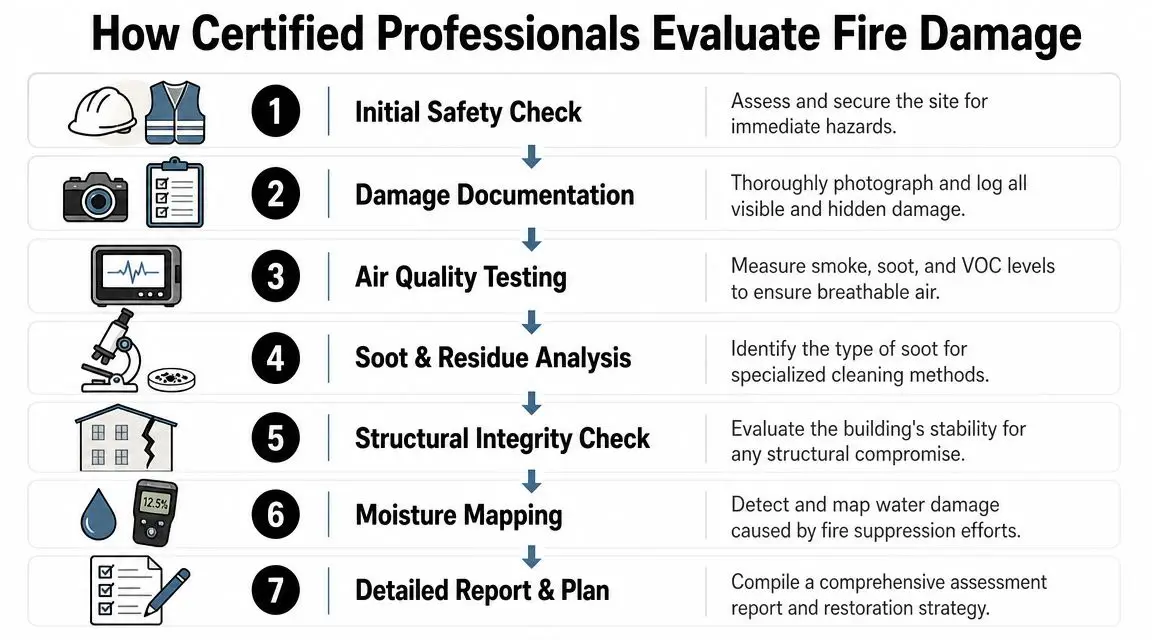
A certified team doesn't walk through a fire scene and make quick guesses. The work follows a sequence. That sequence exists for a reason. Fire assessment developed into a formal engineering workflow because annual fire losses are so large, and modern evaluation goes beyond visible charring to include non-destructive testing and analysis of residual structural condition, as described in Berkeley's review of fire-damaged concrete assessment.
The first pass is about safe entry
Before any serious scoping starts, professionals check whether the building can even be entered safely. That includes obvious concerns like collapsed ceilings and burned framing, but also less obvious ones like loose fixtures, damaged electrical components, slippery suppression residue, and weakened stair assemblies.
If the scene isn't safe, the rest waits.
That's one reason a casual walkthrough by the owner can go wrong. Homeowners often focus on belongings first. A technician focuses on occupancy risk first.
The real assessment is broader than what you can see
Once entry is cleared, the evaluation usually moves through several layers:
- Scene documentation. The team photographs affected rooms, contents, and transitions between damaged and less damaged areas.
- Source and spread mapping. They track how flame, heat, smoke, and water moved through the structure.
- Material-specific review. Drywall, framing, insulation, cabinets, stone, finished wood, electronics, and HVAC components all react differently.
- Moisture detection. Suppression water often creates a second loss condition that needs its own drying plan.
- Cleaning feasibility. Some surfaces can be restored. Some can be cleaned but still hold odor. Some should be removed.
Tools that change the quality of the answer
A professional assessment often uses tools that a homeowner won't have on hand and shouldn't try to substitute with DIY methods:
- Moisture meters help locate wet drywall, subfloors, and trim.
- Thermal imaging cameras can help identify temperature variation and hidden moisture patterns.
- Lighting and inspection mirrors reveal soot trails in tight spaces.
- Surface testing and material review help distinguish what's cleanable from what's compromised.
For homeowners who want a clearer picture of what happens after the assessment, this overview of the fire damage restoration process connects the inspection phase to the actual cleanup and repair work.
A strong assessment doesn't produce a vague opinion. It produces a scope of work, a salvage strategy, and a record that other parties can rely on.
What doesn't work
Quick wipe tests with household cleaners don't tell you whether damage is minor. Turning the HVAC back on to “air the place out” can move contamination farther. Plugging in appliances to see if they still work can create new hazards.
The assessment works best when the scene is documented in its fire-affected condition, before well-meant cleanup changes the evidence.
What You Can Safely Document Before Help Arrives
You can help the process. You just need to stay inside your lane. The goal is to document, not diagnose.
What not to do
Start with the hard line items. Don't cross them.
- Don't enter a structure that hasn't been cleared as safe. Sagging ceilings, wet floors, and damaged wiring aren't always obvious from the doorway.
- Don't restore power yourself. Fire and water together create too many unknowns.
- Don't plug in electronics or appliances. Heat and soot can damage internal components even when the outside looks fine.
- Don't scrub soot with household cleaners. Many residues smear, stain, or become more embedded when wiped incorrectly.
- Don't throw major items away too early. Disposal before documentation can complicate a claim and remove evidence of damage.
What you can do from a safe position
If emergency responders or the property representative say it's safe to be near the building, focus on documentation that doesn't disturb the scene.
| Action | Why It's Important |
|---|---|
| Take wide photos of each affected area | They show the overall pattern of damage before items are moved |
| Record short videos while narrating the room | Voice notes help you remember what was present and where |
| Photograph serial numbers and model labels when visible | They help identify appliances, electronics, and equipment later |
| Start a written room-by-room contents list | It's easier to build while the scene is fresh in your memory |
| Save receipts for hotel stays, meals, and urgent purchases | These may matter if your policy includes temporary living expenses |
| Gather IDs, medications, and essential documents if safely accessible | These items are harder to replace and often needed immediately |
| Write down the date, time, and basic event summary | A simple timeline helps keep your insurer conversations consistent |
A simple field method that helps
Use your phone in the same order for every room. Start at the doorway. Take four corner shots. Then photograph the ceiling, walls, floor, and any visible contents damage. End with one short video.
That pattern sounds basic, but it reduces missed areas.
If you aren't sure whether an item is damaged, photograph it and leave it in place until a professional can review it.
Phoenix conditions change what you notice
In the Phoenix area, the dry climate can fool homeowners into thinking the damage is “settled” because surfaces look dry quickly. That doesn't mean the problem is resolved. Fine soot can travel into cabinets, closets, return vents, and soft goods. Water used to put the fire out can also remain trapped in materials even when the room no longer looks wet.
Keep your documentation factual. Room names, visible damage, obvious odor, standing water, burned items, and anything you cannot safely access. Avoid trying to label something as structurally sound or unsalvageable unless a qualified professional says so.
Decoding the Assessment Soot Structural and Water Damage
Most homeowners use the phrase “fire damage” as if it's one thing. In practice, an assessment breaks it into separate problem sets because each one is cleaned, tested, and repaired differently.
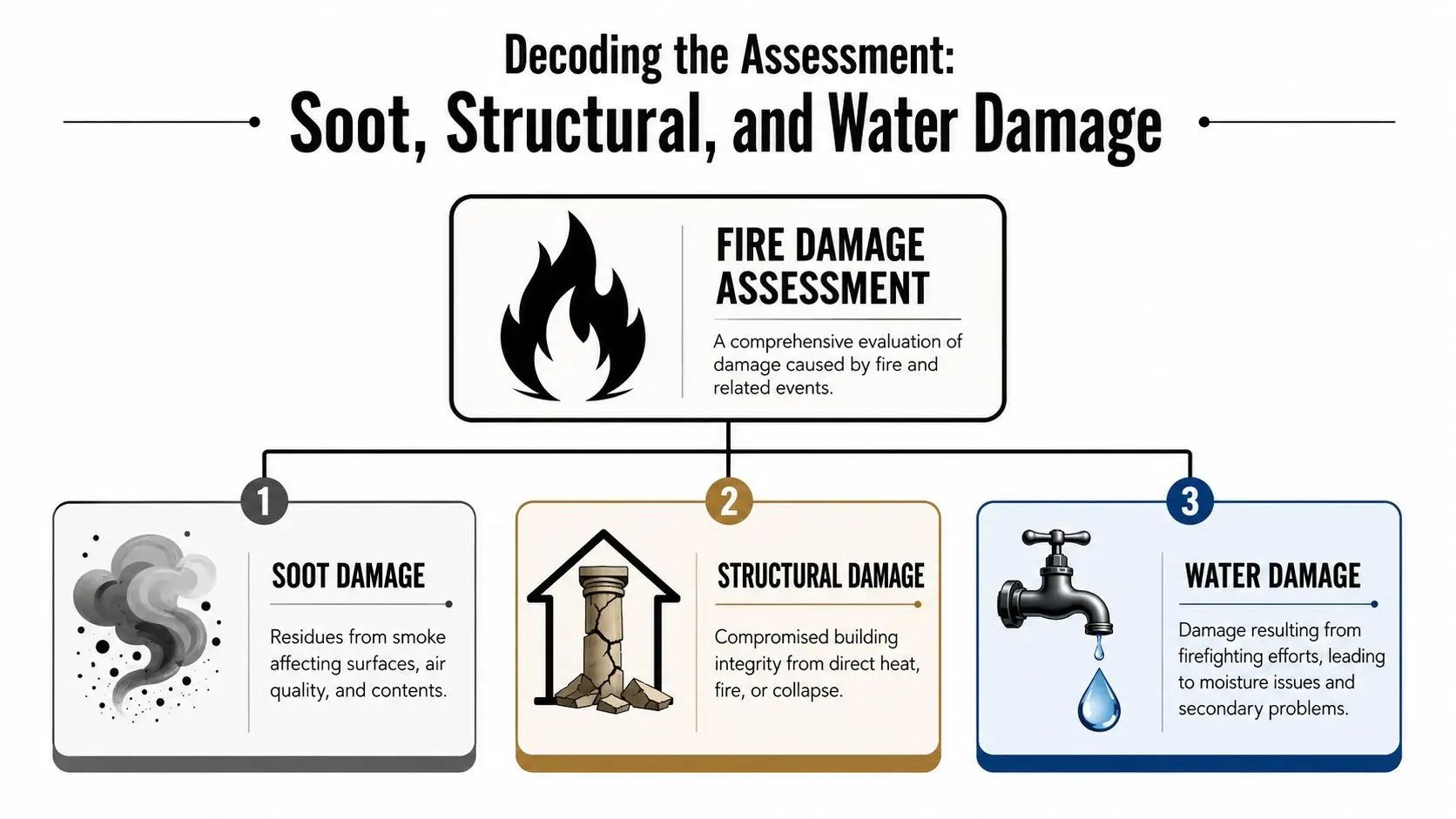
Soot and smoke damage
Smoke moves farther than flames. It follows air pathways, pressure differences, and openings you may not even think about, such as attic hatches, recessed lights, and HVAC chases. In Phoenix homes, that fine dry residue can settle in places that look untouched at first glance.
Soot also isn't a generic black dust. Different fires leave different residues, and cleaning methods need to match the residue and the surface. That's part of why professional review matters.
If you want a deeper look at how residues behave on surfaces and contents, this guide on soot from fire is useful.
Structural and heat damage
The obvious signs are warped framing, fallen drywall, cracked finishes, or visibly charred members. The harder part is hidden heat effect. Professionals often use temperature zoning by looking at surface discoloration and crack patterns to infer what heat levels materials likely saw. They may combine that with non-destructive methods such as rebound hammer testing on concrete because visual review alone can miss a real loss of integrity, as explained in this overview of fire damage assessments and temperature zoning.
Here's the trade-off. A cautious visual-only opinion may over-demolish. An optimistic visual-only opinion may leave damaged material in place. Better assessment narrows that gap.
Heat doesn't have to burn through a material to weaken it. Some components lose reliability long before they look catastrophic.
Water and suppression damage
Many homeowners underestimate this category because it arrives during the rescue. The fire may be out, but now insulation is wet, flooring is swelling, and water has started moving to lower levels. If drying doesn't begin promptly and strategically, the house can shift from fire cleanup into mixed fire-and-water restoration.
This part of the assessment asks practical questions:
- Where did the water travel
- What absorbed it
- What can be dried in place
- What should be removed to prevent longer-term problems
Why all three must be scoped together
A room can have minor direct burn, heavy soot contamination, and serious moisture loading all at once. That's common. It's also why a homeowner's first impression is often incomplete. The kitchen may look like the only damaged room, but the assessment may show a wider footprint due to smoke migration and suppression water spread.
Working with Your Insurance After a Fire
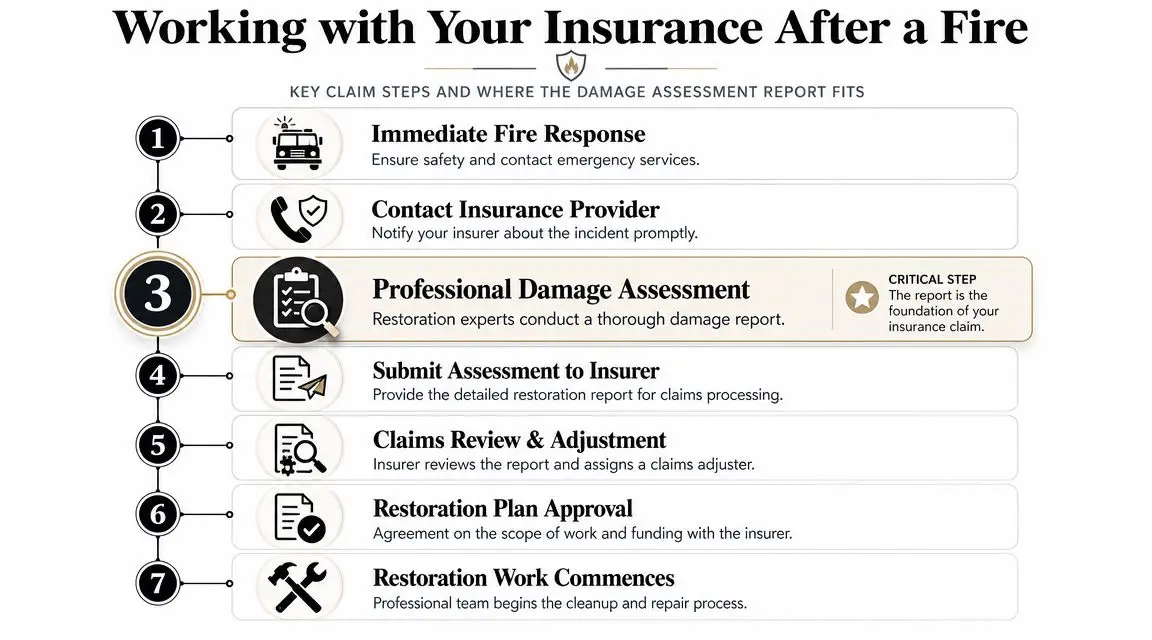
Insurance conversations go better when you separate the emotional loss from the documentation work. Both matter, but they serve different purposes. The claim process runs on dates, photos, item lists, cause documentation, and a defensible scope of work.
What the assessment report does for your claim
The report connects observations to action. It shows where the damage is, what categories of damage are present, what likely needs cleaning versus removal, and what further specialty review may be needed. That gives the adjuster something concrete to review instead of working from general descriptions like “smoke everywhere” or “water in part of the house.”
A thorough assessment also reduces confusion between fire damage and post-fire damage. For example, a warped cabinet near the source room may be heat-related, while staining in a separate hallway may be soot and moisture related. Those distinctions matter when the scope is written.
For homeowners trying to understand policy language before they speak with the adjuster, this article on whether homeowners insurance covers fire damage can help frame the right questions.
Terms you'll hear
A few insurance terms come up often after a fire:
- Actual cash value usually refers to value after age and condition are considered.
- Replacement cost generally refers to the cost to replace with like kind and quality, subject to policy terms.
- Loss of use commonly relates to living expenses if the home can't be occupied, again depending on the policy.
The important part is not memorizing definitions. It's asking how your specific policy applies to your situation.
Questions worth asking early
Use plain language. You don't need to sound technical.
- What immediate documentation do you want from me
- Should I wait for an adjuster before any emergency mitigation begins
- How should I handle damaged contents
- What temporary living expenses should I track
- Do you want one combined estimate or separate mitigation and rebuild scopes
Keep one notebook or phone note for every claim contact. Date, name, direct number, and what was discussed. That log becomes valuable fast.
A restoration contractor can often provide photos, room-by-room notes, and scope documentation that supports the claim review. That helps the insurer evaluate the loss, but it does not guarantee coverage, payment timing, or approval of every line item.
Fire Damage Restoration Timelines and Potential Costs
Homeowners usually want one number and one deadline. Fire losses rarely work that way. The better question is what variables are driving the schedule and the bill.
What extends the timeline
A straightforward cleanup with limited direct burn may move faster than a house with mixed smoke, water, and structural issues. The timeline usually turns on access, testing needs, drying conditions, demolition scope, specialty cleaning, and material replacement.
These factors often slow things down:
- Hidden moisture behind cabinets, inside wall cavities, or under flooring
- Heavy soot spread into rooms far from the origin
- Odor absorbed into porous materials such as insulation, textiles, and upholstery
- Electrical or HVAC review before systems can be safely restarted
- Special-order finishes needed for repair or rebuild
What homeowners often miss in cost discussions
The visible burn area is only part of the expense. Many guides stop at drywall, paint, and debris. Real projects often include duct cleaning, deodorization, contents handling, pack-out labor, specialty cleaning of hard-to-replace items, temporary power coordination, and moisture drying after suppression.
There's an important lesson from industrial fire assessment that applies even in homes. Heat exposure can affect hidden systems and non-building assets, and commercial evaluations may use specialized testing for heat-affected equipment under standards like API 579, according to this fire damage assessment overview for equipment and hidden systems. Residential properties aren't the same as industrial plants, but the principle carries over. Something can look only moderately damaged while critical components still need closer review.
Why fixed-price thinking causes problems
When people lock onto a single early estimate, they often assume any change means someone made a mistake. Sometimes the scope changes because the wall gets opened and the actual condition is worse, or because cleaning tests show a material won't return to a pre-loss state.
That's why it helps to read pricing and timing as ranges shaped by conditions, not promises.
If you want a fuller breakdown of what tends to influence the bill, this guide to fire damage restoration cost covers the common categories.
Why and When to Call a Restoration Pro in the Phoenix Area
Some incidents are clearly beyond DIY. Others look manageable for a day or two and then get worse. In Phoenix, that second category is common because the environment can make damage look deceptively stable.

Red flags that mean it's time
Call a qualified restoration professional if you have any of the following:
- Visible structural movement such as sagging ceiling areas, separated drywall, or warped framing
- Widespread soot beyond the room where the fire started
- Persistent smoke odor after the scene has cooled
- Any suppression water affecting floors, walls, cabinets, or lower levels
- HVAC involvement where smoke may have moved through the system
- Heat exposure to appliances, panels, or wiring
Phoenix adds a few local complications. Fine soot can move and settle in a dry climate in ways homeowners underestimate. At the same time, once firefighters introduce water into a hot structure, you can end up with trapped moisture in materials that seem dry at the surface. That's not the moment for guesswork.
Wildfire exposure needs a different level of caution
After wildfires, the situation can be less clear than a single-room house fire. Forensic engineers often need onsite evidence, photos, and agency data to separate direct fire effects from secondary heat exposure, smoke impact, and post-fire instability, as outlined in this wildfire property damage assessment resource.
That's why “it doesn't look burned” isn't a reliable clearance standard after nearby wildfire events.
If you want a quick visual overview before you make calls, this video is a solid starting point.
What a local pro should help you do
You're not just hiring someone to wipe soot. You're hiring someone to evaluate safety, stop secondary damage, document the loss clearly, and build a defensible scope for cleanup and restoration. In the Phoenix metro, an IICRC-certified company such as Restore Heroes can handle assessment, mitigation, and communication needed for the early stages of a fire loss without you trying to coordinate every moving piece yourself.
If the fire affected more than a single contained item and left smoke, soot, water, or heat impact on the structure, professional assessment is the safer call.
If you need help sorting out what's safe, what to document, and what the next step should be, contact Restore Heroes. They serve the Phoenix metro and can help you move from first response into a clear restoration plan.