
When you first spot a strange discoloration on your drywall, it's easy to jump to conclusions. But what exactly are you looking at? Mold isn't one-size-fits-all; it comes in a variety of colors and textures, much like different types of plants in a garden.
The one thing all mold needs to thrive is moisture. The paper on drywall is a perfect food source for microscopic mold spores that are always floating around in the air. Add a little water from a leaky pipe, high humidity, or a recent flood, and those spores can wake up and start growing into a visible problem in as little as 24 to 48 hours.
A Quick Visual Guide to Drywall Mold
Knowing what to look for is the first step in tackling the issue. Some molds are fairly harmless, while others can be much more destructive to your home and health.
The Three Pillars of Mold Appearance
When you’re inspecting a suspicious spot, you can break down what you see into three main characteristics: color, texture, and pattern. Thinking about it this way helps you make a more educated guess.
- Color Spectrum: "Black mold" gets all the headlines, but you’re just as likely to see shades of green, white, gray, brown, or even orange. The color alone won’t tell you how dangerous it is, but it’s an important piece of the puzzle.
- Surface Texture: How does it feel (or look like it would feel)? Mold can be fuzzy, almost like velvet. It can also be powdery, like a dusting of flour, or slimy if the area is currently very damp. A simple water stain, by contrast, will always be flat.
- Growth Pattern: Mold rarely grows in a neat, uniform shape. It tends to spread out from a central moisture source, often in circular clusters or irregular, splotchy patches.
This flowchart gives you a great visual breakdown of what to keep an eye out for.
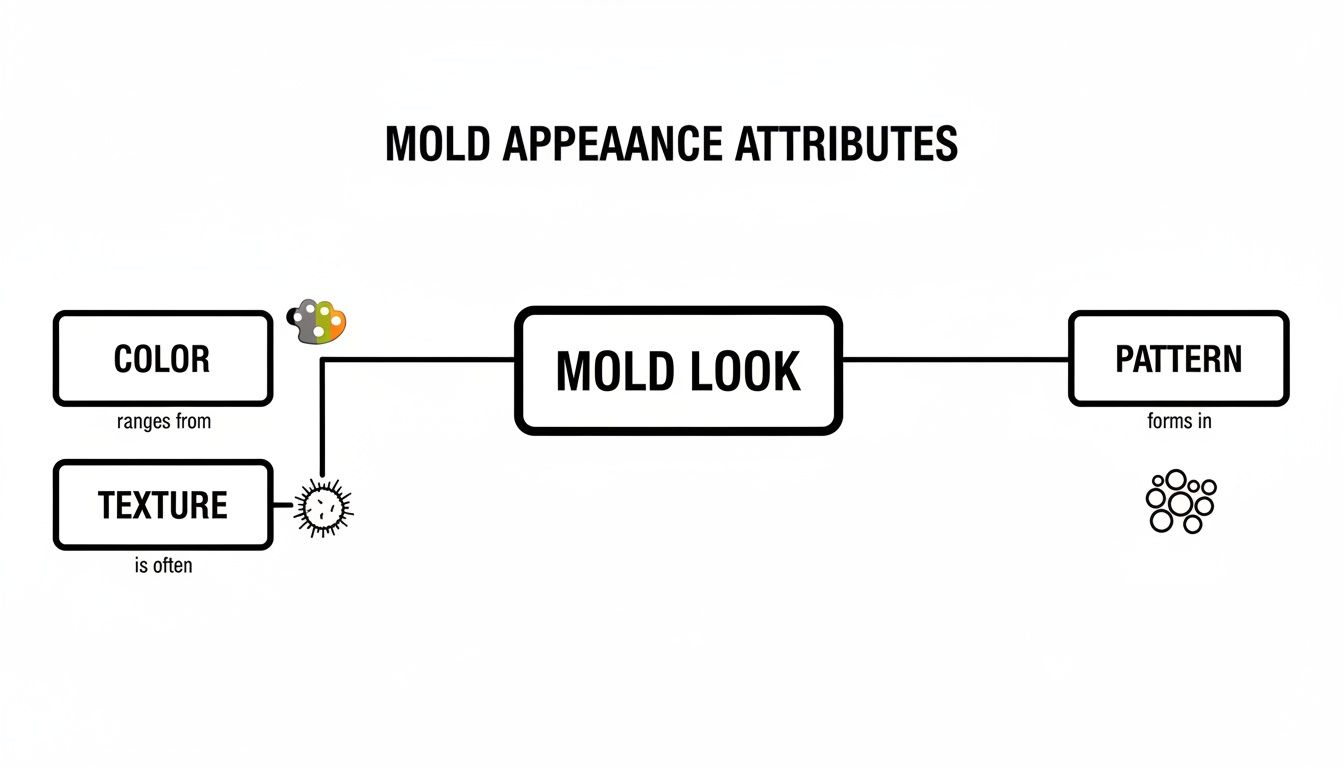
As the chart shows, it's the combination of these three elements—color, texture, and pattern—that gives you the clearest picture of a potential mold problem.
Quick Guide to Common Drywall Mold Types
To help you get a better idea of what you might be seeing, here’s a quick rundown of some of the usual suspects found on drywall.
| Mold Type | Common Colors | Typical Texture | Common Location |
|---|---|---|---|
| Stachybotrys | Dark green or black | Slimy when wet, sooty when dry | Areas with major water damage |
| Aspergillus | Green, white, yellow, or brown | Powdery, fuzzy | Common almost anywhere with moisture |
| Penicillium | Blue-green | Velvety, fuzzy | Water-damaged drywall, carpet, insulation |
| Cladosporium | Olive-green or brown | Suede-like, powdery | Bathrooms, basements, around windows |
This table is just a starting point, as many mold species can look similar. A professional diagnosis is often the best way to be certain.
It’s also interesting how mold growth can be influenced by the way your walls are built. Sometimes, you’ll see a patch of mold stop abruptly at a drywall seam. That tape joint can act as a barrier, slowing its spread because the conditions just beyond it aren't as hospitable. Many aggressive molds need a moisture content above 18% inside the wall to really take hold, and these small construction details can sometimes contain the problem. You can find more deep-dive info like this over at Inspectapedia.com.
Ultimately, spotting the problem is the first and most important step. If you want to learn more, our guide covering all the signs of mold in walls can give you an even more complete picture of what to look for.
Understanding Mold Colors, Textures, and Patterns
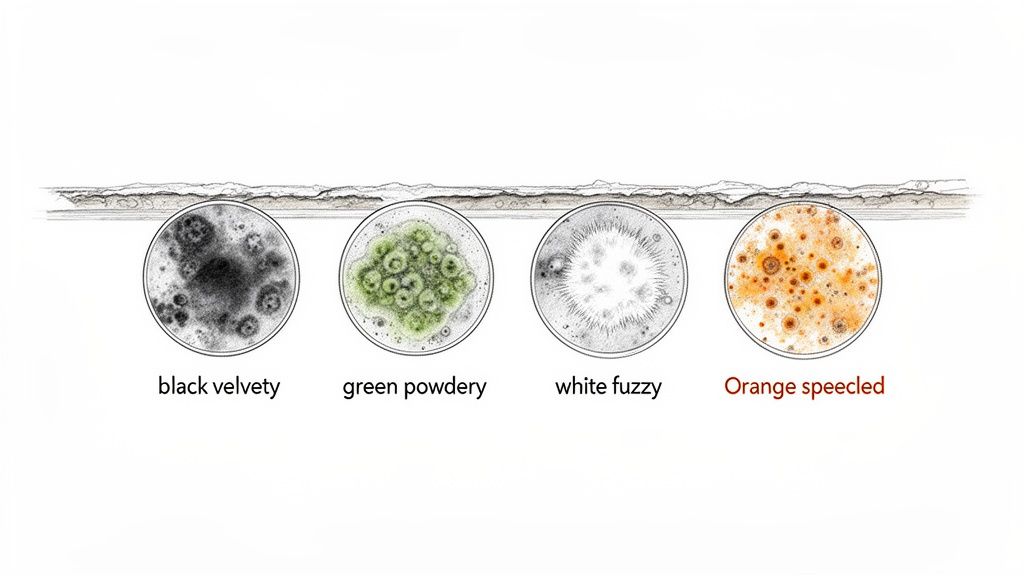
While "black mold" gets all the attention, the truth is that mold on drywall shows up in a whole rainbow of colors. Don't think of mold as one single thing; it's a huge family of fungi, and different species have their own unique looks. This variety is your first clue to figuring out what’s growing on your walls.
The color you're seeing often depends on the type of mold and how long it's been growing. You might spot patches of green, white, gray, brown, or even strange shades of orange and yellow. For example, Penicillium often shows up as a blue-green fuzz, while some types of Aspergillus can look yellowish-brown.
Decoding Mold Textures
Beyond just the color, the texture of a mold colony tells you a lot. The way it looks and feels is often what separates it from a simple stain. Think of it like telling different fabrics apart just by looking at them; mold has a similar range of distinct textures.
Some of the most common textures you’ll find on drywall include:
- Fuzzy: Looks like a patch of fine hair or felt. This is classic for species like Penicillium.
- Powdery: In drier spots, some molds look like a fine dusting of powder that you could easily wipe away.
- Velvety: A texture that looks almost like suede is a tell-tale sign of Cladosporium, a very common sight on damp drywall.
- Slimy: If there's a constant supply of water, some molds like Stachybotrys can look wet and slimy.
It’s this three-dimensional quality that really distinguishes mold from a flat water stain. A stain soaks into the drywall, but mold grows on top of it, creating a texture you can actually see.
Recognizing Common Growth Patterns
Mold doesn’t grow in perfect circles or squares. Its growth pattern is all about where the moisture and food source are. If you pay attention to these patterns, you can often trace the problem right back to the source.
Mold growth is like a detective story written on your wall. The pattern often points directly to the moisture leak, whether it's a slow drip from a hidden pipe or just condensation building up in a cold corner.
You’ll often see mold growing in circular clusters that spread out from a center point, which usually means there's a small, consistent leak feeding it. In other situations, you might just see irregular, splotchy patches where humidity is generally high. Sometimes you can even spot faint vertical lines of mold, which is a big hint that it’s growing along the cooler spots over the studs inside your wall.
Take Cladosporium, for instance. This common indoor mold is known for spreading quickly and often appears as velvety olive-green or black spots. It can grow at a surprising rate of about 28 mm in just 7 days in a typical home environment. Because it’s not too picky about temperature, it pops up frequently where AC units create condensation or poor airflow traps moisture. If you’re curious, you can learn more from this in-depth article on understanding indoor mold. And for those specifically seeing black spots, our guide on how to remove black mold from drywall offers more detailed advice.
Distinguishing Mold from Other Wall Stains
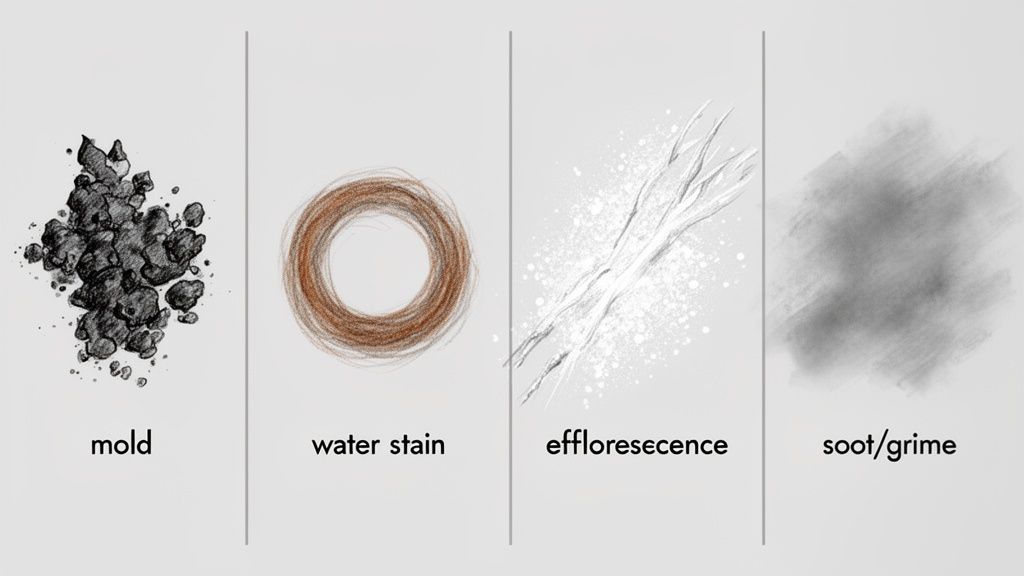
It’s easy to jump to conclusions when you see an ugly spot on your drywall. But not every blemish is a sign of a major mold problem. While it's always smart to be vigilant, many common wall issues can mimic mold at first glance, causing a lot of unnecessary panic.
Think of yourself as a detective. That dark spot is a clue, and your job is to figure out what’s really going on. Is it just a simple stain, or is it an active biological growth? The answer usually comes down to looking closely at the specific characteristics.
Water Stains: The Precursor to Mold
The most common imposter is a plain old water stain. A water stain is really just the ghost of moisture past—a discolored, flat area left behind after water soaked into the drywall and then dried up. These stains typically look yellowish-brown and have sharp, defined edges, almost like the outline of a puddle on the pavement.
The key difference here is texture. A water stain is completely two-dimensional and flat. If you run your hand over it, it feels just like the rest of the wall. Mold, on the other hand, is a living thing growing on the surface. This gives it a three-dimensional texture that you can often see and feel, whether it’s fuzzy, velvety, or even a bit slimy. If the spot is raised at all, your suspicion should definitely shift toward mold.
Efflorescence: The Crystalline Impostor
Another common look-alike, especially on concrete or basement walls, is efflorescence. It sounds complicated, but it's just a fine, white, crystalline deposit of salts. This happens when water seeps through the masonry and evaporates, leaving the salts behind. It looks powdery and is very easily mistaken for white mold.
So, how can you tell the difference?
- Try the Spray Bottle Test: This is a classic trick. Just spray a little water on the spot. Efflorescence will dissolve and seem to disappear into the water. White mold won’t dissolve; it will just get wet.
- Do the Texture Test: If you can safely pinch a bit between your fingers, efflorescence will crumble into a fine, gritty powder. Mold, being an organic growth, will typically smear or feel soft.
The biggest clue for telling a simple stain apart from active mold growth often comes down to one thing: texture. Stains are flat ghosts of a past problem. Mold is a three-dimensional colony that is very much alive and growing on the surface.
Recognizing these differences is incredibly helpful. A water stain tells you that you had a moisture problem that needs to be watched, while efflorescence signals that water is actively passing through the wall. You can learn more about the issues that arise when drywall gets wet in our detailed guide.
To help you sort it out, here’s a quick comparison table.
Mold vs Common Drywall Stains
| Characteristic | Mold | Water Stains | Efflorescence |
|---|---|---|---|
| Texture | Fuzzy, slimy, velvety, or powdery; 3D and raised | Flat and smooth; no change in texture | Crystalline, powdery, or crusty; crumbles easily |
| Color | Black, green, white, blue, orange, or a mix | Yellowish-brown, tan, or light brown | White or yellowish |
| Shape | Spreads in irregular, circular, or spotty patterns | Follows the path of water; has defined edges | Appears as a powdery film or crystalline growth |
| Reaction to Water | Does not dissolve; just gets wet | May darken slightly when wet but remains | Dissolves and disappears when sprayed with water |
| Location | Damp, humid areas (bathrooms, basements, leaky walls) | Anywhere water has leaked from pipes or roofs | Masonry, concrete, brick, or stucco surfaces |
This table should give you a good starting point for identifying what you're seeing.
Finally, don't forget that everyday grime and soot can also create dark smudges, especially near air vents or in corners with poor airflow. These are usually flat, smeary marks that you can wipe away with a simple cleaner. Mold, however, tends to embed itself and will often leave a stain behind even after you clean the surface growth. Knowing what to look for helps you decide if you've got a simple cleaning job or a more serious issue on your hands.
How to Spot Mold Hiding in Your Walls
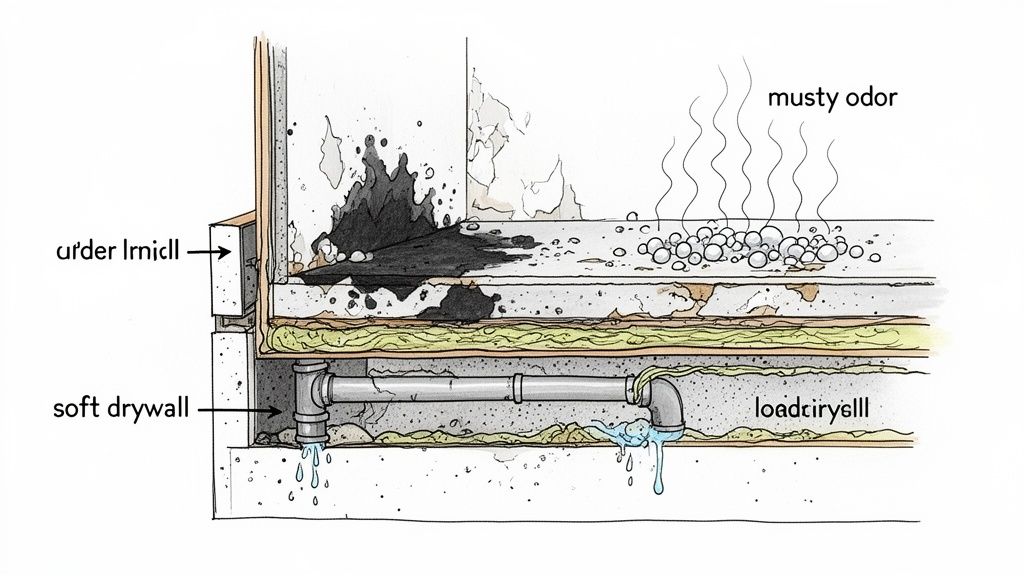
It's a frustrating reality that the worst mold problems are often the ones you can't even see. While visible spots on a wall are an easy catch, mold absolutely loves dark, damp environments. This makes the space behind your drywall prime real estate for a hidden colony to take root.
When it comes to detection, you have to trust your senses. More often than not, the very first clue is that persistent, musty smell—a damp, earthy odor that just won't go away. This distinct smell comes from gases, known as microbial volatile organic compounds (mVOCs), that are released by active mold. If a room smells old and damp no matter how much you air it out, you're likely smelling a hidden moisture problem.
Reading the Subtle Surface Clues
Beyond just your nose, the drywall itself will often give you visual hints that something is wrong. Think of these subtle changes as your wall's way of crying for help, signaling a hidden leak or moisture issue that is feeding a growing mold problem.
Keep a sharp eye out for these tell-tale signs:
- Peeling or Bubbling Paint: When moisture gets trapped inside a wall, it has to go somewhere. It often pushes the paint right off the surface, causing it to bubble, blister, or peel away.
- Warping or Bowing Surfaces: Drywall is rigid when it's dry, but once it absorbs water, it loses its strength. This causes the wall to swell, bow outwards, or look visibly warped.
- A Soft or Spongy Feel: Gently press on any suspicious-looking area. If the wall feels soft or spongy under your fingers, it’s a sure sign the drywall is saturated with water and seriously compromised.
These symptoms are almost always connected to a hidden water source, like a slow pipe leak, condensation from poor insulation, or even moisture creeping up from the foundation. Seeing these signs might also mean you should check for the signs of water damage on your ceiling, since water problems rarely stay in one place.
The most deceptive part of hidden mold is how widespread it can get before a single spot ever appears on the front of the wall. What looks like a tiny paint bubble could just be the tip of the iceberg, hinting at a massive colony growing on the backside of the drywall.
This unseen growth can happen shockingly fast. With just four to six weeks of trapped moisture, a black mold colony can easily cover 50-70% of the back of a drywall panel, all while remaining completely invisible from the room. Some species, like Stachybotrys, can spread at a rate of 2.5 mm per day on damp wallboard. That means a small leak can turn into a huge problem in less than a month.
Don't dismiss these subtle clues. They are serious warnings that demand immediate attention.
Knowing When to Tackle a Mold Problem
Finding what you think is mold on your drywall can definitely be a stressful moment. But it doesn't automatically mean you have a major crisis on your hands. The trick is knowing when you've got a small issue you can keep an eye on versus a serious problem that needs to be dealt with right away.
Mold spores are everywhere, but when they find a damp spot to land, they start to grow and can impact your home's air. For anyone sensitive to them, this can trigger allergy symptoms like a stuffy nose, coughing, or itchy skin. A little mildew on your shower tile is one thing, but mold on drywall is a bigger deal—it’s porous, and that usually points to a moisture problem that has to be fixed.
DIY Cleanup vs. Calling in the Pros
So, when does a little spot cross the line into a big problem? It really boils down to the size of the moldy area and what's causing it. A good guideline to keep in mind is the 10 square foot rule.
If you’re looking at a single, small patch of surface mold that’s smaller than that, you might be able to handle it yourself with the right safety gear and cleaning products. But that’s only if you’ve also found and completely stopped the source of the moisture. No point cleaning the mold if the leak is still active.
But some situations are immediate red flags. These are the signs that tell you this is more than a simple weekend project and it’s time to get an expert opinion.
A strong, musty smell is probably the biggest giveaway of a serious mold issue, even if you can’t see a thing. That smell is a dead ringer for a hidden colony thriving behind a wall or under the floorboards, happily feeding on a leak you don't even know exists.
Clear Signs It's Time to Call a Professional
Some scenarios instantly bump a mold problem from a DIY task to a job for a certified pro. If you run into any of these, your next step should be to call a remediation company.
-
It's Spread Out: Is the mold covering an area larger than 10 square feet? That’s considered a significant contamination. Trying to clean that much mold yourself is a bad idea—you could easily send a massive cloud of spores into the air, spreading the problem to other rooms.
-
The Mold Keeps Coming Back: You scrubbed a spot clean, but a week or two later, it’s back. This is a classic sign that the underlying water source is still there. The mold will just keep regenerating until that leak, drip, or condensation issue is fixed for good.
-
You Suspect It's Hiding: If you smell that musty odor but can't find the source, or if you see drywall that's warping, bubbling, or feels damp, you likely have mold growing where you can't see it. Professionals have specialized equipment like moisture meters and thermal cameras to pinpoint these hidden colonies without tearing your walls apart.
Why Professional Mold Remediation Matters
When you spot a significant patch of mold spreading across your drywall, your first thought might be to reach for a spray bottle and start scrubbing. While that might work for a tiny spot in the shower, it's often the worst thing you can do for a larger problem.
Here's why: aggressively scrubbing a thriving mold colony is like hitting a dandelion puff with a stick. You'll send a massive cloud of invisible spores airborne, which can then hitch a ride on your HVAC system to contaminate every room in your house.
This is where professional remediation comes in, and it's a world away from simple cleaning. It’s a systematic, science-backed process designed to not only remove the mold you see but to help ensure it doesn't come roaring back.
The Professional Remediation Process
A certified professional isn't just a cleaner; they're a technician following a strict, methodical playbook. The entire focus is on getting rid of the mold while protecting your home and the air you breathe.
They'll typically follow these key steps:
- Containment: The very first thing they do is seal off the entire area. Think of it like creating a quarantine zone with plastic sheeting and negative air pressure machines. This crucial step prevents any disturbed spores from escaping into the rest of your home.
- Air Filtration: While they work, industrial-grade HEPA air scrubbers are running constantly. These machines act like giant air purifiers, capturing microscopic spores right out of the atmosphere to keep the air clean.
- Safe Removal: Professionals know what can be saved and what can't. Porous materials that are deeply contaminated, like drywall and insulation, are carefully cut out, bagged, and disposed of according to strict guidelines.
- Source Correction: This is the most important step of all. A true professional will help find the water source that allowed the mold to grow in the first place. Whether it's a leaky pipe or a humidity problem, if you don't fix the leak, the mold can return.
Hiring a certified professional is about more than just wiping away a stain. It's an investment in restoring your home to a safe, healthy state by containing the threat, cleaning the air, and solving the problem at its root.
Ultimately, calling in the pros gives you something invaluable: peace of mind. Knowing the job was done right by a certified team with the proper training and equipment protects your property's value and, more importantly, your family's health. To see how these principles apply in notoriously damp areas, you can learn more about treating mold on basement walls in our other guide.
Common Questions About Mold on Drywall
If you've just spotted something suspicious on your drywall, you probably have a lot of questions. Let's tackle some of the most common ones that homeowners ask.
Can I Just Paint Over the Mold?
It’s a tempting quick fix, but painting over mold is one of the worst things you can do. Think of it as putting a band-aid on a problem that needs stitches.
The paint might hide the ugly stain for a little while, but the mold is still very much alive underneath. It will continue to feast on the drywall paper, digest the paint, and eventually reappear, often causing the new paint to bubble and peel away. You have to eliminate the mold and fix the water problem first.
What Causes Mold to Grow on Drywall in the First Place?
Mold has a simple recipe: moisture, a food source, and the right temperature. Your home provides the perfect temperature, and the paper facing on drywall is a fantastic food source. The final, and most critical, ingredient is excess moisture.
This moisture can come from a sudden event like a burst pipe, or it can be a slow, sneaky problem. Think high humidity from a poorly ventilated bathroom, or condensation building up inside a cold exterior wall. No moisture, no mold. It's that simple.
A lot of people believe bleach is the go-to solution for mold. But on a porous surface like drywall, bleach can actually make things worse. Its high water content can soak into the wall and feed the mold roots you can't see, fueling its return.
Will Bleach Get Rid of Mold on My Drywall?
This is a big one. The short answer is no—bleach is not the right tool for this job. Because drywall is porous like a sponge, mold doesn't just sit on the surface; it grows deep roots into the material.
When you spray bleach on it, you might kill the surface mold, but the chlorine can't penetrate deep enough to get the roots. Even worse, the water in the bleach soaks into the drywall, giving those hidden roots a fresh drink and encouraging the mold to grow back stronger. Professionals use specialized antimicrobial agents and techniques designed to fully eradicate mold from porous materials.
When you're facing a potential mold problem, getting it handled correctly is the best way to protect your home and your family's health. Restore Heroes provides IICRC-certified mold remediation services. We can give you clear answers and a professional plan.
Reach out for an onsite inspection and get the expert help you need. Learn more at https://www.restoreheroesaz.com.