
Discovering water damage in your Phoenix home is overwhelming, and the insurance claim process that follows can feel just as daunting. Whether you're dealing with the aftermath of a monsoon flash flood, a sudden burst pipe, or a slow, hidden leak, Arizona homeowners need a clear and actionable plan. This guide provides a comprehensive checklist of essential insurance claim tips for water damage, designed to help you navigate the complexities with confidence.
Our goal is to empower you with the knowledge to meticulously document your loss, communicate effectively with your insurance provider, and take the correct steps toward a successful restoration. We will break down the critical actions you need to take from the moment you discover the damage, so you are prepared from day one to protect your interests and property. Following a structured process can make a significant difference in the outcome of your claim, helping you avoid common pitfalls that can lead to delays or disputes.
This article offers detailed, practical advice on everything from capturing initial evidence and reporting your claim to understanding your policy's fine print and managing repair expenses. We will cover how to create a thorough inventory of damaged items, why professional damage assessments are crucial, and what to do if your claim becomes complicated.
Please note, the information provided here is for educational purposes and should not be considered a substitute for professional advice. It is not a guarantee of service, coverage, or pricing. Always refer to your specific insurance policy and consult directly with your insurance provider for details regarding your situation.
1. Document Everything Immediately with Photographic and Video Evidence
The single most powerful tool you have when starting a water damage insurance claim is your smartphone's camera. Comprehensive, immediate documentation creates a clear and undeniable record of the damage as it happened. This visual evidence is the foundation of your claim, providing objective proof that insurers need to validate the extent of the loss and its cause. Without it, you are relying solely on memory and descriptions, which can lead to disputes and delays.
Think of it this way: your photos and videos tell a story that words alone cannot. They capture the initial chaos, the water's path, and the specific items that were ruined. This is a crucial step in the process, as recommended by major insurers and industry bodies like the Insurance Information Institute (III). Acting fast to document the scene before any cleanup begins is one of the most effective insurance claim tips for water damage you can follow.
How to Create Powerful Visual Evidence
Your goal is to create a complete visual record. Don't just take one or two pictures; be thorough and methodical.
- Capture Everything: Take photos and videos of the entire affected area from multiple angles. Get wide shots to show the overall scope of the damage and close-up shots to detail specific issues like warped floorboards, soaked drywall, or ruined furniture.
- Document the Source: If you can safely identify the source of the water (like a burst pipe under the sink or a leaking washing machine hose), take clear pictures of it. This helps establish the cause of the loss, which is critical for your claim.
- Video Walkthroughs: A video can be even more compelling than photos. Walk through the damaged rooms and narrate what you are seeing. For example, you could say, "This is the master bedroom on Tuesday at 4 PM. As you can see, water is dripping from the ceiling fixture, and the entire carpet is saturated." This adds valuable context.
- Personal Property: Don't forget to document damaged personal belongings. Take pictures of ruined electronics, furniture, clothing, and any other items. Make a list of these items as you go.
Pro Tip: Create a dedicated album on your phone or a folder in a cloud service (like Google Drive or Dropbox) immediately. Upload all photos and videos to this folder to ensure they are backed up and organized. Make sure the timestamp feature is enabled on your camera.
Why This Step Is Non-Negotiable
Immediate documentation prevents disputes with your insurance adjuster about the pre-existing condition of your property. For instance, if water damage has caused visible discoloration on your ceiling, having time-stamped photos proves it happened during this specific event. You can learn more about the signs of water damage on a ceiling to better identify what to capture. This evidence strengthens your position and can significantly speed up the approval process, helping you get the resources you need for restoration faster.
2. Report Your Claim Immediately and Document All Communication
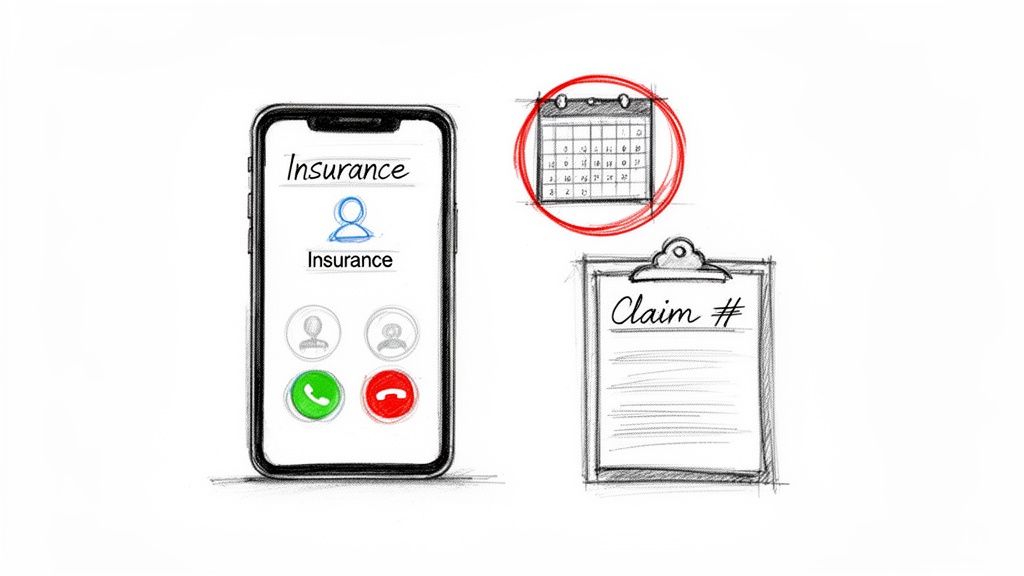
After documenting the initial damage, your next immediate action is to contact your insurance company. Most insurance policies have a clause requiring you to provide "prompt notice" of a loss. Delaying this step can complicate or even jeopardize your claim. Reporting the incident right away officially starts the claims process, establishes a date of loss, and is often necessary to get authorization for emergency mitigation services.
This initial call is the first of many communications you will have with your insurer. As such, meticulously documenting every single interaction is one of the most critical insurance claim tips for water damage you can follow. This creates a clear, chronological record of your claim, establishes accountability, and provides a paper trail that can be invaluable if disputes or confusion arise later. This practice is strongly recommended by consumer protection bodies like the National Association of Insurance Commissioners (NAIC) and is a standard part of claim handling requirements.
How to Effectively Report and Document Your Claim
Your goal is to be both swift and systematic. Be prepared before you call and organized after you hang up.
- Have Your Policy Ready: Before calling, locate your insurance policy documents. Have your policy number on hand to expedite the process.
- Use the 24/7 Hotline: Most major insurers have a dedicated 24/7 emergency claims hotline. Use this number instead of a general customer service line for the fastest response.
- Request and Record Key Information: During your first call, be sure to get your official claim number. Also, ask for the name, title, and direct contact information of the adjuster assigned to your case.
- Follow Up in Writing: After any phone conversation, send a brief, polite email to the representative you spoke with. Summarize the key points of the discussion, including any instructions or authorizations they provided. This creates a written record of the verbal conversation.
- Create a Communication Log: Keep a dedicated notebook or digital document to log every interaction. For each entry, record the date, time, the name of the person you spoke with, and a summary of the conversation.
Pro Tip: Ask your insurer for specific authorization to begin emergency water mitigation. Inquire about your policy's coverage for these services and ask them to confirm this authorization in writing via email. This can help prevent reimbursement issues later.
Why This Step Is Non-Negotiable
Failing to report a claim promptly can give an insurer grounds to question the timeline or even deny the claim based on a policy violation. A detailed communication log serves as your proof of compliance and diligence. For example, if a dispute arises over whether you were approved to hire a restoration company for emergency water extraction, your email log can provide the necessary evidence. This organized approach demonstrates that you are a responsible policyholder, streamlines the process, and helps all parties be held accountable for their commitments.
3. Create a Detailed Inventory of Damaged Property with Receipts and Valuations
While structural repairs are a major part of a water damage claim, the contents of your home often represent a significant financial loss. A detailed inventory of your damaged personal property is the primary tool for recovering these losses under your policy's contents coverage. This list provides your insurer with the specific information needed to calculate a fair settlement for everything from furniture and electronics to clothing and collectibles. Without it, you risk a settlement based on guesswork, which almost always leads to undervaluation.
A comprehensive inventory is your proof of loss for personal belongings. This step, strongly recommended by the National Association of Insurance Commissioners (NAIC), transforms abstract losses into a concrete, itemized list that adjusters can process. For instance, a Mesa homeowner meticulously documented over $8,000 in damaged electronics and furniture using credit card statements and original receipts, which enabled them to receive a full replacement cost payout. This level of detail is a critical insurance claim tip for water damage that directly impacts your financial recovery.

How to Build a Powerful Inventory
Your goal is to create an undeniable and easy-to-follow list of every single item that was damaged. Be systematic and leave no stone unturned.
- Go Room by Room: Start in one affected area and list every damaged item before moving to the next. This prevents you from missing things and keeps the list organized.
- Use a Spreadsheet: Create columns for the item name, brand, model/serial number, original purchase date, original cost, and estimated current replacement cost.
- Gather Proof of Value: Search for original receipts in your files, email confirmations from online purchases, or credit card statements. If you can't find them, a guide on getting copies of receipts can offer helpful strategies.
- Research Replacement Costs: Look up what it would cost to buy a new, comparable item today from retailers like Amazon, Best Buy, or local furniture stores. Include links or screenshots as evidence.
- Photograph Each Item: Take clear photos of each damaged item, including close-ups of brand names, serial numbers, and the damage itself.
Pro Tip: Do not throw away any damaged items until your insurance adjuster has inspected them or given you explicit permission to do so. Disposing of items prematurely can result in those items being denied from your claim.
Why This Step Is Non-Negotiable
A detailed inventory removes ambiguity from your claim. Instead of saying "a TV was ruined," your list will state, "one 55-inch Samsung QLED TV, model QN55Q80A, purchased in 2021 for $1,200, current replacement cost is $1,100." This specificity leaves no room for dispute and provides the adjuster with everything they need to approve that portion of your claim. Understanding the value of your damaged items is just as important as knowing the potential water damage repair cost for the structure itself. This thorough approach substantiates your claim, prevents delays, and helps you receive proper compensation for what you lost.
4. Obtain Professional Damage Assessment and Mitigation Estimates Before Full Claim Settlement
Before you accept your insurance company's initial settlement offer, it is crucial to get an independent, professional assessment of the damage. An insurer's initial estimate is often based on visible damage, but water has a way of hiding behind walls, under floors, and in insulation. A certified restoration company provides a comprehensive evaluation that accounts for the full scope of work, including hidden moisture and potential mold growth, which is a critical part of the insurance claim process.
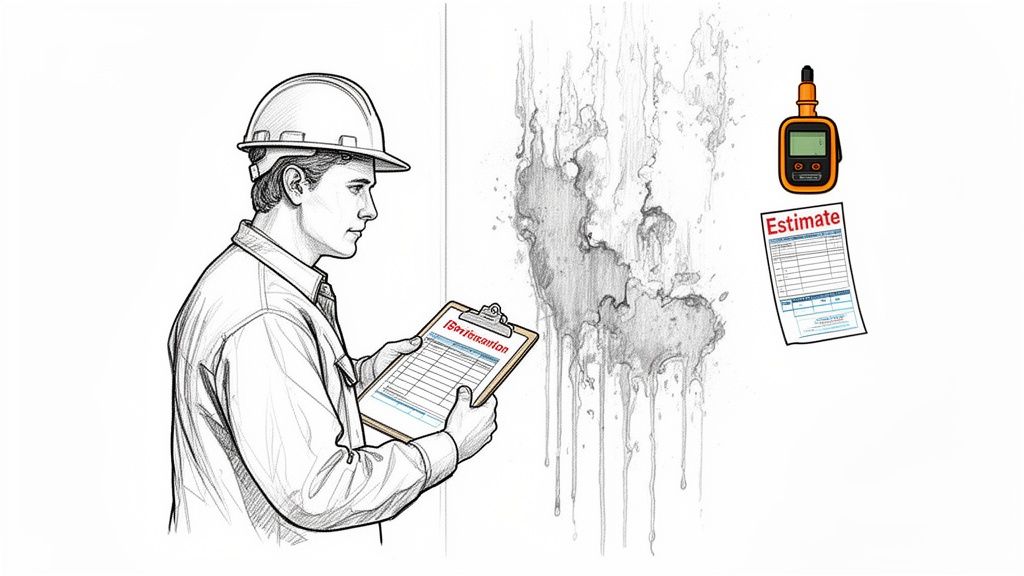
Think of it this way: your insurer sends an adjuster to evaluate the claim from their perspective, but you may want an expert working from yours. Reputable, IICRC-certified companies can provide onsite inspections to calculate the real costs of water extraction, structural drying, and full restoration. This detailed estimate serves as powerful, objective evidence to validate your claim and help you receive appropriate compensation for all necessary repairs, not just the ones that are immediately obvious. This is one of the most important insurance claim tips for water damage because it protects you from settling for less than you need.
How to Leverage a Professional Estimate
Your goal is to have a detailed, line-item estimate from a qualified professional to present to your insurance company. This document can become a key negotiation tool.
- Schedule an Inspection Quickly: Contact a certified restoration company within 24-48 hours of discovering the damage. The faster they can assess the situation, the more accurate the picture of the initial damage will be.
- Verify Credentials: Ensure the company you choose is IICRC-certified and carries the proper insurance. This is a standard accepted by major insurers like State Farm and Allstate and adds significant credibility to the estimate.
- Request Detailed Reports: The estimate should be more than just a single number. Ask for a written report with photos, moisture readings, and line-item costs for labor, materials, and equipment.
- Ask About Hidden Damage: Specifically inquire how the company assesses hidden damage, such as moisture within wall cavities or the potential for mold. A thorough inspection should use tools like thermal cameras and moisture meters.
Pro Tip: When you receive a professional estimate, share it with your insurance adjuster immediately. Document any discrepancies between their initial assessment and the expert report. This proactive communication can prevent disputes and expedite a fair settlement.
Why This Step Is Crucial for a Fair Settlement
An independent estimate is your best defense against a lowball offer. It shifts the conversation from your opinion versus the adjuster's opinion to a data-driven discussion based on industry standards. For example, a Gilbert homeowner received an initial insurance offer of $4,500 for what appeared to be minor water damage. A professional inspection, however, uncovered hidden mold and saturated subflooring, resulting in a revised estimate of $12,000. The insurer approved the higher amount after reviewing the detailed documentation.
This professional validation can help ensure that all aspects of the restoration, from initial water damage mitigation to final repairs, are accounted for. It empowers you to confidently negotiate a settlement that truly covers the full cost of returning your property to its pre-loss condition.
5. Understand Your Policy Coverage Limits, Deductibles, and Exclusions Before Filing
Navigating a water damage claim successfully hinges on one critical element: knowing what your insurance policy actually covers. Many claims face disputes or denials simply because homeowners are unaware of the specific terms, limits, and exclusions written into their contract. Standard policies typically cover sudden and accidental water damage, like a burst pipe, but often exclude issues like flooding, gradual leaks, or sewer backups. Taking the time to understand these details before you file is a crucial insurance claim tip for water damage that can save you from significant stress and financial surprises.
Think of your policy as the rulebook for your claim. It defines what constitutes a covered event, how much the insurer will pay, and what your financial responsibility (the deductible) will be. According to the National Association of Insurance Commissioners (NAIC), thoroughly reviewing your policy is a fundamental step in being an informed consumer. By familiarizing yourself with these rules, you can set realistic expectations, communicate more effectively with your adjuster, and build a stronger case for the compensation you may be entitled to.
How to Decode Your Insurance Policy
Your goal is to become an expert on your own coverage. Don't rely on assumptions; get the facts directly from the source documents.
- Request the Full Policy: The declarations page provides a summary, but you need the entire policy document to understand the fine print. Ask your agent for a complete digital or physical copy.
- Identify Key Sections: Look for sections detailing "covered perils," "exclusions," and "conditions." Highlight every mention of water damage, flood, sewer backup, and mold.
- Know Your Numbers: Locate your coverage limits for the dwelling (structure) and personal property. Note your deductible, and check if there's a separate, higher deductible specifically for water-related claims.
- Ask About Endorsements: Inquire about optional add-ons, or endorsements, you may have. These can provide coverage for events that are typically excluded, such as sump pump failure or sewer backup.
Pro Tip: Create a one-page summary sheet that lists your policy number, agent's contact information, key coverage limits, and all relevant deductibles. Keep this with your other important household documents for quick access during an emergency.
Why This Step Is Non-Negotiable
Understanding your policy's specifics beforehand empowers you to frame your claim accurately and avoid common pitfalls. For example, a Chandler business owner discovered their policy had a steep $5,000 deductible for water damage, much higher than their general deductible, which prompted them to adjust their emergency fund. Knowing these details upfront is essential. This proactive review helps you understand all aspects of your coverage, from major structural repairs to specific personal property, and validating a claim includes knowing, for instance, whether renters insurance covers storage units if your belongings were stored off-site.
This knowledge prevents you from wasting time on a non-covered event and helps you present the facts of your covered loss more clearly to the insurance company. By knowing the rules of the game, you can make the strongest possible claim for the damage you have sustained. For more information on navigating the complexities of different water damage scenarios, you can explore resources on Category 3 water damage to better understand what may or may not be covered.
6. Maintain Clear Records of All Remediation, Repairs, and Replacement Expenses
While visual evidence shows what was damaged, meticulous financial records prove what it cost to fix it. Your insurance claim is essentially a request for reimbursement for the documented expenses you incurred to restore your property. Without a clear paper trail of receipts, invoices, and payments, you leave the door open for an insurer to question or deny reimbursement for legitimate restoration costs.
Think of yourself as the financial manager for your restoration project. Every dollar spent on mitigation, repairs, and replacements must be accounted for with supporting documentation. This systematic approach transforms your claim from a collection of estimates into a concrete, verifiable financial statement of your loss. This practice is strongly recommended by industry authorities like the Insurance Information Institute (III) as a fundamental part of a successful claim process.
How to Create a Bulletproof Financial Record
Your goal is to build an organized and comprehensive file that leaves no room for doubt about your expenditures. Be methodical from the very first expense.
- Create a Central File: Start a physical folder or a dedicated digital folder (e.g., in Google Drive) for all claim-related financial documents. Store every receipt, invoice, contract, and bank statement here.
- Request Itemized Invoices: Never accept a vague, lump-sum bill. Ask every contractor for an itemized invoice that breaks down costs for labor, materials, equipment rentals, and any other charges. This level of detail is crucial for adjusters.
- Track Payment Methods: Pay with credit cards or checks whenever possible, as this automatically creates a clear record of payment. If you must pay with cash, get a signed and dated receipt immediately.
- Document Everything: Keep records of not just the big-ticket items like drywall and flooring, but also smaller purchases like cleaning supplies or storage bin rentals. These costs can add up.
Pro Tip: Create a simple spreadsheet to log every expense. Include columns for the date, vendor name, a brief description of the expense, the amount, and the payment method. This provides a quick-glance summary for you and your adjuster.
Why This Step Is Crucial for Full Reimbursement
A well-documented financial record is one of the most effective insurance claim tips for water damage because it eliminates disputes over costs. When an adjuster can clearly see how and where money was spent on approved restoration work, the payment process becomes much smoother and faster. For example, a Phoenix homeowner who kept detailed invoices from their restoration company, receipts for new flooring, and contracts for painting was able to match their claim reimbursement exactly to their documented expenses.
This level of organization is especially important when you work with a water damage restoration contractor who is providing multiple services. Having clear, written contracts that outline the scope of work and associated costs before work begins helps align everyone and provides essential documentation for your insurer, solidifying your claim and helping you recover your losses effectively.
7. Know When to Hire a Public Adjuster or Attorney for Complex or Disputed Claims
While you can successfully manage most water damage claims on your own, some situations become too complex, contentious, or high-stakes to handle without professional help. This is when hiring a public adjuster or an insurance attorney can be a strategic move. These professionals advocate solely for you, the policyholder, to help you receive a fair and complete settlement from your insurance company, leveling the playing field when disputes arise.
Think of it this way: your insurance company has its own team of adjusters and legal experts working to protect its financial interests. A public adjuster or attorney works on your side, using their deep knowledge of insurance policies and negotiation tactics to protect yours. For homeowners facing significant financial loss, enlisting an expert is one of the most critical insurance claim tips for water damage, especially when communication with the insurer breaks down or the settlement offer seems unreasonably low.
When to Consider Professional Representation
Bringing in a third party isn't necessary for every claim, but certain red flags indicate it may be time to seek help. Their expertise can be invaluable in navigating the complexities of a large or disputed claim.
- Significant Damage: If your claim is large, generally over $10,000, or involves complex structural damage, hidden mold, or extensive personal property loss, a professional can help ensure nothing is overlooked.
- Claim Denial or Underpayment: If your claim is outright denied or the settlement offer is substantially less than the repair estimates from your trusted contractors, an expert can challenge the insurer's decision.
- Complex Coverage Issues: Policies can contain confusing language, endorsements, and exclusions. A public adjuster or attorney can interpret your policy to argue for maximum coverage.
- Signs of Bad Faith: If your insurer is using delay tactics, refusing to communicate, or misrepresenting your policy terms, it may be time to get legal or professional claims help.
Pro Tip: Before signing any agreement, verify the professional's credentials. Public adjusters must be licensed by the Arizona Department of Insurance and Financial Institutions (DIFI). You can verify their license on the DIFI website to ensure they are in good standing.
How to Work with Adjusters and Attorneys
Taking the step to hire professional help requires careful consideration and due diligence. Knowing how to engage with them effectively can lead to a better outcome for your claim.
- Understand the Fee Structure: Most public adjusters and attorneys work on a contingency fee, meaning they take a percentage (typically 10-20%) of the final claim settlement. Ensure this percentage is clearly stated in your contract.
- Ask for Referrals and References: Ask for references from past clients who had similar water damage claims. A reputable professional will be happy to provide them.
- Document Everything: Keep a complete record of all communications with your hired adjuster or attorney, just as you do with your insurance company. This includes emails, phone call notes, and copies of any documents you provide.
- Clarify Their Role: Ask how they will interact with your restoration contractor and the insurance company's adjuster to ensure a smooth, collaborative process.
Why This Step Can Be a Game-Changer
Hiring an expert may prevent you from accepting a lowball offer out of frustration or necessity. For example, a Scottsdale homeowner with a $35,000 disputed water damage claim hired a public adjuster who uncovered hidden mold and structural issues the initial adjuster missed. This new evidence led to an additional $15,000 in the settlement. Even after the adjuster's fee, the homeowner netted a significantly higher amount to properly restore their home. This demonstrates how an advocate can maximize your claim and help you get the funds needed for a complete recovery.
7 Essential Water-Damage Insurance Claim Tips Compared
| Strategy | 🔄 Implementation Complexity | ⚡ Resource Requirements | ⭐ Expected Effectiveness | 📊 Expected Outcomes / Impact | 💡 Ideal Use Cases / Key Tips |
|---|---|---|---|---|---|
| Document Everything Immediately with Photographic and Video Evidence | Low–Moderate — immediate, simple steps under stress | Low — smartphone/camera, cloud storage, basic organization | High — strong objective proof for claims | Faster approvals; fewer disputes; clearer causation | First action after discovery — timestamp, multiple angles, back up media |
| Report Your Claim Immediately and Document All Communication | Moderate — timely, precise communications required | Low — phone, email, claim log, organized notes | High — preserves notice requirements and claim validity | Prevents denial for late notice; authorizes mitigation quickly | Call emergency hotline, record claim #, follow up calls with emailed summaries |
| Create a Detailed Inventory of Damaged Property with Receipts and Valuations | High — time‑intensive, item‑by‑item documentation | Moderate — receipts, photos, spreadsheets, possible appraiser | High for contents recovery — key to maximizing payouts | Higher personal property settlements; fewer low‑ball valuations | Room‑by‑room inventory, collect receipts/serials, use retailer prices or appraiser for high‑value items |
| Obtain Professional Damage Assessment and Mitigation Estimates Before Full Claim Settlement | Moderate — scheduling and coordinating professionals | Moderate — restoration inspectors (often free inspection), time for reports | Very High — third‑party validation carries weight with insurers | Identifies hidden damage, supports higher/accurate estimates, stronger negotiation | Request IICRC credentials, line‑item estimates, share reports with adjuster |
| Understand Your Policy Coverage Limits, Deductibles, and Exclusions Before Filing | High — policies are complex and nuanced | Low–Moderate — time to review, agent/insurer consultation | High — prevents misunderstandings and wrong expectations | Clarifies coverage scope, deductible impact, and need for endorsements | Get full policy copy, highlight water sections, ask for written clarifications |
| Maintain Clear Records of All Remediation, Repairs, and Replacement Expenses | Moderate — ongoing bookkeeping during restoration | Moderate — receipts, itemized invoices, payment records, spreadsheets | High — essential for reimbursement and audit defense | Enables full reimbursement, simplifies adjuster review, supports tax documentation | Request itemized invoices, pay traceably, keep before/after photos and permits |
| Know When to Hire a Public Adjuster or Attorney for Complex or Disputed Claims | High — involves legal/professional engagement and negotiation | High — contingency fees or legal costs, time for representation | Variable‑High — often improves outcomes in complex disputes | Can recover substantially more on large or contentious claims; enables legal remedies | Consider when disputes exceed ~$10k or denial occurs; verify credentials and contingency terms |
Taking the Next Step Towards Recovery
Navigating the aftermath of water damage can feel overwhelming, but a structured approach to your insurance claim can make all the difference. As we've detailed, successfully managing this process hinges on a few core principles: immediate and thorough documentation, prompt and clear communication, and a deep understanding of your specific insurance policy. You are your own best advocate, and the power to influence a fair and efficient outcome lies in the details you meticulously collect and the proactive steps you take from the very beginning.
Remember, every photo, every video, every logged phone call, and every saved receipt builds the foundation of your claim. These aren't just administrative tasks; they are the evidence that tells the story of your loss. By creating a detailed inventory and maintaining organized records of all expenses, you transform a chaotic situation into a well-documented case file that your insurance adjuster can process more effectively. This level of preparation is one of the most crucial insurance claim tips for water damage a homeowner can implement.
The Power of Preparation and Professional Partnership
Understanding the nuances of your policy, including its coverage limits, deductibles, and potential exclusions for issues like gradual leaks or mold, is equally critical. This knowledge empowers you to set realistic expectations and engage in more productive conversations with your insurer. It also helps you recognize when the complexity or value of your claim might warrant bringing in a public adjuster or attorney to advocate on your behalf.
Ultimately, the goal is not just to file a claim, but to restore your property and your peace of mind. Partnering with an experienced, IICRC-certified restoration company is a pivotal step in this journey. A professional team provides the immediate mitigation needed to prevent further damage and offers the expert damage assessments required by insurers. Their detailed estimates and documentation serve as invaluable, third-party validation that supports your claim from start to finish.
Key Takeaway: A successful water damage insurance claim is a blend of your diligent documentation and the technical expertise of a professional restoration partner. One supports the other, creating a comprehensive package that clearly outlines the scope of damage and the necessary path to recovery.
While no restoration company can guarantee specific insurance coverage or claim outcomes, working with a team that understands the insurance process can significantly streamline your experience. This partnership allows you to focus on your family and your well-being, confident that the technical aspects of mitigation and repair are being handled with professional precision. By applying these insurance claim tips for water damage, you are not just recovering from a disaster; you are taking control of the process and actively paving the way back to normalcy for your Phoenix-area home.
Facing water damage in the Phoenix area? Don't navigate the complex insurance claim process alone. Contact Restore Heroes for an immediate, 24/7 response and a free, no-obligation onsite inspection to start your recovery with an experienced, insurance-preferred partner by your side. Restore Heroes provides the expert mitigation and detailed documentation you need to support your claim with confidence.