
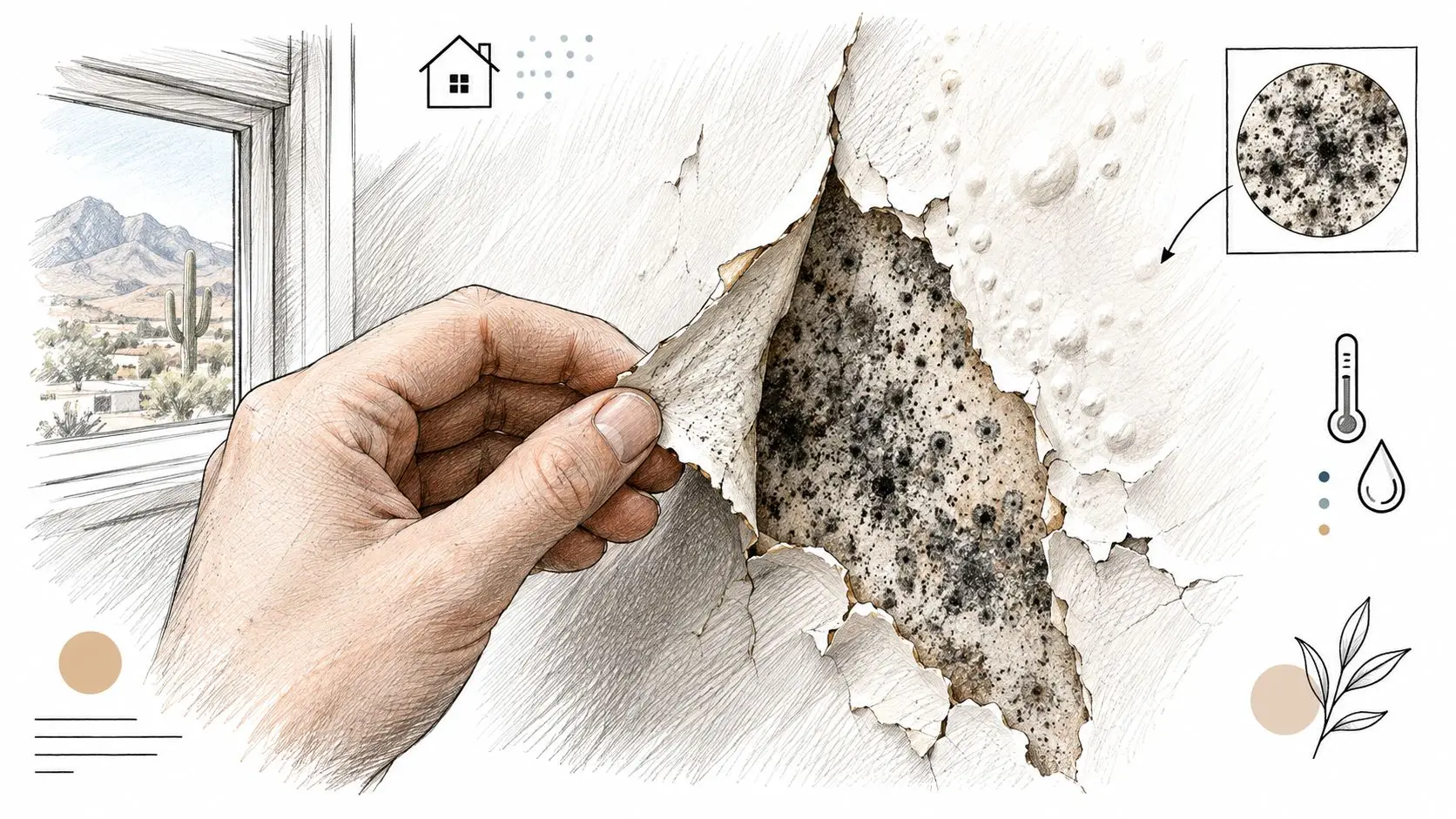
You notice a soft bubble near a bedroom window in your Phoenix home. The paint has changed color, and the first instinct is to wipe the spot, run a fan, and touch it up. But mold under paint on drywall usually isn't just a paint problem. It points to moisture that reached the paper and gypsum behind the coating, where growth can remain hidden while the surface still looks mostly sound.
Dry desert weather doesn't make homes immune. Monsoon rain can enter through roof or window defects, plumbing can leak inside a wall, and air conditioning can create cold surfaces where moisture condenses. Once water reaches drywall, paint may act like a lid, slowing evaporation and concealing what is happening below.
This guide will help you read the clues without becoming alarmed. You'll learn how hidden mold develops, where Phoenix homes commonly collect moisture, how to inspect without spreading contamination, and how to choose between drying, cutting out drywall, and calling a professional. The practical goal is simple: find the moisture source, understand the wall's condition, and avoid sealing an active problem beneath a fresh coat of paint.
Introduction to Mold Hiding Beneath Painted Drywall
A Phoenix homeowner may first notice the issue while preparing a room for repainting. A small blister appears beside a window. A yellow-brown stain returns after cleaning. The lower edge of a wall feels slightly soft near a bathroom, laundry area, or exterior corner. None of these clues proves that mold is present, but each suggests that moisture may have traveled behind the paint.
That distinction matters. A surface stain sits on the coating and may respond to appropriate cleaning. Hidden growth sits on or within the porous drywall assembly, often on the paper facing. The U.S. EPA explains that the backside of drywall is a common hidden location for mold, especially when water enters a wall cavity or remains near a leaking or condensing pipe.
Why the desert still needs a moisture investigation
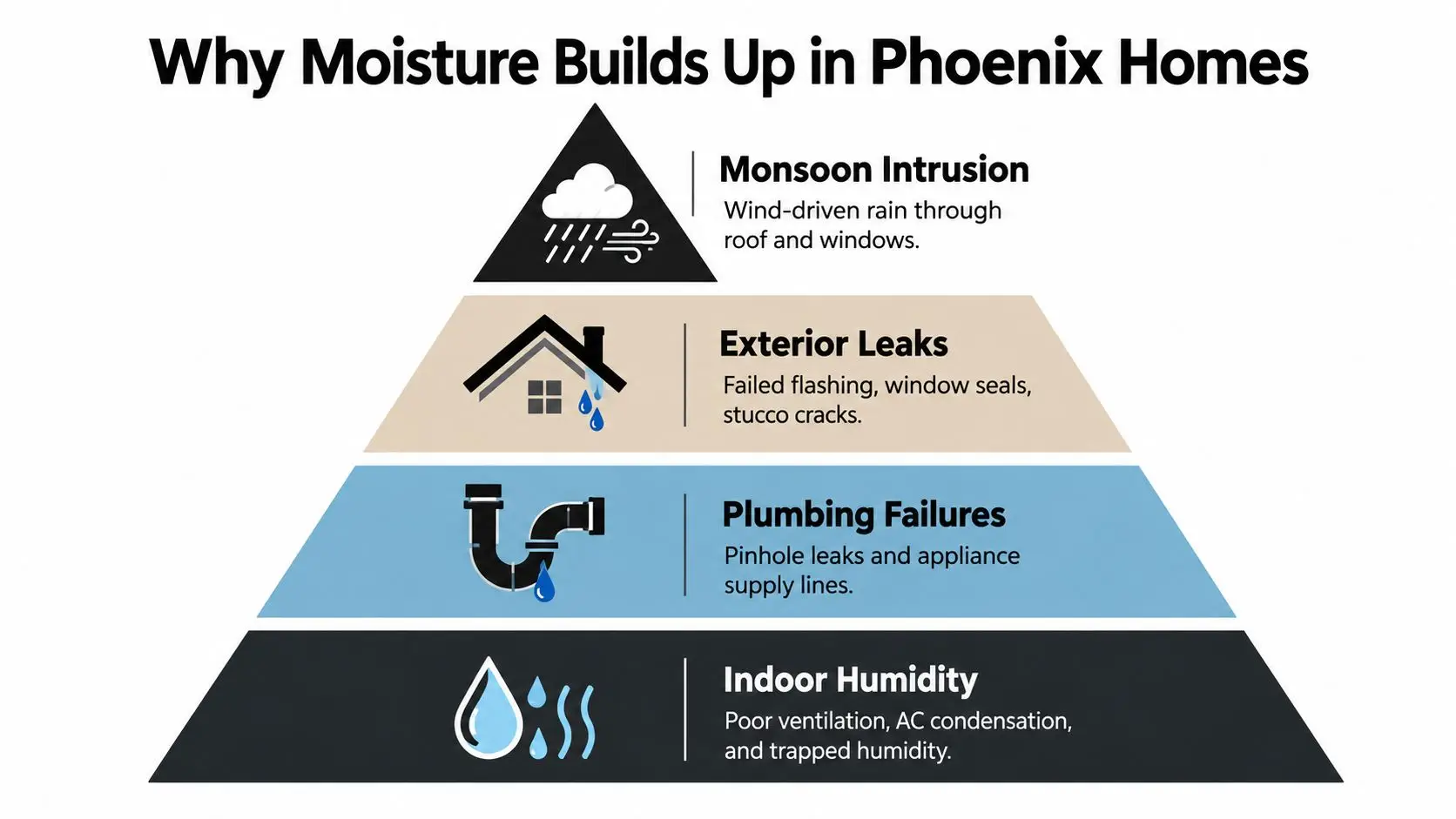
Phoenix homes experience long dry periods, but indoor and outdoor moisture events still happen. Wind-driven monsoon rain can test roof penetrations and window seals. A slow supply-line leak can wet drywall without producing a dramatic puddle. Cooling equipment can also make pipes, ducts, and wall surfaces cold enough for condensation.
The paint may hide the timeline. It can cover an old stain, reduce air movement across the wall, and make the surface appear repaired even when the paper beneath remains damaged. Visible peeling is sometimes a late symptom rather than the beginning of the problem, as explained in EPA guidance on mold in building materials.
What you need to decide
You don't need to start by cutting a large opening. Begin with low-disturbance observations, document what you see, and determine whether the wall is structurally sound and dry. From there, the appropriate response may range from controlled drying to drywall removal and professional containment.
The key question isn't, “Can I make the mark disappear?” It's, “Why did moisture reach this material, and can the affected drywall be dried and cleaned without leaving hidden contamination?”
How Mold Grows Under Paint on Drywall
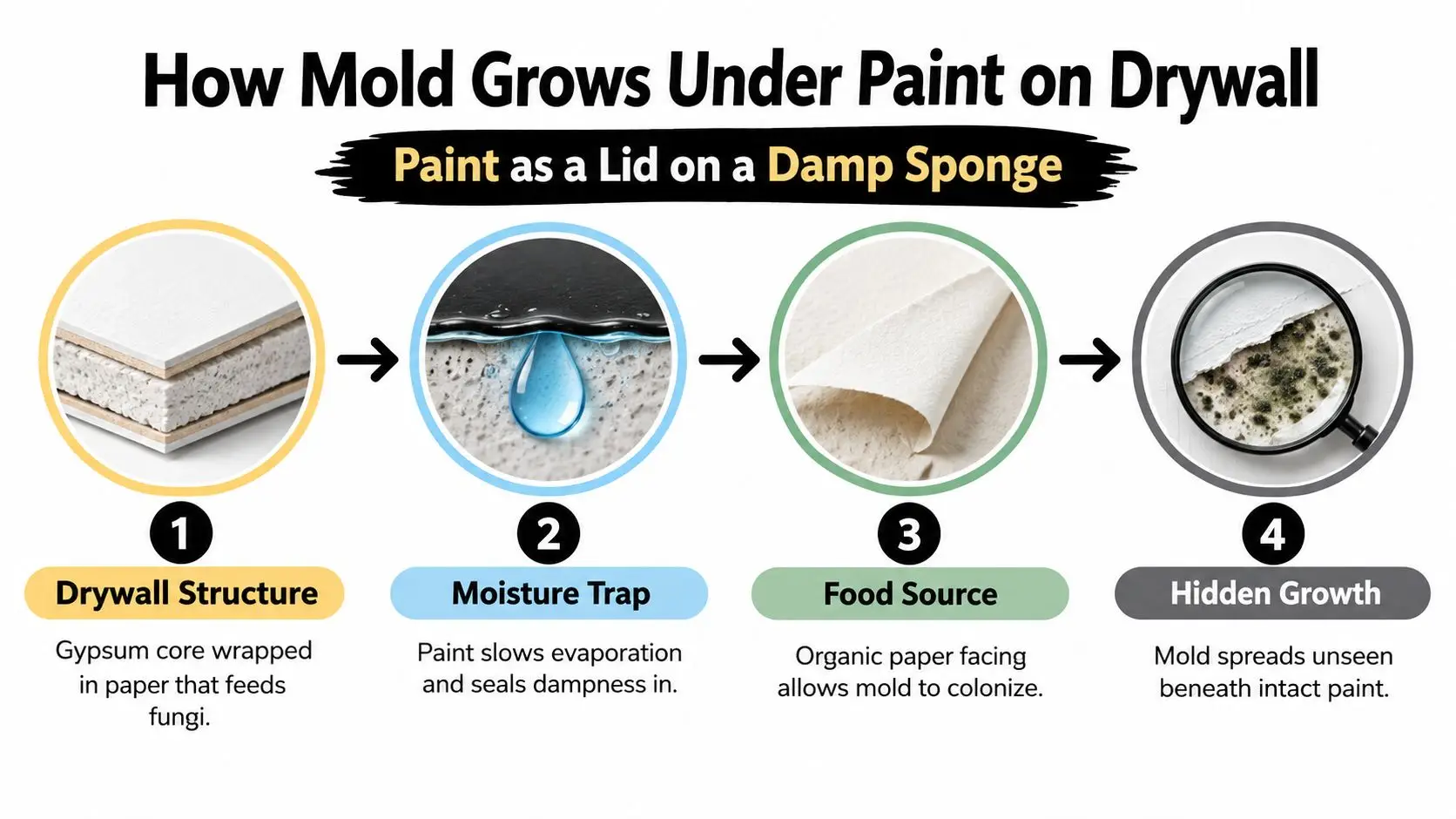
Think of painted drywall as a damp sponge covered by a lid. The sponge represents the gypsum board and its paper facing. The lid represents the paint film. If water reaches the sponge, the lid can slow evaporation and prevent you from seeing how much moisture remains.
Drywall is a layered material. A gypsum core is wrapped in paper, and that paper contains cellulose, an organic food source that can support fungal growth when moisture is available. The paint itself isn't the main food source. The concern is what happens beneath it, where damp paper and limited drying can create a protected environment.
Moisture, paper, and time
Building-science sources note that fungal growth can begin when relative humidity reaches about 80% or higher, while some species can survive at 65% relative humidity. After water intrusion, rapid germination is often observed in about 24 to 48 hours when conditions support it, according to the moisture-related drywall guidance from Alpine Intel.
Those figures aren't a countdown that proves mold will grow in every wall. They show why a damp assembly deserves prompt attention. A brief wetting event may be dried successfully when the board remains intact. A wall that stays wet, absorbs repeated condensation, or has moisture trapped behind a coating presents a different decision.
Appearance isn't a moisture test. Intact paint can cover a wet paper facing, while peeling paint can also reflect older damage that has already dried.
Growth may remain between paint layers, on the front paper surface, or toward the backside of the board. The exact location matters because wiping the visible coating doesn't necessarily reach the porous material underneath. The EPA notes that mold can grow in the empty spaces and crevices of porous materials, making complete removal difficult or impossible.
A small area of cleanable surface contamination isn't the same as mold that has reached paper or gypsum. That difference explains why a painted wall can look normal after cleaning and then develop recurring odor, staining, or coating failure. It also explains why a drywall guide such as Soca Services Painting's drywall repair information can be useful when the final repair involves replacing damaged board and preparing the surface correctly.
For a broader discussion of causes in residential walls, see what causes black mold in homes. The practical lesson is that paint isn't a reliable barrier against moisture. It can behave like a lid, hiding the condition of the sponge until the wall begins to show it.
Why Moisture Builds Up in Phoenix Homes
The wall can't tell you where the water started. You have to trace the path from the first wet point to the damaged paint. In Phoenix, that path may begin outside during a storm, inside a plumbing chase, or on a cold surface created by air conditioning.
Exterior water paths
Monsoon weather can drive rain against roof edges, windows, stucco, and exterior penetrations. Failed flashing, cracked sealant, or a damaged roof transition may let water enter above a ceiling or behind a wall. The moisture can then move downward through framing and reach the paper facing of drywall away from the original entry point.
Window openings deserve special attention when bubbling paint appears near a sill or corner. Check for staining on trim, swollen casing, deteriorated caulk, and dampness that follows the window's lower edge. Don't assume that a dry surface on a clear day rules out an earlier intrusion.
Interior leaks and condensation
A pinhole plumbing leak may release water slowly into a wall. Appliance supply lines, refrigerator connections, washing-machine hoses, and drain assemblies can create similar problems. A bathroom wall can also receive moisture from plumbing penetrations or an enclosure on the opposite side.
Condensation follows a different route. Cold water pipes, air-conditioning components, ducts, or chilled wall surfaces can collect moisture when surrounding air is humid enough. Poor ventilation can allow indoor humidity to linger, especially in bathrooms, laundry rooms, and kitchens. The water may be small in quantity but repeated often enough to keep the paper-facing damp.
Trace the likely route
Use the location of the damage as a clue, not a conclusion:
- Near a window or exterior corner: Inspect flashing, sealants, stucco cracks, roof drainage, and the wall below the opening.
- Near a bathroom or kitchen: Check supply lines, valves, drains, backsplashes, and the wall on the other side.
- Near an appliance: Look for slow leaks at connections and signs of swelling around flooring or baseboards.
- On an air-conditioned wall or ceiling: Consider condensation, duct leakage, insulation gaps, and condensate drainage.
- Along the bottom of an exterior wall: Look for water migration, failed exterior drainage, or a leak that began higher in the assembly.
A suspected leak beneath a slab needs a different investigation from a visibly wet wall. For general background on that type of plumbing problem, Stultz Plumbing's slab leak repair resource explains why hidden plumbing leaks require source detection before repairs can be planned.
Moisture control comes first. The moisture damage repair process is most effective when the water source, affected material, and drying conditions are considered together. Repainting before that work only changes the appearance while leaving the cause unresolved.
How to Spot and Test for Hidden Mold Without Spreading It
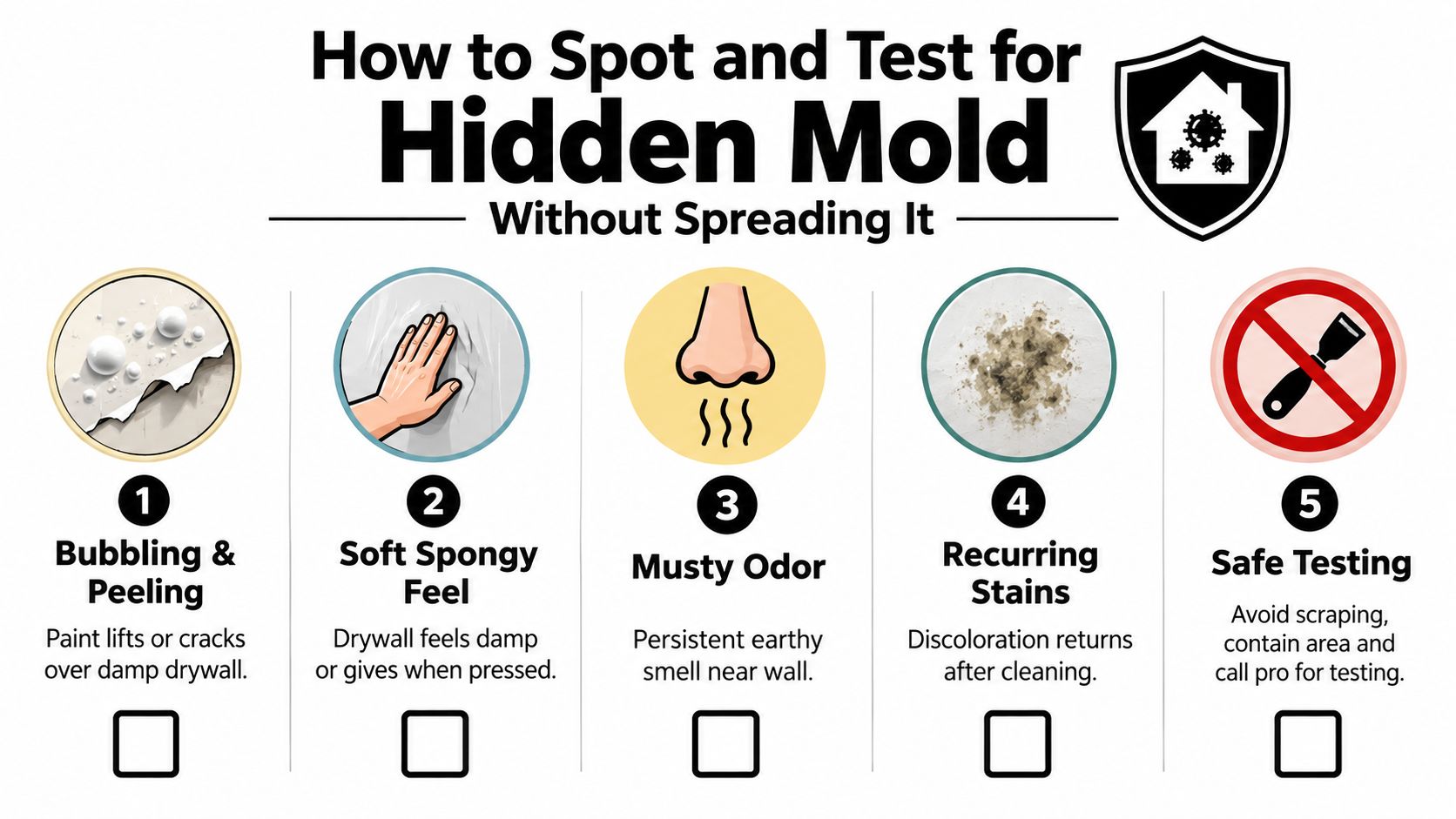
Start with the wall's behavior. Paint that bubbles, peels, cracks, or lifts from the surface may indicate that moisture has moved behind the coating. A soft or spongy feel is more concerning than a cosmetic mark because it suggests that the gypsum-paper matrix has weakened or absorbed water.
A musty or earthy odor can help identify a problem area, especially when it persists after the room has been ventilated. Staining that returns after cleaning also deserves attention. Odor and stains aren't proof by themselves, but they can help you decide where to focus a careful inspection.
Check without opening the wall
Look closely around bathrooms, kitchens, laundry areas, windows, exterior walls, baseboards, and ceiling transitions. Use a flashlight held at a low angle to reveal raised paint, uneven texture, and hairline cracking. Photograph the area with a wider room view and a close-up, then record when you noticed it and whether the mark changes after rain or appliance use.
A moisture meter can add useful information, but it doesn't tell the whole story. A pin or pinless meter may miss a small wet path, read through finishes imperfectly, or show a dry result after an earlier leak. Use readings as part of a pattern that includes wall condition, odor, location, and the suspected source.
Avoid scraping, sanding, drilling, or peeling back paint to satisfy curiosity. Disturbing porous material can release particles and spread debris into nearby areas. If you need a more focused evaluation, professional mold testing services can help determine what type of assessment is appropriate without turning a small suspect area into a larger disturbance.
Know when to pause
Stop your inspection if the wall feels soft, the affected area extends beyond a small patch, the odor is strong, or multiple locations show similar signs. Also pause if you suspect contamination inside a wall cavity, attic, crawl space, or HVAC pathway. Hidden mold changes the work plan, and the NC State mold remediation guidance emphasizes revising the remediation approach when hidden growth is discovered.
Keep records of visible damage, moisture readings, plumbing or roof events, and any repair invoices. That documentation can help a contractor understand the sequence and may be useful when discussing the loss with an insurer. Don't remove material solely to create evidence. Photograph first, preserve the area, and ask the relevant professional how to proceed.
DIY Limits Versus Professional Remediation for Painted Drywall
The clean-versus-remove decision depends on porosity, moisture status, structural condition, and contamination location. A hard, nonporous surface with a small amount of removable growth is different from paper-faced drywall with bubbling paint and a soft core.
The EPA says drywall may be dried in place when there is no obvious swelling and seams remain intact. When the board has swollen, sagged, delaminated, or lost strength, removal becomes the safer material decision. EPA mold cleanup guidance also says not to paint or caulk moldy surfaces. Clean and dry them before painting, because paint applied over moldy surfaces is likely to peel.
A practical decision matrix
| Situation | Clean in Place | Remove and Replace |
|---|---|---|
| Small area on an intact, nonporous coating, with no ongoing moisture | May be reasonable after proper cleaning and drying | Not automatically needed |
| Painted drywall with bubbling or peeling | Surface wiping won't reach the damaged paper | Usually appropriate when hidden contamination is likely |
| Wall feels soft, spongy, swollen, or structurally weak | Not a suitable DIY cleaning target | Cut out compromised material and inspect the cavity |
| Moisture source is still active or unknown | Delay finishing work and trace the source | Remove affected board when drying and inspection require access |
| Recurring staining or odor after cleaning | Treat recurrence as evidence that the cause remains | Consider removal and a broader assessment |
| Larger, hidden, or spreading contamination | Avoid disturbing the area without containment | Use trained remediation procedures and controlled removal |
This table isn't a substitute for an onsite assessment. It gives you a way to avoid the common mistake of treating every dark mark as either harmless dirt or a reason to demolish an entire room.
Where professional work adds value
Professionals can establish containment, select appropriate personal protective equipment, remove affected porous materials with less disturbance, dry the cavity, and document the work. An IICRC-certified remediation team is particularly relevant when the source is unresolved, the wall is open to occupied areas, contamination is hidden, or the problem keeps returning.
Homeowners, landlords, and facility managers should also separate mold removal from the larger remediation process. This explanation of mold removal and mold remediation can help clarify why source correction, containment, cleaning, drying, and restoration may all be part of one project.
A small, isolated surface issue may fit a careful homeowner's capabilities. Painted drywall with hidden growth is less forgiving because the paper and gypsum can retain contamination beyond the visible stain. When you can't confidently verify the material's condition, stopping before disturbance is often the more responsible choice.
Safe Repair Sequence and Why Painting Over Mold Fails
A lasting repair follows the moisture path in the right order. If you skip source control or drying, a new finish can hide the evidence while the wall continues to deteriorate.
Follow the sequence
- Stop the water source. Repair the roof, window, plumbing connection, appliance line, condensation path, or drainage issue before treating the wall.
- Assess the drywall. Check for swelling, soft areas, delaminated paper, sagging, and seams that no longer hold their shape. These conditions affect whether the board can stay in place.
- Contain the work area when needed. Limit unnecessary movement through the room, protect nearby contents, and use appropriate protective equipment for the task.
- Remove affected drywall when hidden growth or structural damage is likely. Cut-out decisions should follow the contamination and material condition, not the size of the visible stain alone.
- Inspect and dry the cavity. Check framing, insulation, plumbing, and the backside of surrounding materials. Air movement and dehumidification may be needed before reconstruction.
- Clean suitable remaining surfaces. Cleaning is more reliable after the source has stopped and the assembly has dried. Porous materials that can't be cleaned completely may need removal.
- Prime and repaint only after drying and preparation. The replacement or retained surface should be stable, clean, dry, and ready to accept the finish system.
Why coatings aren't remediation
Paint and caulk can cover a mark, but they don't remove active contamination or correct trapped moisture. The EPA specifically warns against painting or caulking moldy surfaces, noting that paint is likely to peel when applied over moldy material.
A coating may also make future inspection harder. If the wall stays damp, the new film can fail again through bubbling, cracking, odor, or discoloration. If the paper-facing has already been colonized, the finish coat doesn't change the porous material beneath it.
An antimicrobial treatment may be one component of a broader plan, but it shouldn't replace source correction, removal decisions, or structural drying. Learn more about the role of antimicrobial treatment in a repair plan, then confirm that the wall's moisture condition has been addressed before any finishing work begins.
For Phoenix homes, verify drying around air-conditioning lines, exterior walls, roof penetrations, and monsoon-exposed openings. A wall that feels dry at the surface may still require a cavity inspection when the damage pattern, odor, or material condition suggests hidden moisture.
Preventing Recurrence and Restoring Peace of Mind in Phoenix
Mold prevention starts with moisture management, not a stronger paint product. Promptly repair plumbing and roof leaks, keep bathroom and kitchen ventilation operating, maintain air-conditioning condensate drainage, and watch cold pipes or cooled wall areas for condensation.
Before monsoon weather, inspect roof edges, window seals, stucco cracks, exterior penetrations, and drainage paths. After a significant storm, check ceilings, upper corners, window returns, and baseboards for new staining or soft spots. Small clues are easier to investigate before paint failure exposes a larger area.
Choose the right response
Monitor a stable, dry-looking mark only when its history is understood and no warning signs are developing. Act promptly when staining returns, odor persists, moisture readings suggest a pattern, or the drywall changes texture. Request an inspection when the source is hidden, the material is soft, the affected area is more than minor, or occupants need the work area contained.
A local restoration company may coordinate assessment, water mitigation, structural drying, sanitation, and communication with an insurer. Restore Heroes is a licensed, bonded, insured, IICRC-certified Phoenix-area restoration company that offers mold inspection and mold removal services, including work involving hidden mold behind drywall and contaminated drywall removal. No inspection can promise a particular outcome, coverage decision, or price, so ask for a clear scope of work before authorizing repairs.
The calmest next step is usually the most useful one. Photograph the area, identify nearby water sources, avoid disturbing the paint, and arrange an evaluation if the evidence points beyond a simple surface mark.
If bubbling paint, recurring stains, or a musty odor suggests mold under paint on drywall, Restore Heroes can assess the affected area, investigate moisture, and coordinate drying or drywall removal when appropriate. Visit the site to request an inspection for your Phoenix-area home or property.