
You woke up to a wet floor in Reno, and the first question isn't how to dry it. It's where the water came from, and who you should call before anyone cuts into a wall.
Maybe a supply line under the sink let go overnight. Maybe meltwater from a warm rain ran down the street and in at the garage. Those two losses look similar on the carpet, and they are handled in different ways. Tear-out before photos, or a call to the wrong office, can slow a claim and leave the same path open for the next storm.
This guide separates the water source from the cleanup decision. You'll see who usually responds, what to document in the first hours, how policies often treat each cause, and when drying has to move faster than a weekend project.
Where Reno Water Damage Comes From
River and tributary flooding is the Reno water damage source with the longest public record, but it isn't the only way water gets in. Homes also take on rain-on-snow runoff, a burst pipe or appliance leak, a sewer or drain backup, or roof and surface runoff. None of these is always the culprit.
The Truckee River, Steamboat Creek, and Dry Creek can overflow, and flooding here repeats rather than arriving once in a lifetime. The National Weather Service identifies December 18–25, 1955, as the largest flood recorded in Reno, with Truckee River flow of 20,800 cubic feet per second and floodwaters covering nearly 100,000 acres. Reno-Tahoe International Airport was inundated to about 4 feet, and air traffic stopped from December 23 through December 26.
A winter storm can stack rain on snowpack in a single day. NOAA documented nearly 7 inches of rain in Reno during the 24-hour period ending January 1, 1997, and the Truckee River crested on January 2. A street that looked dry in the morning can become the path into a garage by evening. An indoor failure, such as a cracked supply line, is a different call than river water. Some owners start with a water damage response checklist so they don't treat every wet room the same way.
Who usually responds
| Water Source | Typical Reno Trigger | Usually Handled By |
|---|---|---|
| River or tributary flooding | Truckee River, Steamboat Creek or Dry Creek overflow | County or city emergency services, plus your insurer for property loss |
| Rain-on-snow runoff | Warm rain melting snowpack, as in the January 1997 flood | Local agencies for public flooding, your insurer for the home |
| Burst pipe or appliance leak | Indoor failures, including freeze-related pipe breaks in winter | You, your insurer and a restoration contractor |
| Sewer or drain backup | Blocked lines pushing water into lower levels | Utility or city drainage for the main line, plus your insurer |
| Roof or surface runoff | Storm water entering through the roof or ground-level openings | Homeowner for repairs; insurer decision depends on the cause |
Practical rule: Name the source before you authorize tear-out. The source decides who you call, what you photograph, and how the claim is sorted.
First Steps to Limit Loss in the First Hours
Safety comes before towels. The Centers for Disease Control and Prevention says to shut off electrical power and gas when water has entered a home, and to have an electrician disconnect the main if you would have to stand in water to reach it. Wet circuits, appliances, and tools should stay off. Don't use electrical equipment while standing in water. Wear rubber boots and plastic gloves, wash your hands, and clean hard surfaces with soap and water. For disinfection on those hard surfaces, the CDC specifies 1 cup of bleach in 1 gallon of water. Sewage, other contamination, or live electrical hazards call for qualified professionals, not a household mop.
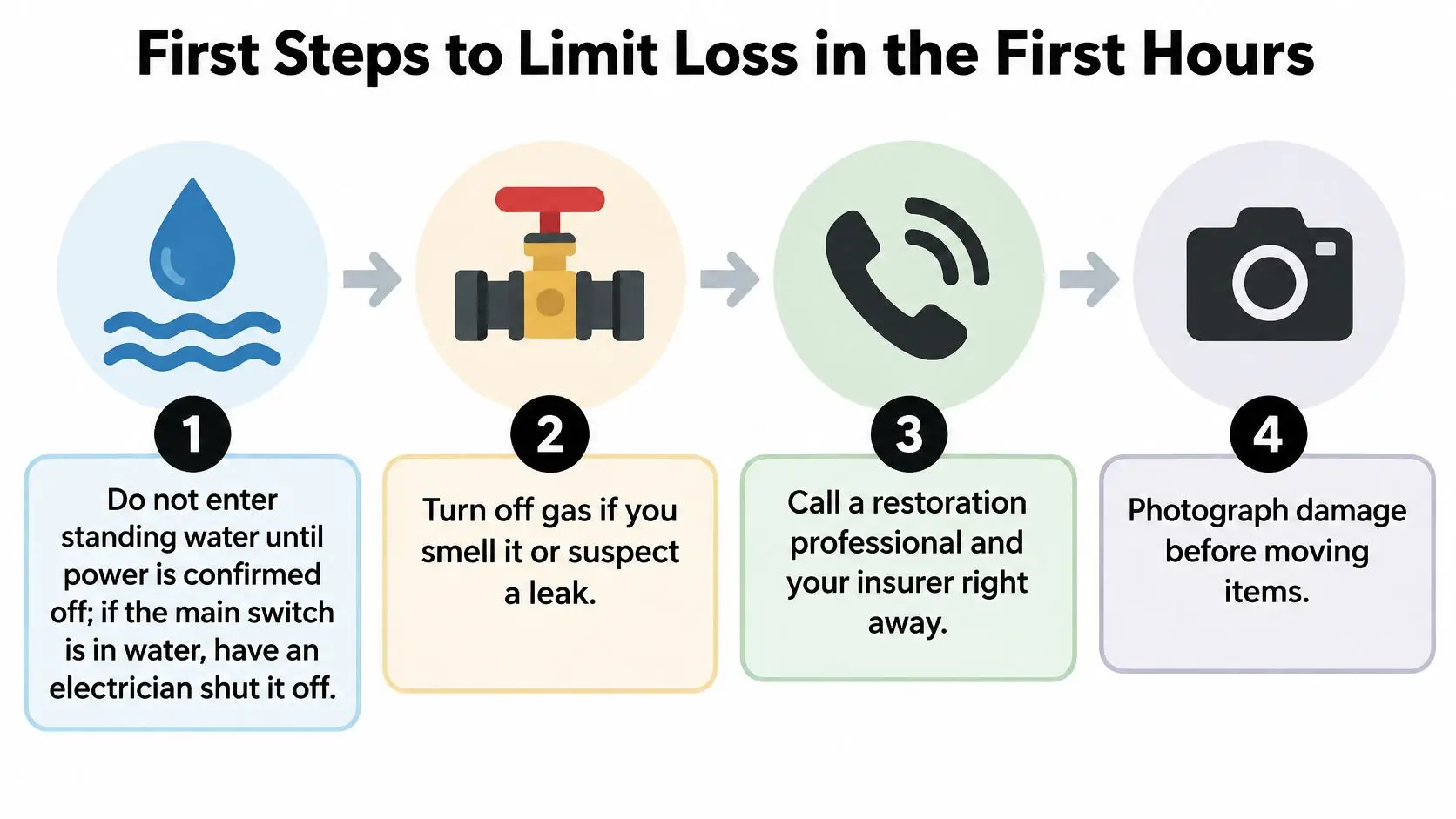
The order that limits the loss
- Stay out until power is confirmed off. If the main switch sits in water, an electrician shuts it off. The common mistake is wading in to "just grab the laptop" while outlets are still live.
- Turn off gas if you smell it, or if water reached a gas appliance. Gas and standing water don't belong in the same room. Don't hunt for the smell with a lighter or a plugged-in fan.
- Put on rubber boots and plastic gloves, and keep tools out of the water. A shop vacuum on a wet floor is a shock risk, not a shortcut.
- Stop the source when it's safe. For a burst pipe, close the main water valve. If you don't know where that valve is, use this guide to find the emergency water shut-off before the next leak, not while you're standing in it.
- Photograph and video everything before you move items. Capture the water line, the failed part, and how the room looked before the loss. Starting cleanup first is the mistake that leaves an insurer with no before picture.
- Move valuables to a dry room, then remove standing water once power and contamination risks are handled. Don't drag wet boxes across clean carpet and spread the loss.
- Call your insurer and a restoration company, and keep every receipt for pumps, fans, and emergency lodging. A receipt you can't find later is the same as a cost you paid twice.
If the ceiling is the entry point, a temporary cover can limit what keeps coming in while you wait for a roofer. JA Edwards of America Roofing tarping advice walks through a short-term roof cover so rain doesn't keep feeding the same wet cavity.
A short walkthrough of the first safety checks is easier to follow on video than from memory while the floor is wet.
Bleach mix is for hard surfaces after the power is off and the water category is known. It isn't a fix for sewage, and it isn't a reason to plug in a light while you're standing in the puddle.
Insurance Coverage by Water Source
Policies sort water by cause, not by how upset the room looks. Allstate's home-insurance overview describes the usual split. Sudden, accidental damage, such as a burst pipe or a ruptured appliance, may fall under dwelling or personal-property coverage, subject to the deductible, exclusions, and limits. Flood from storms, overflowing or surging water, or saturated ground is generally excluded from standard homeowners policies. Sewer or drain backup may need an optional endorsement. FEMA warns that many owners learn too late that ordinary homeowners insurance doesn't cover flooding. Nothing in a cleanup bid makes that work automatically covered or reimbursed.
A Reno address outside a mapped high-risk zone can still flood. Washoe County's FEMA map FAQ describes FEMA maps as tools for land-use planning and building decisions. Newly designated homeowners aren't automatically required to modify homes unless substantial improvements or new construction trigger requirements. Map status, a mortgage rule, a policy exclusion, and the physical source of the water are separate questions. A map is a planning tool, not a promise that water will or won't enter.
What each cause usually means
| Cause | Typical Standard Policy Treatment | Document First |
|---|---|---|
| Burst pipe or ruptured appliance | Often falls under dwelling or personal-property coverage, subject to deductible and exclusions | Failed part, photos, plumber or repair invoice |
| Sewer or drain backup | May require an optional endorsement | Photos of affected rooms, drain location, invoices |
| Storm flooding or overflowing river | Generally excluded from standard homeowners policies | Water-line photos, storm date, flood-zone status |
| Saturated ground seeping in | Generally excluded from standard homeowners policies | Entry-point photos, moisture readings |
| Wind-driven rain through roof | Often reviewed as sudden storm damage if wind opened the roof, subject to exclusions and limits | Roof photos, storm date, repair estimate |
Save the failed part, moisture readings, invoices, photographs, and any pre-loss photos before demolition. Once the wall is open, that evidence is gone.
Confirm coverage with your insurer before you authorize large repairs. A deeper look at whether insurance covers water damage helps you match the cause to the questions an adjuster will ask. Don't treat a contractor's schedule as proof that a policy will pay.
Drying Window and Mold Prevention
Speed matters, and so does proof that materials are dry at depth. The U.S. Environmental Protection Agency recommends drying wet or damp materials within 24–48 hours, because mold growth is often prevented in that window. That period is a guideline, not a guarantee. Mold may still develop, and materials wet longer than 48 hours need a fuller evaluation. If the water may contain sewage or other biological or chemical contaminants, ordinary clean-water steps aren't enough. The EPA calls for protective equipment, containment, and experienced professional handling.
Separate EPA guidance sets the humidity line. Keep indoor relative humidity below 60%, and aim for about 30–50% when you can, as the EPA mold and moisture directory describes. Remove bulk water, run fans and dehumidifiers, and open doors or windows only when outdoor air is drier than the room. Hard surfaces can generally be cleaned with mild detergent and water. Absorbent materials that stay wet, or that you can't fully clean, may need to be discarded.
How to check progress
Take moisture-meter readings at the wet spot and at a dry control spot in the same room. Look under flooring and inside wall cavities. A floor can look dry while the subfloor is still wet. Log every reading with the date, the location, and the meter setting.
- Remove bulk water so materials aren't sitting in a pond.
- Start air movement and dehumidification sized to the wet area, not to how the room looks.
- Log readings each day so you can see a downward trend.
- Remove porous materials that won't dry or that stayed contaminated. Carpet backing needs extraction, lower humidity, and airflow, and you still check the subfloor. Wood needs dehumidifiers and fans. Use heat only with caution so you don't drive moisture deeper or crack finishes.
| Measure | Target or Window | Notes |
|---|---|---|
| Indoor relative humidity | Below 60% | Aim for 30–50% when possible |
| Wet or damp materials | Dry within 24–48 hours | Longer wet time needs fuller evaluation |
| Carpet with backing | Extract water, reduce humidity, add air movement | Check the subfloor for hidden moisture |
| Wood framing or subfloor | Prompt drying with dehumidifiers and fans | Use heat only with caution |
| Hard surfaces | Clean with mild detergent and water | Replace porous materials that stay wet |
Cleaning visible growth without fixing the leak, drying concealed cavities, and holding humidity in range leaves the condition in place. Pull a baseboard or look under a sink cabinet before you call a room finished. Rugs follow the same clock. The 24–48 hour rug drying window is a useful reminder that a pad can stay wet after the face of the rug feels fine. After a larger event, these steps to prevent mold after a flood keep the checks in order.
Each day, record one humidity reading, note any musty smell, look for new staining, and write down dampness that returns after the equipment cycles off. Drying is on track when readings trend down and materials feel dry at depth, not only on the surface. Judge the trend. Don't promise yourself a fixed calendar day when every room will be done.
Reno Risks and Ways to Reduce Them
Public water and private water meet at the property line, and that line decides the phone call. The City of Reno Flood and Drainage Section manages public drainage systems. Washoe County identifies the Truckee River and tributaries, including Steamboat Creek and Dry Creek, as concentrated flood-risk areas. The county also tells residents to keep roadside ditches and pipes clear of debris and points people to sandbag resources. You maintain the pipes, ditches, and downspouts on your own lot. A blocked public inlet goes to the city or the county, not only to a drying crew.
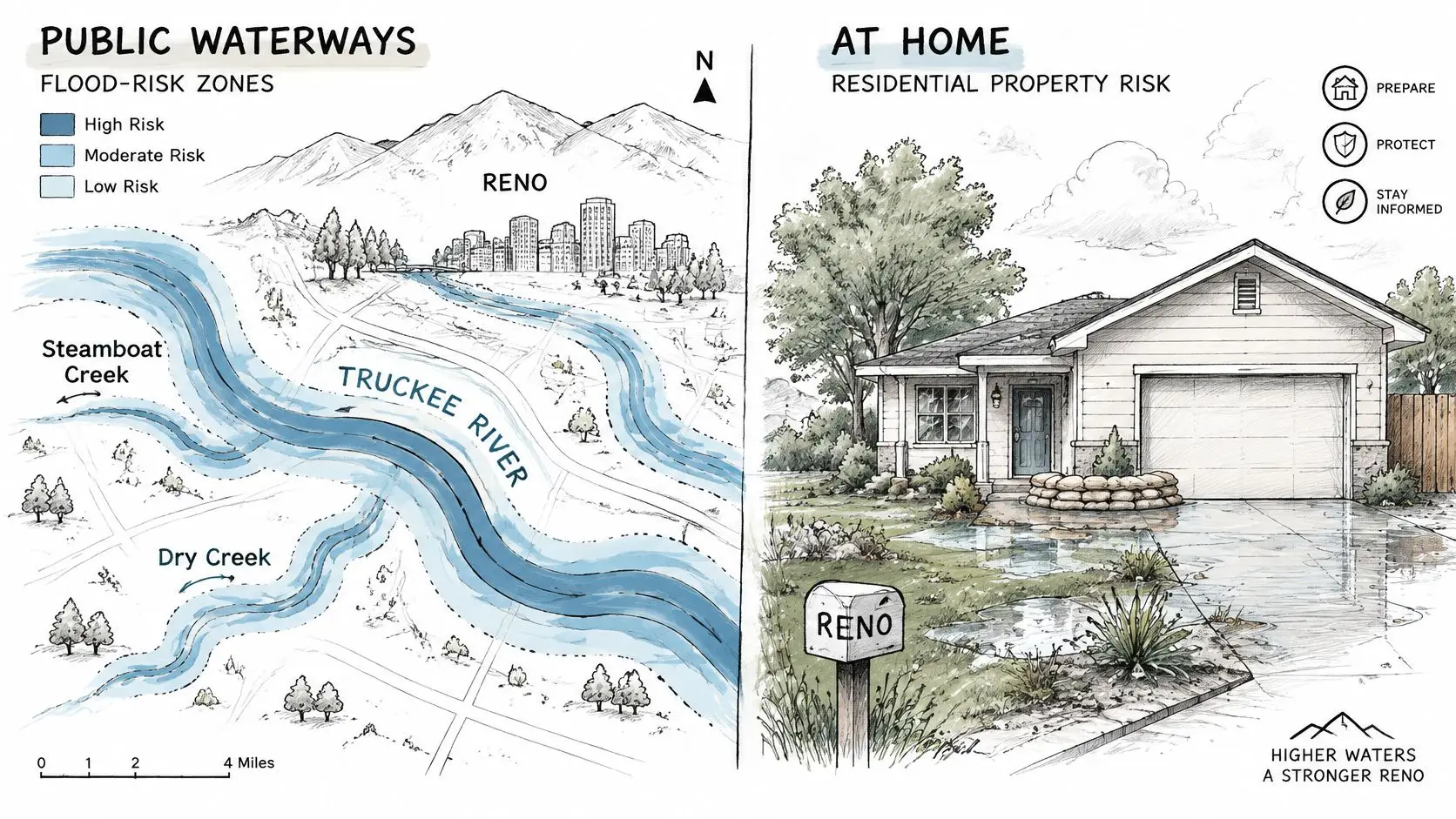
Flood exposure isn't frozen at last year's map. As of 2024, First Street projected that about 7,735 Reno properties, or 9% of the city's properties, could face flood risk within 30 years. Fast extraction doesn't stop a repeat loss if an upstream drainage defect is still there. Pumps empty a room. They don't regrade a swale or clear a public culvert.
Checks that belong on the calendar
- Clean gutters and downspouts so roof water leaves the house instead of spilling at the foundation. SuperiorPRO on effective gutter systems explains why a clogged run sends that water back toward the wall.
- Grade soil away from the foundation so snowmelt doesn't sit against the concrete.
- Check roof flashing after storms and seal openings while they're still small.
- Photograph drainage paths before winter snow so you can later show what was blocked or altered.
- Insulate exposed pipes before a hard freeze, and know where the main shutoff is, so a split line doesn't run all night.
Do these checks each autumn and again after a major storm. Freeze-thaw cycles and rain-on-snow can turn a small opening into a large loss.
Decide When to Call Certified Restoration Help
Call for certified help when you have standing water, an electrical hazard, sewage or other contaminated water, damage that is still wet after the first day, or visible growth and a musty odor. Those aren't do-it-yourself leftovers. They need containment, meters, and a written plan.
Our IICRC-certified professionals assess the extent of the damage, develop a customized restoration plan, and make sure all moisture is properly removed. Restore Heroes is IICRC certified, licensed, bonded, and insured. We offer a free onsite estimate and a free inspection, available 24/7 by using our contact form or by calling 480-690-5277. You can read what IICRC-certified restoration means before you compare any written scope with a verbal promise about timing or price. We help homeowners throughout the greater Phoenix area and Rim Country, so confirm that the crew you hire serves the loss address.
Before you sign, ask these questions. Are the technicians certified, and by which program? Is the company licensed for this work where the property sits, and is it insured? Will moisture readings and drying progress be recorded in writing? How will the company coordinate with your insurer, and what do they need from you before large work begins?
- Photograph the damage.
- Call your insurer and report the loss.
- Request a licensed inspection and a written scope.
- Keep receipts for emergency measures.
If you're sorting a wet room and you need a clear plan before walls come down, Restore Heroes can assess the loss, dry what can be saved, and document moisture so you aren't guessing. We handle water damage from flooding, burst pipes, appliance leaks, and severe storms, and we coordinate the work with your insurer. Visit Restore Heroes to request a free inspection and talk through the next step for your property.