
Water on the floor changes the mood of a house fast. One minute you're starting the day. The next, you're staring at a warped baseboard, a wet hallway, or a ceiling stain that wasn't there last night.
If you're in Phoenix, that moment can come from more than one direction. A burst supply line under a sink. A failed water heater in the garage. A washing machine hose that lets go while you're at work. During monsoon season, it can also be storm-driven water that finds a way in where your home usually feels safe.
Panic is normal. So is confusion. Most homeowners don't deal with this often enough to know what happens next.
The good news is that residential water restoration follows a clear process. It's not guesswork, and it's not just "drying things out." It's a methodical response built around safety, stopping further damage, removing water, drying the structure, and verifying that hidden moisture is gone before repairs begin.
Your Guide to Navigating a Water Damage Emergency
A common call starts like this. A homeowner wakes up before sunrise, steps onto cold tile, and realizes the floor is wet from the laundry room all the way into the hallway. The visible water is upsetting, but what really worries them is everything they can't see yet. Did the water run under the cabinets? Is it inside the wall? Can they stay in the house? Should they call a plumber first, insurance first, or a restoration company first?
Those are the right questions.
Water damage isn't some unusual, one-off event. About 1 in 60 insured homes files a water-damage-or-freezing claim each year, and water damage is estimated to account for nearly 24% of all homeowners insurance claims according to industry water damage claim statistics. That matters because it means you're not overreacting. This is a common homeowner problem, and it needs an organized response.
In Phoenix homes, I often tell people to think in two tracks at once. First, stop the cause if you safely can. Second, assume the water traveled farther than it looks. Tile may look fine while moisture slips under baseboards, under floating floors, or into drywall.
Practical rule: If water touched building materials for more than a short moment, treat it like a structural drying problem, not a mopping problem.
If you're trying to understand whether the situation calls for immediate mitigation, this overview of emergency water damage response in Phoenix helps frame what an urgent loss looks like. And if the cause appears to be plumbing-related, it's also worth reviewing expert plumbing for water damage so you can distinguish between the source repair and the restoration work that follows.
Why homeowners get tripped up
The biggest misunderstanding is simple. People see the visible water as the whole problem.
It isn't. Wet carpet padding, damp drywall, swollen trim, and trapped moisture beneath flooring often cause more trouble than the puddle you started with. A calm first response doesn't mean doing everything yourself. It means making the right decisions early, in the right order.
What to Do Immediately After Discovering Water Damage
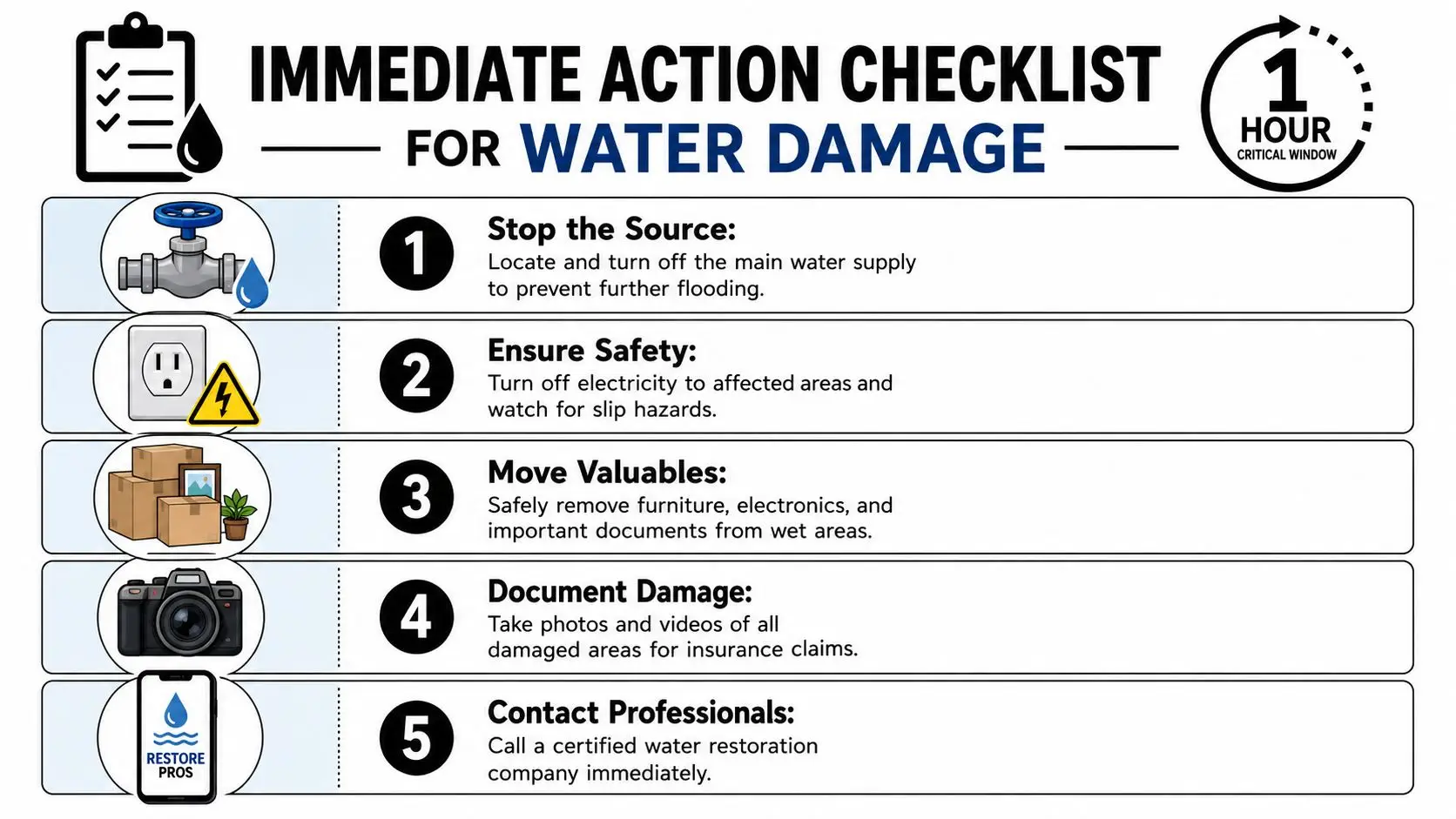
In the first hour, your job isn't restoration. Your job is triage.
The first 24 hours are a triage window. Homeowners should stop the source, kill power where needed, document damage for insurance, remove valuables only if the area is safe, and avoid DIY drying if contamination may be involved, as outlined in this water damage emergency guidance.
First protect people, then property
Don't start by grabbing towels. Start by asking whether the area is safe to enter.
- Shut off the water source if you can identify it safely. That may mean a local fixture valve or the home's main shutoff.
- Turn off electricity to affected areas if water is near outlets, cords, appliances, or baseboard-level wiring. If you can't do that safely, stay out and wait for qualified help.
- Watch your footing. Wet tile, laminate, and polished concrete get slick fast.
Phoenix homeowners sometimes lose time because the floor surface looks manageable. But a small appliance leak can spread farther than expected, especially in open-plan homes where water follows grout lines, slab transitions, and low spots.
What you should do while help is on the way
Once the area is safe, take steps that help both the cleanup and any future claim.
- Photograph everything: Get wide shots and close-ups of wet materials, damaged belongings, and where the water came from.
- Move valuables carefully: Pick up electronics, papers, rugs, and small furniture only if you can do it without stepping into a hazard.
- Separate wet from dry items: This keeps damage from spreading to unaffected belongings.
- Call a qualified mitigation company: If you need a local overview of the service itself, this page on water damage mitigation in Phoenix explains what emergency mitigation crews do after arrival.
If you have to choose between cleaning up and documenting, document first.
What not to do
Some mistakes make a bad situation harder to fix.
- Don't use a household vacuum for standing water: It's not built for that kind of loss.
- Don't assume fans solve everything: Moving air without a drying plan can miss hidden moisture. If the water may be contaminated, it can also spread the problem.
- Don't pull up materials too early: Wet hardwood, baseboards, or trim should be assessed before you start tearing things apart. If your home has wood flooring, these Buff & Coat Hardwood Refinishing tips can help you understand what may be salvageable and what signs point to deeper damage.
The goal isn't perfection. It's preventing further loss while setting up a proper restoration response.
Understanding the Types and Causes of Water Damage
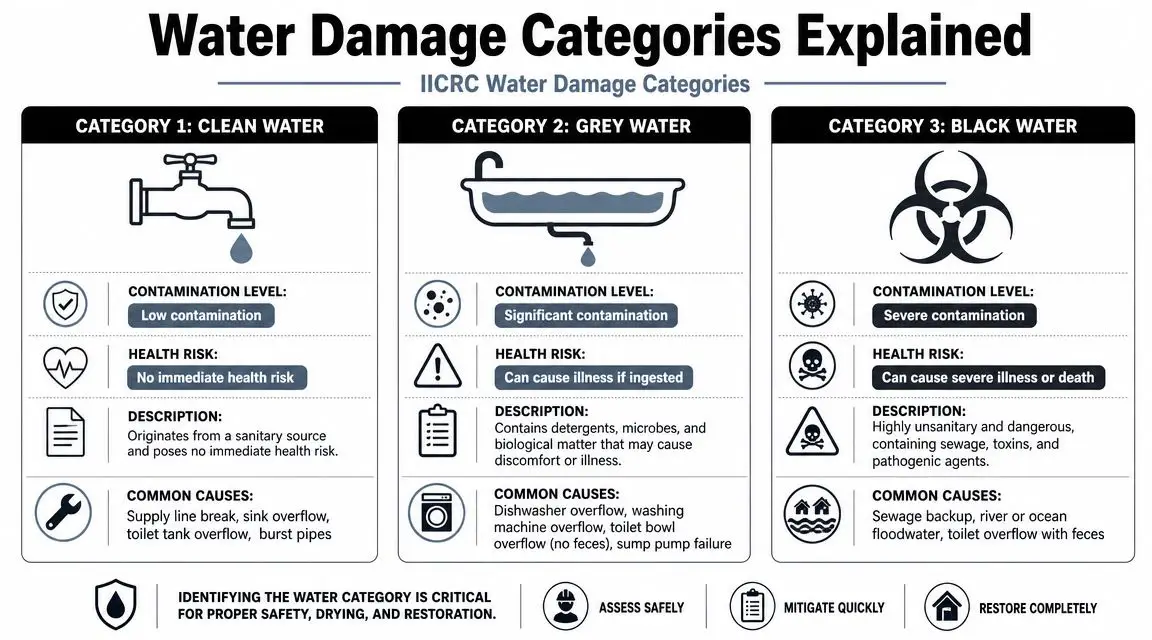
Not all water damage is the same. Homeowners hear terms like clean water, gray water, and black water, but they aren't told what those labels mean in practical terms.
The simplest way to think about it is a traffic light.
Green means cleaner source
Category 1, often called clean water, starts from a sanitary source. A broken supply line under a sink, an overflowing toilet tank, or a refrigerator line leak usually begins here.
That doesn't mean you should ignore it. Clean water can soak insulation, drywall, and wood very quickly. If it sits, its condition can worsen as it passes through building materials.
Yellow means caution
Category 2, or gray water, contains a meaningful level of contamination. Think dishwasher discharge, washing machine overflow, or water that has moved through dirty surfaces and can no longer be treated as sanitary.
Homeowners often make the wrong call by trying to dry it themselves. The issue isn't just moisture anymore. It's exposure risk and proper cleaning.
Surface appearance doesn't tell you the water category. The source does.
Red means stay out and call professionals
Category 3, or black water, is heavily contaminated. Sewage backups and outdoor floodwater fall in this category. This water can carry pathogens and shouldn't be handled like a routine cleanup.
If your loss involves sewage or clearly contaminated water, a dedicated Category 3 water damage response is the right level of service to look for.
Common causes in Phoenix homes
The source often hints at both urgency and scope. Here are typical residential causes:
| Cause | Likely starting category | Why it matters |
|---|---|---|
| Burst supply line | Category 1 | Often spreads fast through walls and flooring |
| Water heater leak | Category 1 | Can affect adjacent rooms before it's noticed |
| Washing machine overflow | Category 2 in many cases | Water may contain detergents and soil load |
| Toilet overflow with waste | Category 3 | Requires contamination control, not simple drying |
| Monsoon flood intrusion | Category 3 | Outdoor floodwater should be treated as unsafe |
The category affects protective gear, material removal decisions, cleaning methods, and whether parts of the home are safe to occupy. That's why a professional assessment matters early, especially when the source isn't obvious.
The Professional Water Restoration Process Explained
At 9 p.m., a Phoenix homeowner can walk into a room with soaked baseboards, a damp smell, and floors that already feel dry on top. That mix is confusing, especially in our climate. Heat can dry the surface fast while moisture stays trapped inside drywall, under flooring, or behind cabinets. The first 48 hours matter because the wrong decision during cleanup can leave hidden damage behind.
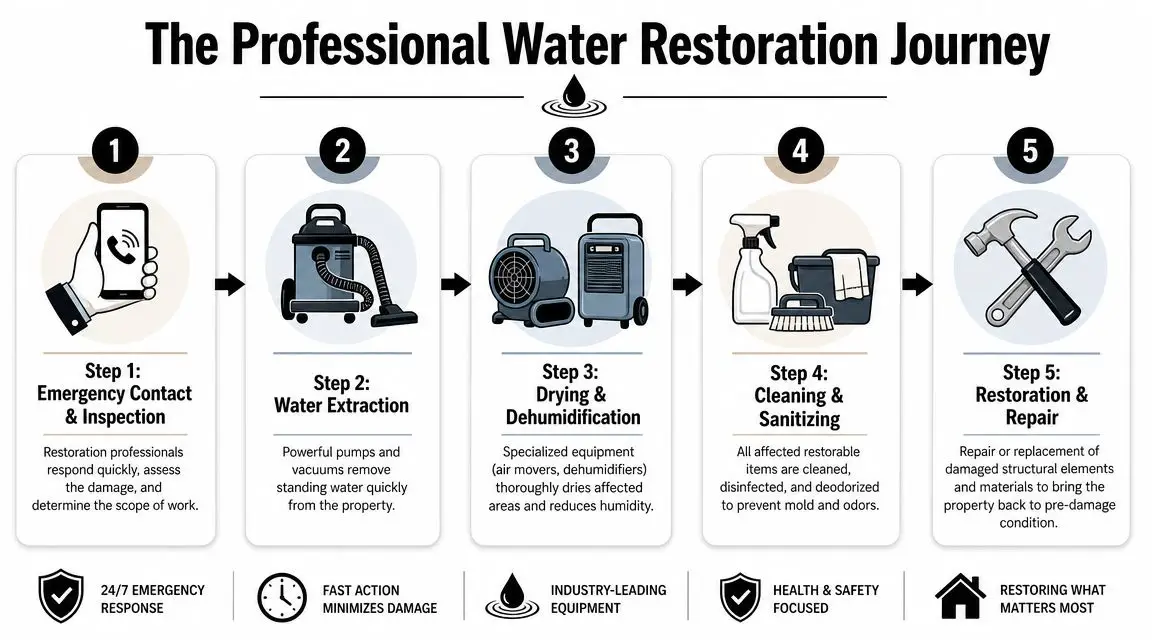
Once the source is stopped and the area is safe to enter, professional residential water restoration follows a measured process. It helps to view it like medical triage for a house. The goal is not just to remove water you can see. The goal is to find where water traveled, dry the structure to acceptable levels, clean affected materials, and confirm the home is ready for repair.
This visual gives the big picture first.
Inspection comes before major decisions
A proper job starts with inspection and moisture mapping. Technicians check the source, the rooms affected, and how far water migrated beyond the obvious wet area. They use moisture meters and often infrared thermal cameras to identify moisture that a homeowner cannot spot from surface appearance alone.
That matters because materials often dry unevenly. Tile may look normal while the underlayment stays wet. Drywall can feel firm while insulation behind it is still holding moisture. For homeowners comparing providers, a Phoenix water restoration company should be able to explain how it measures moisture, what drying goals it sets, and how it decides whether materials can stay or need removal.
Extraction removes standing water. Drying removes what soaked in.
These are related steps, but they are not the same job.
Extraction removes the bulk water load with pumps, weighted tools, wet vacuums, or truck-mounted equipment. That quick removal lowers the amount of water the structure has to release into the air. It also reduces swelling, staining, and the spread into nearby rooms.
Drying starts after that. Industry guidance from the IICRC explains that successful structural drying depends on controlling air movement, humidity, and temperature so wet materials release moisture in a controlled way, as outlined in the ANSI/IICRC S500 Standard and Reference Guide for Professional Water Damage Restoration. In plain language, crews are creating conditions that let the home dry from the inside out, not just from the top down.
Visible water can disappear long before the structure is actually dry.
Restore Heroes provides emergency extraction and structural drying for Phoenix homes. That kind of service is often needed after monsoon intrusion, slab leaks, appliance overflows, or supply line breaks, especially when moisture has moved into wall cavities or under hard-surface flooring.
To see these stages in action, this short video helps make the sequence easier to picture.
Drying, cleaning, and repair happen in order
Homeowners are often surprised that equipment may stay in place for several days. In Phoenix, that can feel excessive because the air is hot and surfaces can seem dry quickly. But a dry surface does not confirm that wood framing, subfloors, insulation, or cabinet toe-kicks have reached acceptable moisture levels.
A typical professional workflow looks like this:
- Moisture detection: Technicians identify affected structural materials and set drying targets.
- Water removal: Extraction tools remove standing water and reduce the immediate load.
- Selective demolition where necessary: Baseboards, drywall cuts, insulation, or damaged flooring may be removed to open hidden cavities for drying.
- Air movement and dehumidification: Equipment runs continuously while technicians monitor moisture readings and adjust placement as conditions change.
- Cleaning and sanitation: Restorable materials are cleaned based on the water category and residue left behind.
- Repair and rebuild: Drywall, trim, flooring, or cabinetry work begins only after drying is confirmed.
That order protects the house. Rebuilding too early is like painting over wet wood. It may look finished for the moment, but the trapped moisture can lead to odor, warping, or microbial growth later.
Why the process feels methodical
Water restoration is applied building science. Good crews do not guess. They document readings, check progress, and change the drying plan if a wall, floor assembly, or cabinet bank is drying slower than expected.
That careful approach is especially important in Phoenix during monsoon season, when storm water can bring contamination into the home, and during hot months when quick surface evaporation can hide deeper moisture. In the first 48 hours, homeowners do not need to master the equipment. They do need to know what questions to ask. What is still wet? How are you measuring it? What has to be removed, and why? When will you confirm drying is complete?
The best restoration teams can answer those questions clearly, with measurements instead of guesses.
Navigating Insurance Claims and Restoration Costs
Most homeowners are dealing with two problems at once after a water loss. The house is disrupted, and the paperwork starts immediately.
That second part can feel almost as stressful as the damage itself.
Start with the cause and the documentation
Insurance usually looks closely at what caused the loss. In plain language, a peril is the event that caused the damage. A sudden pipe break is one kind of peril. A long-term neglected leak may be treated very differently.
A deductible is the amount you pay before covered insurance benefits begin. Your policy sets that amount. Your restoration contractor doesn't decide it.
What you can control right away is documentation.
- Take photos and videos early: Include the source, affected rooms, and damaged belongings.
- Make a simple room-by-room list: Note flooring, drywall, trim, furniture, and personal items that were affected.
- Keep communication organized: Save claim numbers, adjuster names, emails, and invoices in one folder.
- Ask for drying records: Professional moisture logs and job photos can support the file.
If you want a homeowner-focused overview before making those calls, these water damage insurance claim tips for Arizona property owners can help you prepare your questions.
Know where your contractor fits in
A restoration company handles emergency mitigation, drying documentation, and scope details for the damage it can observe and measure. Your insurer decides coverage based on the policy and cause of loss.
That distinction matters. A contractor can document conditions and explain needed work. They shouldn't promise claim approval, pricing outcomes, or policy coverage.
A well-documented claim is easier to understand than a rushed verbal description after the damage has already changed.
Ask better questions
When you speak with your adjuster, keep your questions practical:
- Was the reported cause of loss noted clearly?
- What documentation do you need from me versus the mitigation company?
- Are temporary protective steps expected while the claim is under review?
- Which portions of the loss are still being evaluated?
Homeowners who aren't sure whether their policy is current or broad enough for common home risks may also want to review options for secure homeowners coverage before the next emergency happens.
The key is to stay factual. Don't guess, don't exaggerate, and don't throw damaged materials away until you've confirmed what's been documented.
How to Choose a Certified Contractor in Phoenix
At 9 p.m., a supply line bursts under a bathroom sink. By morning, the tile may look dry, the hallway may feel normal, and the house may seem to have escaped the worst of it. In Phoenix, that first impression is often wrong. Heat dries the surface fast, but moisture can still be sitting inside drywall, under baseboards, and beneath flooring.
That is why contractor selection matters so much here.
Certification is your baseline
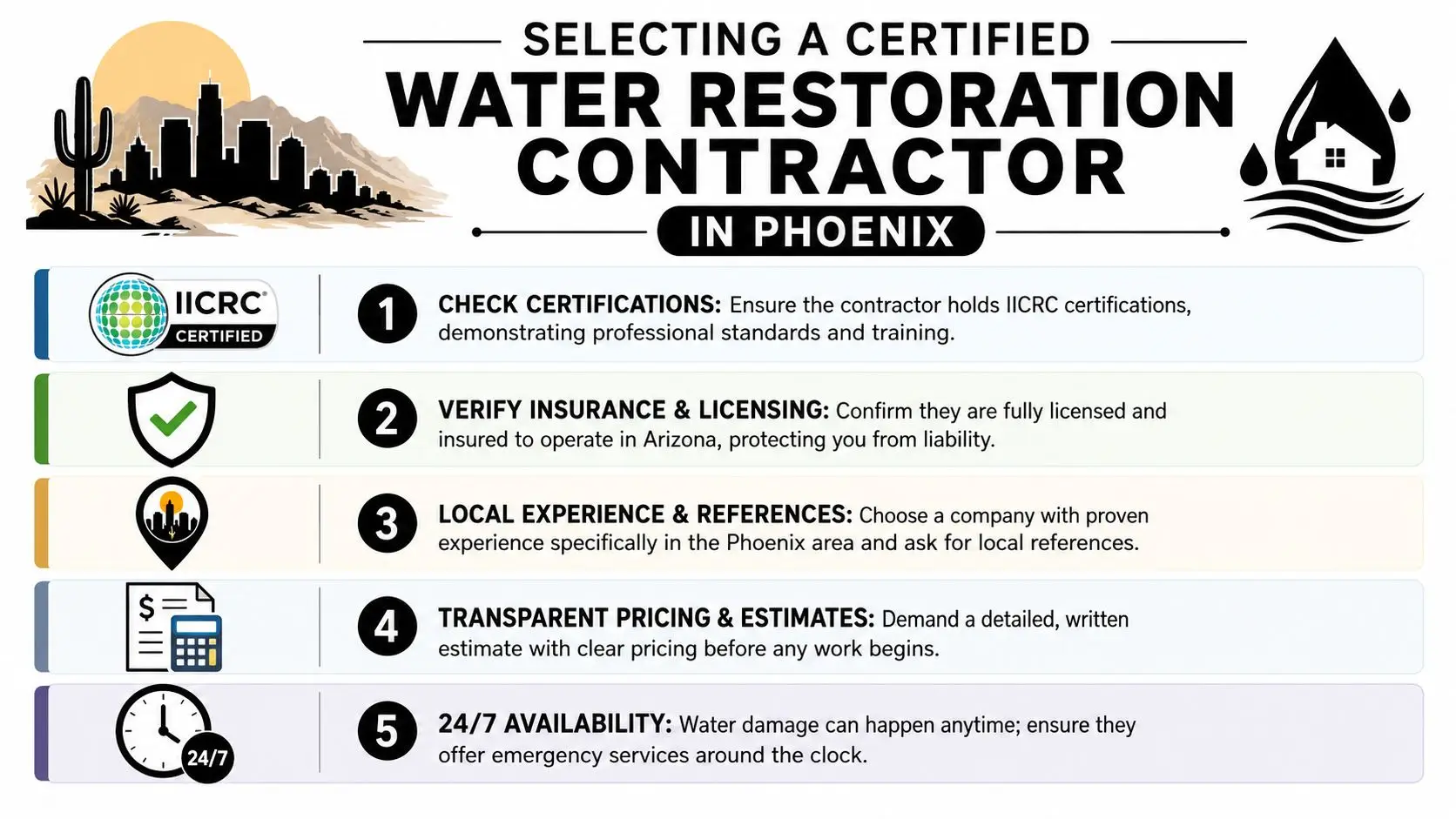
Start with IICRC certification. It shows the company has been trained in restoration standards, moisture measurement, and structural drying principles. It does not guarantee good communication or careful workmanship on its own, but it gives you a solid floor to stand on while you compare companies.
Then check the practical pieces that affect the first 48 hours:
- Arizona licensing and insurance: Ask whether the company is properly set up to work in Phoenix and carries current insurance.
- True emergency response: Water damage gets worse while you wait, especially after monsoon intrusion or overnight plumbing failures.
- Clear scope of work: You should hear a plain explanation of what the crew will do now, what may need to be removed, and what repair work happens later.
- Daily documentation: Good contractors record moisture readings, equipment use, and drying progress so you are not left guessing.
Local Phoenix experience changes the quality of the decision
Phoenix is not just another dry market. It creates a misleading drying pattern. The surface can look better before the structure is fully dry.
A contractor who understands local conditions should be ready to explain how they check for trapped moisture, not just how they extract visible water. That matters even more during monsoon season, when wind-driven rain can enter through roof edges, window assemblies, garage thresholds, and block wall transitions in ways homeowners do not always notice at first.
As noted in this guidance on hidden moisture and water damage restoration in hot climates, hot conditions can speed up surface drying while leaving moisture hidden in building materials. That is one reason Phoenix homes can develop mold problems after an owner believes the area has already dried.
Ask direct questions:
| Ask this | Why it matters |
|---|---|
| How do you confirm drying inside walls and under flooring? | Phoenix heat can make surfaces look dry before the structure is dry |
| What moisture detection tools do you use on every job? | You want measurements, not guesswork |
| Have you handled monsoon-related water intrusion in Phoenix homes? | Storm entry patterns differ from pipe leaks and appliance failures |
| Who updates me each day on readings, demolition decisions, and next steps? | Clear communication helps you make better decisions under pressure |
Look for a measured process, not a sales pitch
A qualified restoration contractor should sound calm, specific, and methodical. If a company jumps straight to tear-out without explaining moisture mapping, material conditions, or containment needs, slow the conversation down and ask for the reason behind each step.
Drying a home works like drying a sponge inside a closed box. The outside may feel fine first. The moisture you cannot see is the part that causes trouble later.
The right contractor treats visible water as the starting point, not the whole job. That changes whether wet cavities are opened at the right locations, whether equipment is sized to the space, and whether the home is checked again before repairs begin. In Phoenix, where hidden moisture can be mistaken for a problem that has already passed, that discipline protects both the structure and your timeline.
Common Questions About Residential Water Restoration
Can I clean up water damage myself
A small spill from a sink or a tipped-over appliance tray may be manageable if the water is clearly clean, the area is limited, and you can dry it fast.
The problem is that water rarely stays where you first see it. It wicks into drywall like a paper towel, slips under baseboards, and settles beneath flooring where surface fans cannot reach it. In Phoenix, that creates a false sense of safety. Dry air can make the room feel better while hidden materials are still wet.
DIY cleanup usually stops making sense when the source is unclear, the water may be contaminated, more than one room is involved, or wet materials sat long enough for odor or mold concerns to start.
How long does the process usually take
The timeline depends on three things. Where the water came from, what materials got wet, and how far the moisture spread beyond the visible area.
Some homes only need extraction and drying. Others need selective tear-out first so trapped moisture can escape. A kitchen supply-line leak and a monsoon intrusion through a wall assembly may both leave wet floors, but they dry very differently because the water entered the structure in different ways.
Homeowners often get confused at this stage because surfaces can look normal before the structure reaches a dry standard. Professional drying uses measured airflow, dehumidification, and repeat moisture checks to bring materials back toward their normal range. The Institute of Inspection Cleaning and Restoration Certification explains structural drying as a monitored process, not a matter of waiting for surfaces to feel dry, in its Applied Structural Drying overview.
Will I have to move out
Sometimes yes, sometimes no.
You may be able to stay if the affected area is contained, power remains safe, and the water was clean. You may need to leave for a short time if the loss involved contaminated water, major demolition, unsafe electrical conditions, or constant equipment noise in the main living areas.
For Phoenix families, the first 48 hours matter here too. If a monsoon event pushed water into several rooms, the decision is not only about convenience. It is about safety, air quality, and whether the home can be dried and cleaned without exposing you to hidden contaminants.
Why does the house smell musty after water damage
A musty smell usually means moisture stayed in contact with materials long enough to change them. That can mean residue in carpet backing, damp drywall paper, wet wood, or microbial growth inside a cavity.
Air fresheners only cover the signal. They do not remove the cause.
The odor source has to be found, dried, cleaned, and in some cases removed. If the smell lingers after cleanup, treat that as a warning that moisture may still be present somewhere you cannot see.
If the floor looks dry, is the job over
No. A dry-looking floor can still hold moisture below the finish layer or at the edges.
Tile, engineered wood, laminate, and cabinet toe-kick areas are common trouble spots. They work a bit like a crust on top of a damp casserole. The surface changes first, but the heat and moisture underneath take longer to clear.
That is why a proper stopping point is based on moisture readings and documented drying progress, not appearance alone.
If you're dealing with an active loss or trying to decide what to do in the first critical hours, Restore Heroes provides Phoenix-area emergency restoration services for residential water damage, including extraction, structural drying, and contamination-aware cleanup. Use them as one local option to get a professional assessment, understand the scope of damage, and make safer next-step decisions without guessing.