
When a disaster like a fire hits your home, the process of putting it back together is called water and fire restoration. It’s the work of cleaning up, repairing the structure, and getting your property back to the way it was before the incident. This isn’t just about dealing with flames and smoke; it also involves tackling the massive amounts of water used to put the fire out.
The Dual Threat of Water and Fire Damage
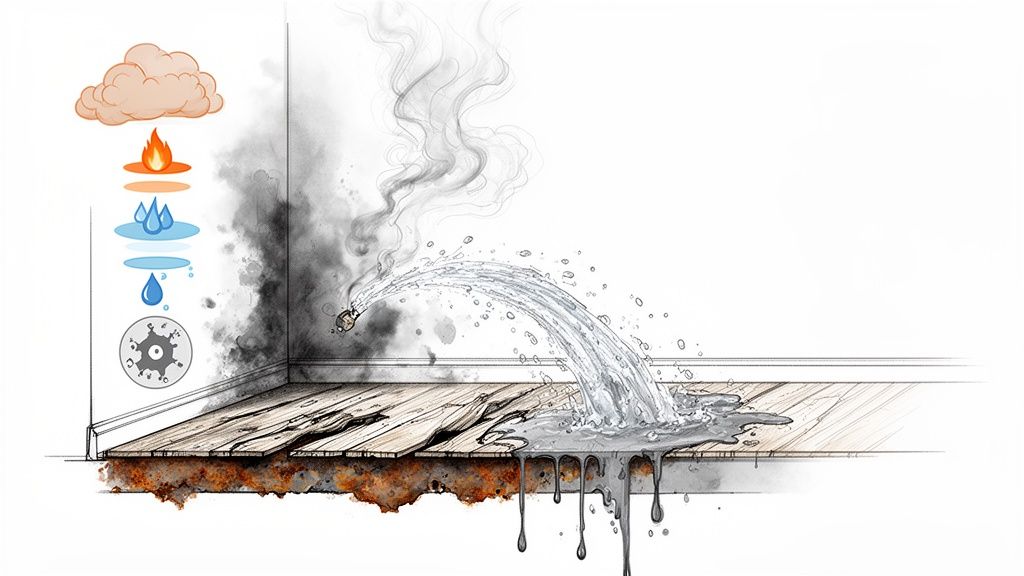
After a fire, the damage you can see is often just the beginning. The real challenge comes from two separate problems that have now become one destructive force. You have the obvious fire damage—the charring, soot, and smoke. But you also have massive water damage, not from a plumbing leak, but from the thousands of gallons of water firefighters used to save your house.
This combination creates a uniquely hazardous environment that needs immediate and expert attention.
To understand the scope of the problem, it helps to see how each type of damage creates its own issues, and how they become even worse when combined.
The Dual Threats of Water and Fire Damage
| Damage Type | Primary Problem | Secondary Problem (When Combined) |
|---|---|---|
| Fire | Charred materials, structural compromise, and pervasive smoke odor. | Soot and ash become mobile, spreading and staining everything. |
| Water | Saturated drywall, flooring, and insulation, leading to swelling and warping. | Activates soot to form a corrosive acid; creates the perfect environment for mold. |
As you can see, the situation is much more complex than dealing with just a fire or just a flood. The two problems feed off each other, accelerating the damage.
A Corrosive Combination
The real trouble starts when the water from the firehoses mixes with all that soot and smoke residue. This creates a toxic, acidic slurry that’s far more destructive than either water or soot on its own. It’s a chemical cocktail that immediately goes to work on your home.
This acidic mixture begins tarnishing metal, etching glass, and deeply staining anything porous like drywall, wood, and upholstery. Within just a few hours, it can cause permanent damage. Belongings that might have been salvageable after the fire can be quickly ruined by these chemical reactions. This is exactly why a rapid response is crucial for any hope of successful water and fire restoration.
Key Insight: The water used to fight a fire is a double-edged sword. While it saves the structure from total loss, it also becomes a vehicle, carrying acidic soot deep into porous materials and kicking off a second wave of damage.
More Than Just a Cleaning Job
Getting a property back in shape after a fire and water event is so much more than a surface-level cleanup. It requires tackling multiple, deeply connected issues at the same time. A true restoration professional doesn't just treat the fire damage and then move on to the water damage; they have a strategy for the unique problems their combination creates. You can explore a complete overview in our guide on what a restoration company does.
This requires highly specialized knowledge for several critical tasks:
- Safe Debris Removal: Soot-covered and waterlogged materials are considered hazardous. Handling them requires specific safety gear and disposal methods to protect everyone involved.
- Advanced Drying: Getting rid of standing water is only the first step. Industrial-grade dehumidifiers are needed to pull hidden moisture from inside walls, subfloors, and ceilings to help prevent mold growth.
- Odor Neutralization: Smoke odor has a nasty habit of embedding itself into every material in your home. Special equipment, like thermal foggers, is used to attack and neutralize these odor particles at a molecular level.
Without a methodical approach from certified experts, homeowners can be left with incomplete repairs, hidden structural dangers, and lingering health risks from mold and soot. This is why professional water and fire restoration is an effective way to safely and completely reclaim your home and your peace of mind.
What to Do Immediately After a Fire
The moments after a house fire are a blur of confusion, shock, and stress. It’s completely normal to feel overwhelmed. But what you do in these first few hours is absolutely critical, setting the tone for your entire recovery and restoration journey.
The most important thing to remember is safety first. Never go back into your home until the fire department gives you the official all-clear. Even if the flames are gone, the structure could be unstable, toxic gases might linger, and live electrical wires could be a hidden danger. Your safety is not worth the risk.
Your Immediate Action Checklist
Once you've been told it's safe to be on the property (not necessarily inside), your focus needs to shift to getting the right help on the way. These first few calls are the foundation of a successful water and fire restoration.
Contact Your Insurance Company: Call your agent right away. This gets the claims process started. They can walk you through your coverage, explain what to expect next, and tell you what kind of documentation you'll need to begin.
Call a Certified Restoration Professional: Soot is acidic and water is corrosive—the damage starts a stopwatch the moment the fire is out. A 24/7 emergency restoration company can get a team on-site quickly to assess the situation, board up any openings, and take the first critical steps to prevent the damage from getting worse.
Secure the Property: A fire can leave your home wide open to the weather or even intruders. If your restoration team can't get there right away, you may need to make sure any broken windows, busted doors, or holes in the roof are covered with plywood or tarps.
A Word of Warning: Please, do not try to clean anything yourself. We've seen it time and again—homeowners try to wipe soot off a wall or shampoo a smoky carpet, and they accidentally grind the acidic residue in permanently. This can turn a salvageable item into a total loss.
Critical "Do Nots" After a House Fire
Knowing what not to do is just as important as knowing what to do. Fighting the urge to get things "back to normal" can save you from serious danger and expensive mistakes.
- Do Not Turn On Utilities: The fire department shuts off your gas, water, and electricity for a reason. Leave them off. They must be thoroughly inspected and cleared by a licensed professional before being turned back on.
- Do Not Use or Clean Electrical Appliances: A TV or microwave might look fine, but heat, soot, and water can cause hidden internal damage. Plugging it in could lead to a short, another fire, or a dangerous electrical shock.
- Do Not Eat Exposed Food: Throw away any food, drinks, or medicine that was left out—and that includes everything in your fridge and freezer. Smoke and toxic fumes can easily penetrate packaging, and a power outage means your refrigerated food likely entered the temperature danger zone.
Taking these initial steps will make a huge difference in the timeline and final outcome of your restoration. For a more in-depth guide, check out our complete checklist on what to do after a house fire. Your priorities are simple: stay safe, make the essential calls, and prevent any more damage while you wait for the pros to arrive.
The Professional Restoration Process Step by Step
When you're facing the aftermath of a fire, the path forward can seem overwhelming. But for experienced professionals, it's a carefully orchestrated process. Think of it less like a chaotic cleanup and more like a systematic recovery mission. Every step is deliberate, designed to safely and effectively bring your home back to life.
Here's a look at what to do immediately after a fire. It all boils down to three simple, crucial rules: stay safe, call the pros, and don't try to clean up on your own.
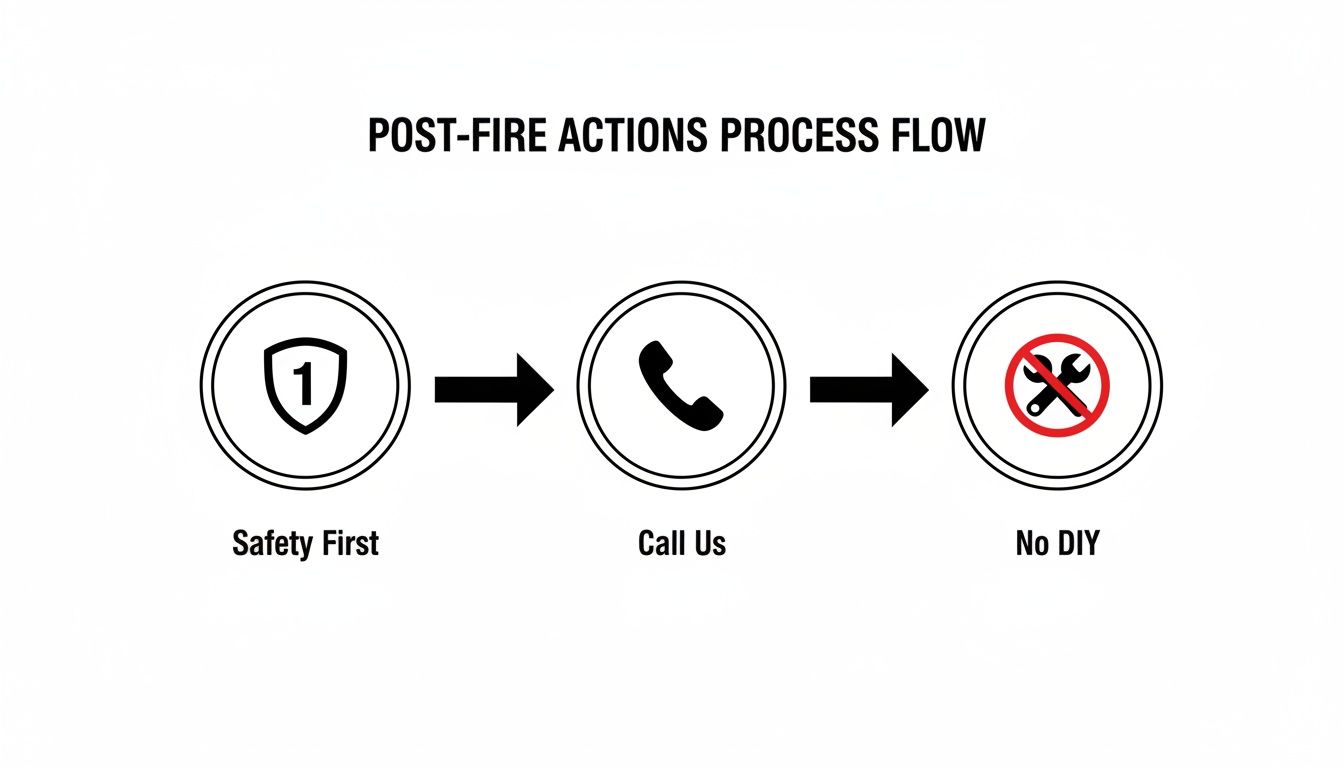
Resist the urge to start wiping things down. You could accidentally make the damage worse. Once the professionals arrive, their methodical approach takes over.
Step 1: Initial Assessment and Damage Control
The first thing a certified team does upon arrival is a thorough inspection. This isn't just a quick walkthrough. They need to get the full picture of the fire, smoke, and water damage, which means checking for structural issues, figuring out the type of soot they're dealing with, and using meters to find hidden moisture in walls and floors.
With that information, they immediately pivot to damage control to stop things from getting worse. This usually involves:
- Securing the Property: Boarding up any broken windows or doors and tarping the roof to keep rain and wind out.
- Isolating Affected Areas: Setting up plastic containment barriers to keep soot and dust from spreading to clean areas of your house during the restoration.
This first step is all about hitting pause on the damage and creating a safe, contained worksite.
Step 2: Water Extraction and Debris Removal
With the site secure, the next urgent task is removing all the water used to fight the fire. This isn't just water; it's a corrosive mix of soot and chemicals that can cause further damage the longer it sits. Technicians bring in powerful, truck-mounted vacuums and pumps to get thousands of gallons of this contaminated water out fast.
At the same time, they begin clearing out everything that can't be saved. This means carefully hauling out charred building materials, soaked drywall, and ruined furniture. Clearing this debris is a massive job, often requiring professional junk removal services to properly handle the sheer volume of waste.
A fire can generate a staggering amount of debris. A typical 2,000-square-foot home can easily produce several tons of waste, all of which needs to be disposed of correctly.
Step 3: Structural Drying and Dehumidification
Getting the standing water out is just the first part of the drying process. The real challenge is the moisture that has soaked deep into wood framing, subfloors, and insulation. If you don't get that out, you're at high risk for serious mold problems and potential rot.
This is where the heavy-duty equipment comes in. The crew will set up a strategic grid of specialized machines:
- High-Velocity Air Movers: These are not your average fans. They blast air across wet surfaces to speed up evaporation.
- Commercial Dehumidifiers: As the air movers turn water into vapor, these industrial-strength units pull that moisture right out of the air.
Technicians constantly monitor this process with moisture meters and thermal cameras, making sure every corner of your home’s structure is brought back to a normal dry state. You can get a closer look at the tools and techniques in the full fire damage restoration process.
Step 4: Soot and Smoke Removal
Once the structure is completely dry, the team shifts its focus to the soot and smoke. Soot is oily and acidic, and it sticks to everything. Wiping it with the wrong cleaner can smear it deeper into surfaces, making it impossible to remove. Professionals use specific cleaning agents that are matched to the type of soot and the surface it's on.
This is also when the battle against the smoke odor begins. Smoke particles are microscopic and get into everything. To truly eliminate the smell, not just cover it up, they use advanced tech:
- Thermal Fogging: A special machine heats a deodorizer into a fine mist that acts just like smoke, traveling into the same tiny crevices to neutralize odor particles at the source.
- Ozone or Hydroxyl Generators: These machines create molecules that break down stubborn smoke and soot particles in the air and on surfaces, literally destroying the smell.
Step 5: Cleaning, Sanitization, and Reconstruction
The final stretch of the water and fire restoration process is all about putting your home back together. It starts with a final, deep cleaning of anything that was salvaged—from furniture and drapes to personal belongings. Every affected surface in the home is then thoroughly sanitized to remove any lingering bacteria or contaminants.
With a clean, safe, and deodorized space, the reconstruction can finally begin. This is where new drywall goes up, floors are installed, walls are painted, and all the finishing touches are put in place. It’s the last step that transforms a damaged house back into the comfortable, familiar home you remember.
Navigating Insurance Claims and Restoration Costs
After the immediate shock of a fire, the financial side of things can feel just as overwhelming. Suddenly, you're not just dealing with the emotional trauma and physical mess—you're also facing a mountain of insurance paperwork and questions about restoration costs. It's a lot to handle, but understanding how the process works can make it much more manageable.
Essentially, you'll be working with two key people: your insurance company’s adjuster and your restoration contractor. The adjuster's job is to represent the insurance company, evaluating the damage to figure out what your policy may cover. The restoration company, on the other hand, is your partner in the actual recovery—they document everything, map out a detailed plan, and do the physical work to put your home back together.
Understanding Your Insurance Policy
First things first: you need to know what your homeowner's insurance policy actually says. While most policies cover fire damage, the devil is always in the details. Look for specifics on your dwelling coverage (for the structure itself), personal property (for your belongings), and Additional Living Expenses (ALE), which is a key coverage that helps cover costs if you need to live somewhere else temporarily.
Your insurance agent is your go-to person for help translating the policy language. Don't be shy about asking questions! An insurance policy is just a contract, and the claim process has to follow the rules laid out in it. Keeping the lines of communication open with your agent from day one is absolutely crucial.
Key Insight: Your smartphone is your best friend right now. Before anything is touched or cleaned, document everything. Take tons of photos and videos. Make a detailed list of all damaged items, noting where you bought them, when, and what they were worth. This kind of detailed proof is a powerful tool you can use when filing your claim.
The Scope of Work and Restoration Estimates
The next critical piece of the puzzle is the scope of work. This isn't just a simple price quote; it's an incredibly detailed, itemized report from the restoration company that acts as a complete blueprint for your home's recovery.
This document breaks down every single step of the job, including things like:
- A line-by-line list for demolition, removing debris, and deep cleaning.
- The exact drying and dehumidification equipment needed for the job.
- The specific methods for getting rid of soot and stubborn smoke odors.
- An inventory of all the materials needed for the rebuild, from drywall and flooring to paint and trim.
This detailed scope is what your restoration team submits to the insurance adjuster. The adjuster then reviews it to make sure the work being proposed matches the damage they saw and fits within the terms of your policy. For a deeper dive into this, check out our guide on water damage insurance claim tips.
Factors That Influence Restoration Costs
No two water and fire restoration jobs ever have the same price tag. The final cost depends on so many different variables, which is why a professional has to see the damage in person to give you an accurate estimate.
Several key factors will shape the overall cost:
- Extent of Damage: A small fire contained to the kitchen is a completely different ballgame than a blaze that compromised the home's structure and led to widespread water damage.
- Type of Materials Affected: It’s much harder—and more expensive—to remove soot from porous surfaces like unsealed wood or natural stone than it is to clean non-porous materials like glass or metal.
- Water Contamination Level: The water used by firefighters is automatically considered "Category 3" or black water. It’s a toxic mix of water, soot, and chemicals that requires specialized safety protocols for removal and disposal.
- Reconstruction Needs: Costs add up quickly depending on how much rebuilding is necessary. It could be as simple as replacing a bit of drywall or as complex as rebuilding entire rooms from the studs up.
The good news is that a professional restoration company can work directly with your insurance provider. They use industry-standard pricing software to create fair and accurate estimates, which helps streamline the claims process so the work can begin.
Why IICRC Certification Should Be Your Top Priority
When your home has been hit by a fire, you’re not just hiring a crew to clean up. You need a team of specialists who understand the complex science of making your home safe and livable again. That’s why looking for an IICRC certification isn't just a good idea—it's absolutely essential for any water and fire restoration job.
Let me put it another way: you wouldn't ask your family doctor to perform heart surgery. So why would you trust an uncertified contractor to handle the dangerous aftermath of a fire, with all the hazardous soot, corrosive water, and hidden mold risks involved?
The Institute of Inspection, Cleaning and Restoration Certification (IICRC) is the main standards-setting organization for our entire industry, recognized across the globe. As a non-profit, its whole purpose is to research and establish the best practices that keep you safe and help ensure the job is done right.
What an IICRC-Certified Firm Really Brings to the Table
Getting an IICRC certification isn't just about paying a fee and getting a badge. It means the company has made a serious commitment to ongoing training, professional ethics, and upholding high standards of care. When you hire an IICRC-certified team, you're hiring proven expertise.
And that expertise has never been more critical. The damage restoration industry is constantly evolving with new technologies and methods, as reported by industry analysts at IBISWorld. A certified firm is one that’s dedicated to staying on top of these modern, effective techniques.
Here’s what it boils down to: An IICRC-certified firm sends technicians who are trained and tested on the science of restoration. They know how smoke and water affect different materials and follow precise steps to mitigate secondary damage, like a mold outbreak, before it can start.
The Real Dangers of Hiring an Uncertified Contractor
Hiring an uncertified contractor to save a few bucks can backfire, costing you far more in the long run. A cheap "restoration" job might just be a surface-level fix. We’ve seen it happen: they paint over smoke stains without sealing them first, trapping toxic soot particles in your walls. Or they miss pockets of moisture, which quietly turn into a massive mold problem months later.
Here's what a certified technician knows to do that others often miss:
- Properly Analyze the Damage: They can tell the difference between wet, dry, or protein-based soot and use the right cleaning agents that won't smear the stain or make it worse.
- Use Professional-Grade Tools: They are trained on how to properly operate industrial dehumidifiers, HEPA air scrubbers, and thermal foggers—the kind of equipment needed for a thorough restoration.
- Follow Strict Safety Rules: They know how to handle hazardous materials, set up containment barriers to protect the rest of your home, and keep your family safe from airborne toxins.
Think of the IICRC standard as an indication that the job will be done correctly. It shows the people working on your home are true restoration specialists, not just general cleaners. You can see the difference in expertise by learning what defines a professional water damage restoration contractor.
After a disaster, your peace of mind is invaluable. Insisting on IICRC certification is one of the best steps you can take to protect your property, your investment, and most importantly, your family’s health.
Common Questions About Water and Fire Restoration
When you're standing in the aftermath of a fire, it’s completely normal to feel overwhelmed and have a million questions running through your mind. To help you find some clarity during this incredibly stressful time, we've put together answers to the questions we hear most often from homeowners dealing with water and fire restoration. Hopefully, this can give you a clearer picture of the road ahead.
How Long Does The Restoration Process Usually Take?
This is probably the number one question we get, and the honest answer is: it really depends. There's no magic number. A small fire in the kitchen that was put out fast might only take a few days to clean up. But for a larger fire that caused serious structural damage and required a lot of water to extinguish, you could be looking at several weeks or even months of work.
A few key things will determine the timeline:
- The scale of the damage: How much of the house was actually affected? The more widespread the damage, the longer it will take.
- The materials involved: It’s much faster to clean non-porous surfaces than it is to dry and repair porous ones like drywall and wood.
- How long things were wet: Water is incredibly destructive. The longer it sits, the more damage it does, which adds time to the drying and repair process.
Once a professional can get on-site and see everything firsthand, they can give you a much more accurate timeline for your specific situation.
Is It Safe To Stay in My House After a Small Fire?
Even if a fire looks small, our strong advice is always to find another place to stay. The most serious dangers after a fire are often the ones you can't see. Smoke, soot, and other nasty airborne particles can hang in the air, posing a real health risk if inhaled—especially for kids, seniors, or anyone with breathing issues.
Important Safety Note: On top of the air quality concerns, all the water used to fight the fire creates a perfect environment for mold. It can start growing in as little as 24 to 48 hours. It's always best to wait until a certified professional has given your home a thorough inspection and declared both the structure and the air quality safe.
What Causes The Lingering Smell and Is It Dangerous?
That stubborn, smoky smell that seems to get into everything? It's caused by tiny smoke and soot particles that have worked their way deep into materials like drywall, wood, carpeting, and furniture. Think of it like trying to get the smell of burnt popcorn out of your kitchen—it just clings to every surface.
Unfortunately, these particles aren't just annoying; they can be a health hazard. They often contain toxic chemicals and carcinogens from whatever burned in the fire. Just cleaning the surfaces you can see or using an air freshener won't solve the problem; it only masks the smell for a little while.
This is where professional water and fire restoration techniques come in. We use special equipment, like thermal foggers or ozone and hydroxyl generators, to go after the odor at its source. These methods are designed to find and neutralize those deeply embedded particles, helping to make the air in your home not only fresh again but truly safe to breathe.
When a disaster hits your home, you need a team you can trust to show up fast and handle the entire recovery process. Restore Heroes is an IICRC-certified leader in disaster restoration, and we’re on call 24/7 to help you secure your property and start putting things back together. If you're dealing with water or fire damage, visit us online for immediate help.