
Once the fire trucks leave, you might feel a sense of relief. But the fire leaves something behind, a silent and destructive problem that can cause more lasting harm than the flames themselves: soot from fire.
This isn't just a layer of black dust. It's a nasty, often toxic cocktail of half-burned materials that can wreck your home and your health.
What Is Soot and Why Should You Care
When a fire tears through a home, it doesn't vaporize everything. Materials that don't burn up completely become tiny, oily particles that float away with the smoke, eventually settling on every single surface. That sticky, black film is soot.
Think of it like the ghost of the fire. It’s a stubborn reminder that lingers long after the emergency is over. For homeowners here in Phoenix, the first step to a real recovery is understanding that soot isn't just dirt you can wipe away. It's a completely different animal.
The Corrosive Nature of Soot
One of the sneakiest things about soot is its acidic nature. The moment it lands, it starts a chemical reaction that eats away at whatever it touches. This is why you’ll often see damage happen incredibly fast:
- Metal Corrosion: In just a few days, soot can cause rust and tarnish on faucets, door handles, light fixtures, and appliances.
- Permanent Staining: It sinks deep into porous surfaces like drywall, unsealed wood, and furniture, creating stains that can be difficult or impossible to remove.
- Etching and Discoloration: Soot is powerful enough to etch glass and can cause plastics on your electronics or window frames to turn yellow and brittle.
Soot isn’t just sitting there; it's actively damaging your property. The longer you wait, the more it bonds with and breaks down the materials in your home. What might be a straightforward cleanup job on day one can quickly become irreversible damage.
More Than Just a Mess
Beyond the physical damage, soot from fire is a serious health hazard. These microscopic particles are easily inhaled and can lodge themselves deep in your lungs, causing respiratory problems or making existing conditions like asthma much worse.
Worse yet, your HVAC system can act like a superhighway for soot, pulling particles from the fire-damaged area and spreading them into rooms the flames never even touched. You can see just how smoke and soot travel in our guide to understanding house smoke damage.
Taking soot seriously from the get-go is absolutely critical. This is about more than just cleaning up—it's about protecting your home's structure, your financial investment, and the health of your family.
The Four Types of Soot You Might Find
After a fire, you’re not just dealing with "soot"—you're dealing with a specific type of soot. And knowing the difference is everything. The cleanup method that works for one kind can make another a permanent, smeared-in mess.
Think of it this way: cleaning up a fine powder like flour is a world away from scraping up sticky honey. That’s the exact difference between dry soot and wet soot. Getting them mixed up is a common reason DIY cleanups fail, often smearing acidic residue deeper into walls and furniture.
What burned, and how hot and fast it burned, determines what you're up against. Let's break down the four main culprits you’ll encounter.
Soot Identification Guide
To help you quickly figure out what you're looking at, here's a simple guide. Each type has a unique look, feel, and origin story.
| Soot Type | Appearance and Feel | Common Fire Source | Cleanup Challenge |
|---|---|---|---|
| Dry Soot | Powdery, dusty, grayish-black | Fast-burning, high-oxygen fires (e.g., paper, wood) | Fine particles get everywhere, including inside electronics and crevices. |
| Wet Soot | Greasy, sticky, smeary, black | Slow, smoldering, low-oxygen fires (e.g., plastics, rubber) | Smears easily, has a strong odor, and embeds deep into surfaces. |
| Protein Soot | Nearly invisible, fine greasy film, yellowish tint | Kitchen fires involving food, grease, or organic matter | Leaves a powerful, pungent odor and a hard-to-remove film. |
| Furnace Soot | Oily, stringy, looks like dark spiderwebs | Malfunctioning oil-fired furnaces ("puffbacks") | Petroleum-based residue requires specialized solvents to break down. |
Understanding these distinctions is the first step in creating a real plan for recovery, not just making a bigger mess.
Dry vs. Wet Soot
The two most common types we see are dry and wet soot. They’re polar opposites in almost every way.
Dry Soot comes from fast, hot fires with plenty of oxygen. It’s a powdery, chalky residue. The good news? It’s relatively easy to clean from hard, non-porous surfaces. The bad news? Its fine particles are like dust—they travel everywhere and settle deep inside tiny cracks, vents, and electronics.
Wet Soot, on the other hand, is born from slow, smoldering fires that often involve synthetic materials like plastic or rubber. This stuff is a nightmare. It’s greasy, sticky, and carries a heavy, lingering smell. Trying to just wipe it away will smear the stain and drive it deeper into drywall, wood, and upholstery. This is where professional techniques become non-negotiable.
Protein and Furnace Soot
Then there are two other types that often catch homeowners completely off guard.
Protein soot is what’s left after a kitchen fire. When food or grease burns, it creates a residue that can be almost invisible. You'll notice a powerful, awful smell long before you see the fine, yellowish, greasy film covering every single surface. This is the stuff that stains your cabinets and makes your kitchen feel permanently grimy.
The most deceptive thing about protein soot is that you smell the damage far more than you can see it. People often think it's not a big deal, only to realize later that the contamination is severe and the odor is unbearable.
Finally, there’s furnace puffback soot. This isn't from a house fire but from a faulty oil furnace. It shoots out oily soot that forms these strange, stringy webs that look a lot like dark spiderwebs. Because it's petroleum-based, it's incredibly difficult to clean without specialized solvents that can break down the oil without damaging your home.
This image really drives home why all soot is more than just a stain—it's an active threat.
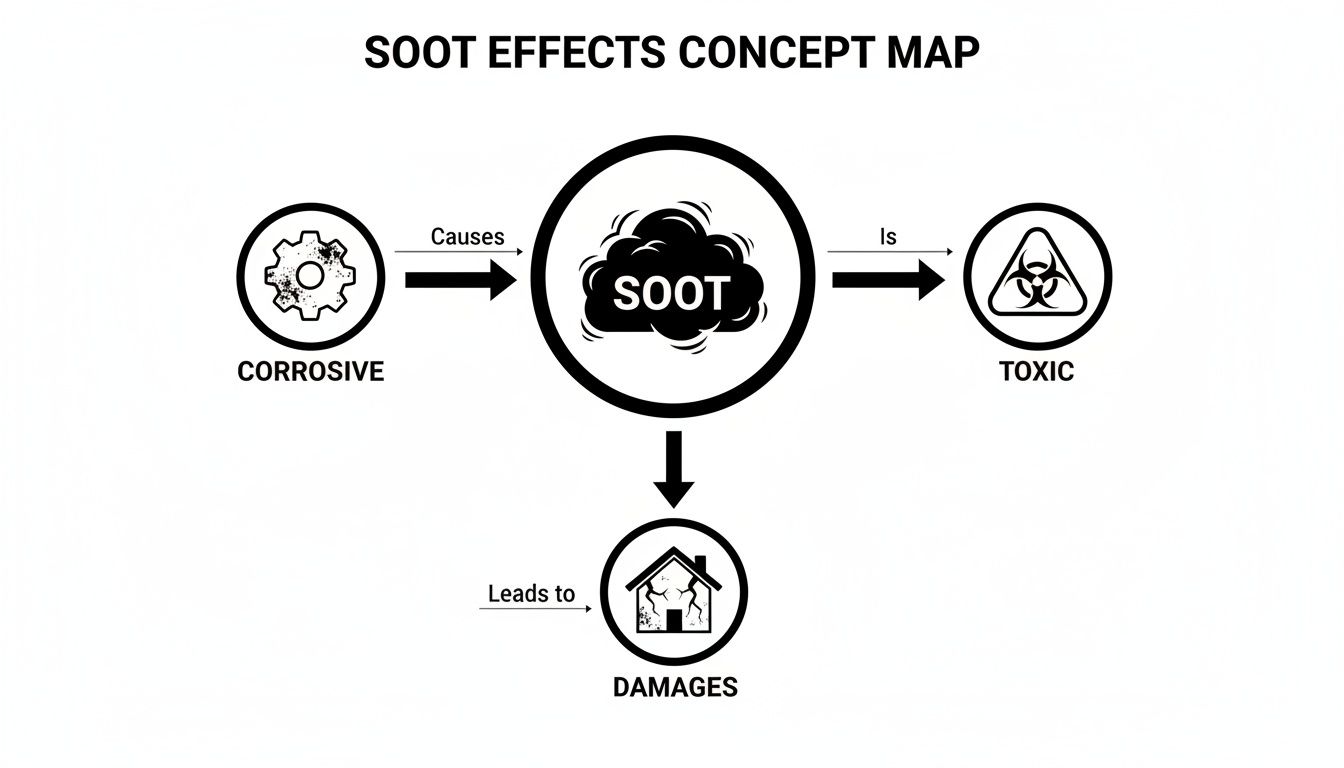
As you can see, soot corrodes metal, is toxic when inhaled, and actively damages your home's structure. Each type we've discussed requires a targeted approach to neutralize these dangers properly.
The Hidden Dangers Lurking in Your Home and Health
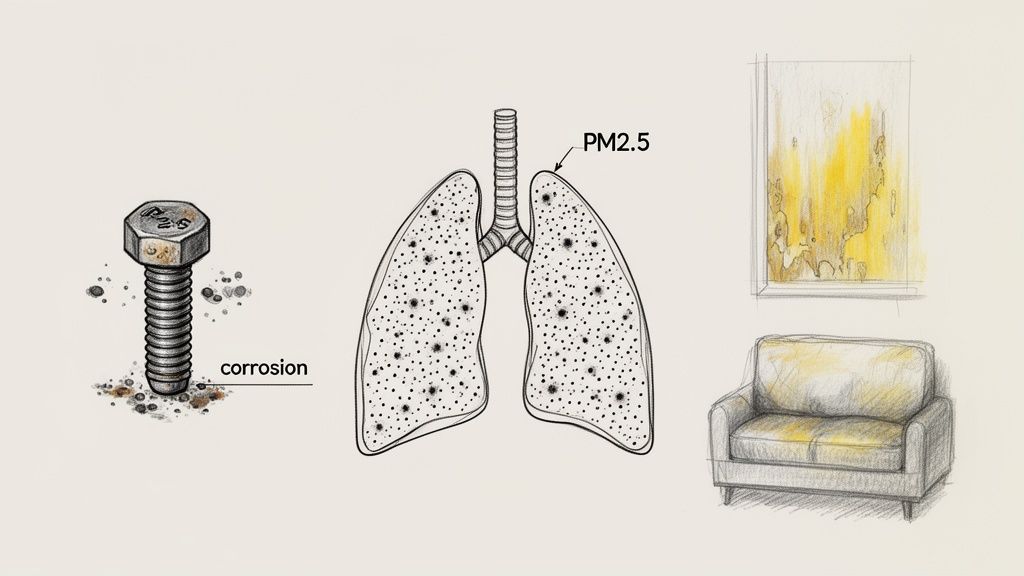
After a fire, it’s easy to focus on the obvious charring and staining. But the real problem isn't just what you can see. The soot from fire leaves behind microscopic dangers that can threaten your family’s health and silently eat away at your home’s structure.
What you’re dealing with isn't just simple dust. It’s a toxic mix of fine particles and acidic chemicals, and its impact can be serious and long-lasting.
The Invisible Threat to Your Health
The biggest health concern with soot comes down to something called PM2.5. These are incredibly tiny particles—about 30 times smaller than a human hair. Because they’re so small, you can easily breathe them deep into your lungs, where they can even get into your bloodstream.
Here in Phoenix, where we already have our share of dust and air quality concerns, adding soot to the mix is a recipe for trouble. Exposure can cause or seriously aggravate a host of health issues:
- Respiratory Issues: Soot is a major irritant for anyone with asthma, bronchitis, or COPD. It can trigger more frequent attacks and make it harder to breathe.
- Cardiovascular Effects: Once those PM2.5 particles enter the bloodstream, they can cause inflammation and increase the risk of heart attacks and strokes.
- Irritation: Even for healthy individuals, short-term exposure often leads to coughing, sore throats, and irritated eyes. Children and the elderly are especially vulnerable.
To put this in perspective, the massive 2023 Canadian wildfires burned over 71,043 square miles and unleashed a cloud of PM2.5 that circled the entire globe. That single event, which accounted for 13% of all global fire-related PM2.5 that year, is linked to over 87,000 premature deaths worldwide. It's a sobering reminder of just how lethal fire residue can be.
How Soot Silently Destroys Your Property
As critical as your health is, the damage soot does to your home is just as sneaky. The moment it lands, its acidic nature starts a corrosive chain reaction. If you don’t deal with it quickly, the damage can become permanent.
The longer soot sits, the more it bonds with materials. A problem that is correctable on day one can become permanent damage within a week, turning a restoration into a replacement.
Here’s how it breaks down your home, piece by piece:
- Corrosion: Metal surfaces like faucets, doorknobs, and appliance frames will quickly start to tarnish and rust.
- Etching: The acid in soot can permanently etch glass. Your windows and mirrors might end up looking cloudy or streaked, and no amount of window cleaner will fix it.
- Discoloration: Plastics and vinyls turn yellow. Paint and furniture fabrics absorb the soot, leading to stains that are impossible to get out. You can learn more about the widespread effects of fire in our article on what to expect with fire damage to a house.
There's a reason fire restoration pros show up in full protective gear. They understand the risks. When you see a team using specialized NFPA 2112 Compliant FR Clothing, it’s a clear signal of just how hazardous soot and other fire residues are. Protecting your family and your property means taking these hidden dangers seriously.
Clear Signs You Need to Call in a Pro
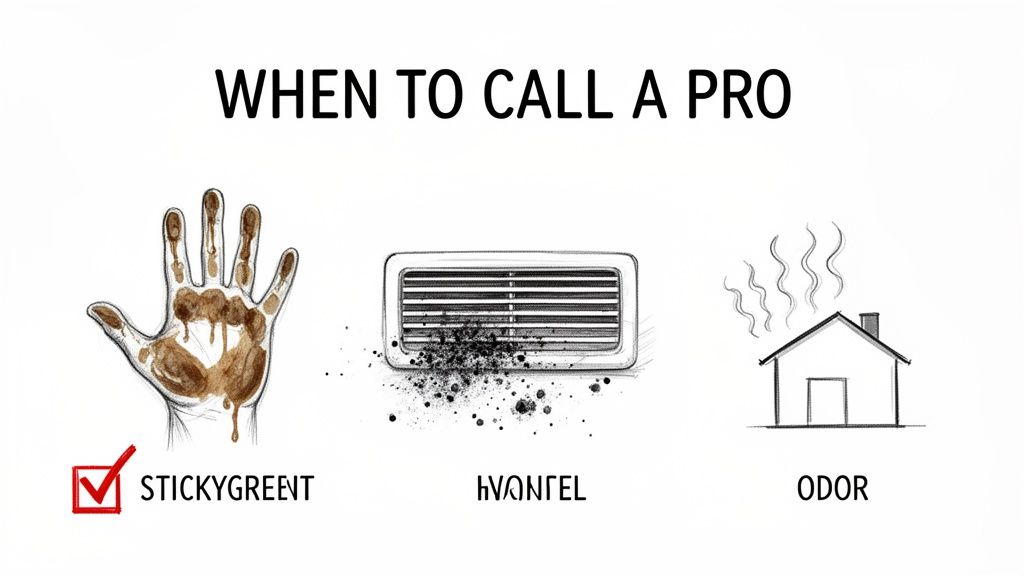
After a fire, the urge to roll up your sleeves and start cleaning is completely understandable. It’s a way to reclaim your space. But with soot from fire, knowing when to step back is the single most important decision you can make. Pushing past your limits can accidentally cause more permanent damage or put your health at risk.
Calling a professional restoration company isn't admitting defeat. It’s making a smart, strategic decision to protect your home and your family. They have the training and equipment to handle hazards that simply can’t be managed with household supplies.
When the Mess Is More Than It Seems
Sometimes, you can just tell the job is too big. If you see soot blanketing entire walls, feel a greasy film on surfaces, or can't escape the smell of smoke, it’s time to put down the sponge and pick up the phone. These aren't surface-level problems.
Here are the tell-tale signs that you're in over your head:
- The Soot Is Everywhere: If the affected area is larger than you can comfortably reach—think bigger than your own arm span—it's too much. A job this size needs professional containment to stop the soot from spreading to clean areas of your home.
- It Feels Sticky or Oily: This is the calling card of wet soot. Trying to wipe it away will smear the acidic, oily residue deeper into your walls, furniture, and carpet, making stains permanent.
- That Smell Just Won’t Go Away: A strong, persistent smoke odor is a sure sign that microscopic particles have worked their way deep into porous materials. No amount of scrubbing will get rid of it. You need professional deodorization, like thermal fogging, to neutralize the odor at its source.
It's not just house fires, either. Here in Arizona, smoke from distant wildfires can settle over Phoenix, bringing hazardous soot right into our homes. Globally, fine particulate matter from these fires is now linked to over 100,000 premature deaths each year, a sobering statistic confirmed by recent research at essd.copernicus.org.
Red-Flag Situations That Always Require an Expert
Beyond the size and type of soot, certain situations are immediate red flags. These involve complex systems and fragile items where a DIY mistake can be incredibly costly.
Soot in Your HVAC System
See soot stains on or around your air vents? Stop. Whatever you do, do not turn on your furnace or AC. You’ll blow those corrosive, toxic particles into every corner of your house, turning a localized problem into a whole-home disaster. A professional needs to thoroughly clean the furnace, air handler, and every inch of ductwork to make your air safe to breathe again.
Damage to Delicate Items
Soot is particularly vicious to electronics, artwork, family photos, and important documents. Its acidic nature corrodes delicate circuits and leaves permanent stains. Professionals use very specific methods, like ultrasonic cleaning and specialized vacuums, to carefully salvage these irreplaceable items.
Feeling overwhelmed is normal, but having a plan helps. Our guide on what to do after a house fire with this checklist can give you the clear, step-by-step direction you need right now.
Navigating the Cleanup and Insurance Process
So, you've decided to call in the professionals. That's a huge step. From here, the chaos starts to transform into a clear, manageable recovery plan. A good restoration team doesn't just clean up; they guide you through every stage, especially when it comes to dealing with the insurance company.
Once called, certified technicians can perform a thorough inspection. They need to understand the full picture—what kind of soot from fire they're dealing with, how far it has traveled through your home, and what materials it has latched onto. This detailed assessment is the foundation for both the cleanup strategy and the report your insurer will need.
The Professional Restoration Workflow
Once a game plan is in place, the real work begins. Professionals follow a careful, step-by-step process to make sure the cleanup is done right and, most importantly, safely.
Here’s what that looks like in practice:
- Containment: First, the damaged area is sealed off. Think of it like creating a clean room in a hospital. Heavy plastic sheeting and negative air pressure machines are used to stop soot particles from migrating into untouched parts of your home.
- Soot Removal: Using specialized gear like HEPA-filter vacuums and dry-cleaning chem sponges, the physical soot is removed. The tools and techniques used depend entirely on whether it's dry, wet, or protein soot.
- Cleaning and Sanitizing: With the bulk of the soot gone, a deep-clean of everything begins. Walls, floors, furniture, and even personal belongings are treated with professional-grade agents that neutralize soot’s corrosive acidity and lift away stains.
- Deodorization: Finally, the odor is attacked. Smoke has a nasty habit of seeping into everything porous. Equipment like thermal foggers or ozone generators can be used to track down and eliminate those stubborn smells at a molecular level.
This level of professional cleanup is more critical than ever. With forest fires having doubled in intensity over the last two decades, burning over twice the tree cover annually compared to 2001, the sheer volume of soot they produce is staggering. For Phoenix homeowners, this means a higher risk of soot damage even from distant fires, making professional mitigation an essential step often required by insurance policies.
Managing the Insurance Claim
Let's be honest—navigating an insurance claim can feel like a second disaster. A quality restoration company can help take that burden off your shoulders by working with your insurance adjuster. They can provide the detailed documentation, photos, and professional assessments needed to process your claim smoothly.
Crucial Tip: Document everything. Before anyone touches a thing, take plenty of photos and videos of the damage. Also, keep a running log of every conversation you have with your insurance provider, including dates, times, and who you spoke to.
To make this part easier, an insurance claim documentation checklist is an invaluable tool for making sure you don't miss a single detail. Your own records are your best asset. For a deeper dive into coverage specifics, you might also want to read our guide that answers the common question, "does homeowners insurance cover fire damage?"
Common Questions We Hear About Soot Cleanup
When you find soot damage in your home, it’s completely normal for your mind to start racing with questions. It's an overwhelming situation, and getting clear, honest answers is the first step toward getting things back to normal. We've been doing this for a long time, and we've heard every question in the book.
Let’s tackle some of the most common ones we get from Phoenix homeowners. Getting this right from the start can save you from costly mistakes that make the damage—or the health risks—even worse.
Can I Just Paint Over Soot Stains?
We get this question all the time, and the answer is a hard no. It’s tempting to think a fresh coat of paint is a quick fix, but it's one of the worst things you can do.
Think of it this way: soot is an oily, acidic film. Just painting over it is like trying to cover an oil spill with a sheet of paper. The acidic residue will eat its way through the new paint, causing it to bubble, peel, and discolor into ugly yellow or gray blotches. The problem will literally bleed right through.
Worse yet, you're trapping the smell. Painting over soot essentially seals that awful smoke odor into the wall. On warm or humid days, that smell will creep back out, leaving your home with a permanent smoky stench.
The only way to do this right is the professional way: The surface has to be meticulously cleaned and de-greased. Then, a special stain-blocking, odor-sealing primer must be applied. Only after that can you paint. Anything less, and you're just guaranteeing you'll have to deal with it all over again.
Is It Safe to Use My HVAC System After Soot Damage?
Please don't. If there's even a chance of soot contamination, your HVAC system is officially off-limits until a professional has given it the all-clear.
Turning on your furnace or AC will turn your ductwork into a superhighway for hazardous particles. The system will pull soot from the affected area and blast it into every single room, embedding those tiny toxic particles deep into your vents, carpets, and furniture. It's a surefire way to contaminate your entire house and create a serious health risk, especially for kids and the elderly.
Any legitimate restoration project includes a deep cleaning of the HVAC system. This isn't just a quick wipe-down of the vents; it's a full-on cleaning of the ducts and internal parts to make sure the air you breathe is safe again.
How Long Does Professional Soot Removal Take?
There's no simple answer here, and you should be wary of any company that gives you one over the phone. The timeline for soot removal depends entirely on the specifics of the situation.
A few key factors determine the schedule:
- The Scale of the Damage: A small fire contained to the kitchen stovetop is a much faster job—maybe a day or two—than a fire that has impacted multiple rooms.
- The Type of Soot: Powdery, dry soot from a fast-burning fire is much easier and quicker to clean than the greasy, sticky soot from a smoldering plastic or rubber fire.
- The Materials Affected: Cleaning hard surfaces like granite countertops is one thing. Restoring porous materials like carpets, drywall, upholstered furniture, and unsealed wood is a far more intensive and time-consuming process.
A thorough job could take a week or more for extensive damage. The only way to know for sure is with a detailed, on-site inspection. For a better sense of how deep soot and smoke can penetrate, check out our guide on how to remove the smoke smell from your house.
Why Is a Certified Restoration Company a Better Choice?
Choosing a company with IICRC (Institute of Inspection, Cleaning and Restoration Certification) credentials isn’t just about a fancy logo—it's your best protection. This certification means the technicians have been formally trained and tested on the right way to handle fire and smoke damage safely and effectively.
Here’s what that means for you:
- Proven Know-How: Certified pros understand the complex chemistry of soot. They use the correct cleaning agents for different materials, preventing the accidental damage that can happen with DIY methods.
- Insurance Company Approved: Insurance adjusters know and trust the IICRC standards. When they see a certified company's report, it makes the claims process smoother because they know the job was done by the book.
- Safety First: An uncertified cleaner might just spread contaminants around. A certified technician knows how to contain the area, manage air quality, and ensure your home is truly safe when they're finished.
Hiring a certified professional is about more than just cleaning; it's about ensuring a complete recovery and protecting the value of your home.
When disaster strikes, you need a team you can count on to restore not just your property, but your peace of mind. The certified professionals at Restore Heroes may be able to handle fire and soot damage with the expertise Phoenix homeowners trust. If you need immediate assistance, visit us at https://www.restoreheroesaz.com to inquire about a free onsite inspection.