
Water damage rarely starts in a dramatic way. Most Chandler homeowners first notice something small. A soft spot near the dishwasher. A damp baseboard after a monsoon storm. A carpet edge that feels cool and heavier than it should.
Then your mind jumps fast. Is it just a spill, or is water sitting inside the wall? Do you call a plumber first, a restoration company, or your insurance carrier? Can the floor be saved? Is mold already starting?
If you're dealing with that right now, take a breath. There is a process. Good water damage restoration chandler az work isn't just about sucking up water and setting out fans. It's about finding where moisture traveled, drying materials in the right order, and making sure today's leak doesn't become next month's mold problem.
A Homeowner's First Guide to Water Damage in Chandler
It often happens at the worst time. You're up in the middle of the night because you hear dripping in the laundry room. Or you come home from work and find the water heater closet wet, with moisture spreading into the hallway. In Chandler, another version is common too. A summer storm passes, the street drains slowly, and water starts pressing against the slab and lower walls.
You're not overreacting if this feels urgent. Water moves farther than expected, and it doesn't always stay where you can see it.
Nationally, 37% of US homeowners have experienced water-related property losses, which shows how common and disruptive these events are, especially in places with sharp weather swings like Arizona, according to Valleywide Restoration's Chandler water damage overview.
Why Chandler homes are a little different
Arizona's dry climate tricks people into thinking water damage should be simple here. It isn't.
A Chandler home can dry on the surface while moisture stays trapped under flooring, behind cabinets, or inside wall cavities. Monsoon season adds another layer. Wind-driven rain, roof leaks, and sudden pooling around the home can create water paths that aren't obvious until staining, odor, or swelling appears later.
What helps most right now
The first useful step is getting clear on whether you're dealing with a small cleanup issue or a real restoration problem. If water touched drywall, insulation, cabinets, baseboards, or flooring for more than a brief moment, it's worth treating it seriously.
If you need immediate guidance, this emergency water damage page outlines what to do next while you're still in that first stressful stage.
Water damage feels chaotic at first, but the work itself follows a sequence. Stop the source, protect people, document conditions, remove water, then dry what can't be seen.
What Professional Water Damage Restoration Really Means
A lot of homeowners hear "restoration" and picture cleanup. That's only part of it.
A better way to think about it is emergency medical care for a building. First you stop the immediate harm. Then you assess how bad it is. Then you treat what was affected. Finally, you monitor recovery so the problem doesn't return.
The difference between cleanup and restoration
Cleanup is what a homeowner might do after a small spill. Towels, a mop, maybe a box fan.
Restoration starts when water has moved into materials. Drywall acts like a sponge. Wood framing absorbs moisture. Padding under carpet can hold water out of sight. Tile floors can look fine while moisture sits under them.
That is why professional crews use moisture meters, thermal imaging, extractors, air movers, and dehumidifiers. They aren't just drying what looks wet. They're drying what testing shows is still wet.
For homeowners comparing providers, a water restoration company should be able to explain its inspection method, drying plan, and documentation process in plain language.
The three water categories
Not all water damage is the same. The IICRC separates water into categories because the health risk changes the job.
- Category 1, clean water: This usually starts from a supply line or another sanitary source. A fresh pipe break can begin here.
- Category 2, gray water: This often comes from sinks or appliances. It carries contamination that raises the risk level.
- Category 3, black water: This includes sewage and other highly contaminated water.
Per Emergency Flood Team's Chandler water damage guide, water is categorized by the IICRC as Clean, Gray, and Black, and gray water can introduce 10^5-10^7 CFU/ml of bacteria, which is why technicians use EPA-registered antimicrobials after extraction in the right situations.
Why category matters to your home
If your refrigerator line leaked clean water onto tile and you found it quickly, the response may focus on extraction and drying.
If a washing machine backed up and sat for hours, that changes the safety approach. If a toilet overflowed with contamination, or stormwater mixed with outdoor debris and sewage, porous materials may need a different decision path.
It's like a cut versus an infected wound. Both involve damage. One can be simpler to handle. The other needs stricter treatment, more protective gear, and more careful cleaning.
What professionals are really trying to prevent
Most homeowners focus on the visible mess. Professionals focus on the secondary problems:
- Hidden moisture inside walls, under flooring, or in cabinets
- Microbial growth if damp materials stay wet
- Material breakdown such as swelling, delamination, or crumbling drywall
- Odors that linger after surface drying
- Claim disputes when damage wasn't documented well from the start
Practical rule: If water got into building materials, the job isn't finished when the surface feels dry. It ends when testing shows the structure has dried to an acceptable level.
Your First 60 Minutes Emergency Steps for Water Damage
The first hour matters because your decisions can limit damage or make it worse. The goal isn't to fix everything yourself. It's to keep people safe and stop the situation from spreading.
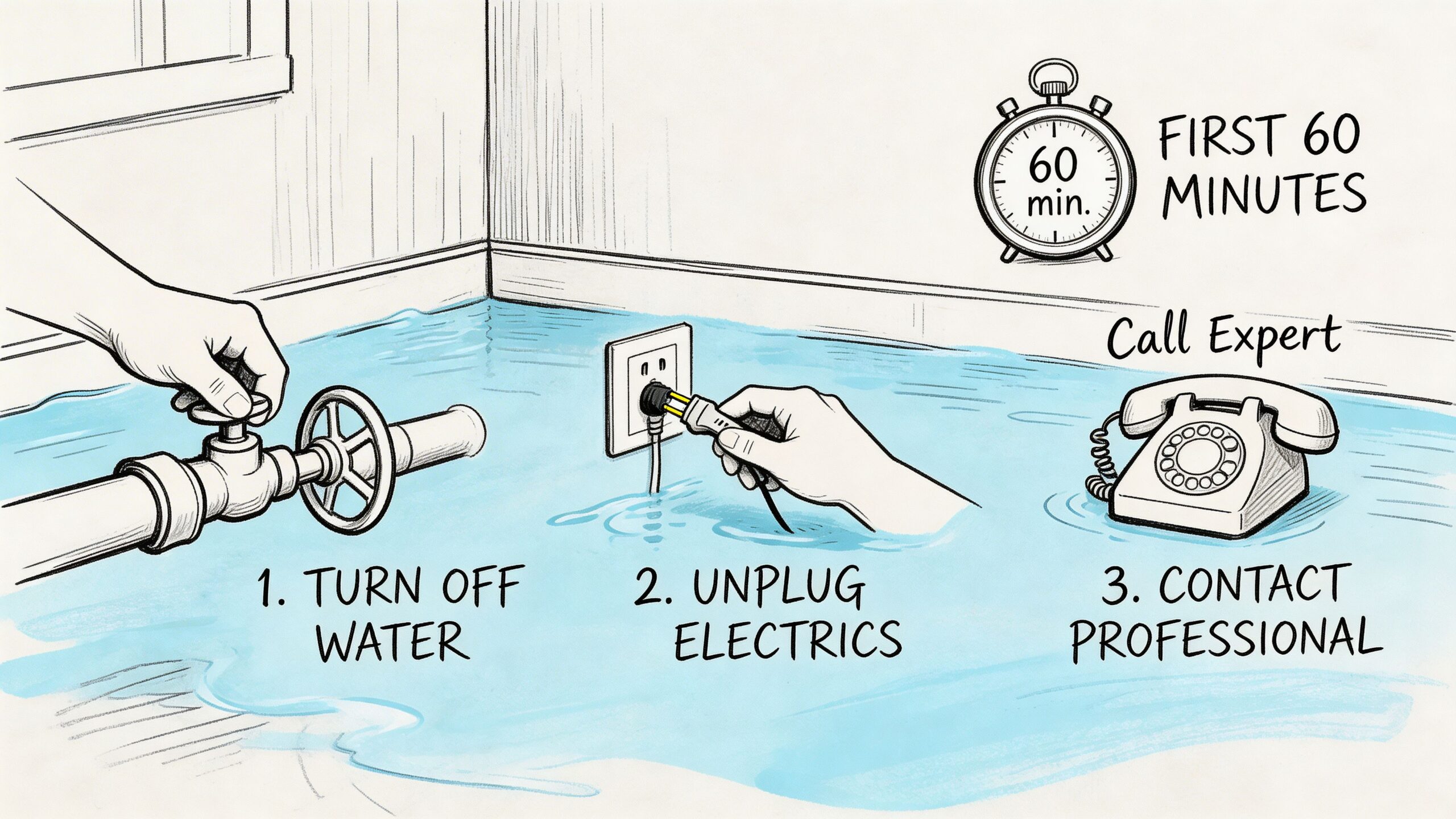
Start with safety, not cleanup
If water is near outlets, appliances, or powered equipment, don't walk into the area casually. If you can safely access the breaker for the affected area, shut power off first. If you can't do that safely, stay out and wait for qualified help.
Next, stop the water source if you can identify it. That might mean a fixture shutoff, the washing machine supply, or the home's main water valve.
What to do in order
- Protect people first: Keep children, pets, and anyone barefoot out of the wet area.
- Shut off power if safe: Water and electricity are a dangerous combination.
- Stop the water source: A closed valve can save flooring, cabinets, and drywall.
- Move easy-to-carry items: Pick up rugs, electronics, documents, and small furniture if you can do it safely.
- Document what you see: Take photos and short videos before you start moving too much around.
- Call a mitigation team: Early response limits how much water keeps migrating.
If you're trying to understand where mitigation fits in, this water damage mitigation resource gives a good overview of the immediate containment and drying stage.
A few smart homeowner moves
These simple actions can help while you're waiting:
- Use foil under furniture legs: This can reduce staining or dye transfer from wet wood onto carpet.
- Lift curtains and fabrics off the floor: Wet textiles wick moisture upward.
- Open cabinet doors carefully: Air circulation helps, especially under sinks.
- Blot, don't scrub: Scrubbing can drive moisture and soil deeper into carpet fibers.
What not to do
Some common reactions cause more trouble later.
- Don't use a household vacuum on standing water: That's a shock hazard and the equipment isn't built for the job.
- Don't turn up the home's heat and hope for the best: Warm air without proper dehumidification can move moisture into other materials.
- Don't assume dry-looking tile means the subfloor is dry: Surface appearance doesn't tell the full story.
- Don't wait to "see if it dries out": Hidden moisture often wins that argument.
A short visual can help if you're too stressed to read much right now:
When the issue seems small but probably isn't
Watch for these clues that water traveled farther than you think:
- Baseboards look swollen
- Flooring feels soft or lifted
- Paint starts bubbling
- A musty smell appears
- The leak may have been active before you noticed it
Those signs usually mean the job has moved past simple towel drying.
Our Proven Restoration Process from Inspection to Recovery
A good restoration job should feel orderly from the first walkthrough. If a crew dries the obvious wet spot but misses the moisture that traveled under flooring or into a wall cavity, the house can look better for a week and then show swelling, odor, or mold later.
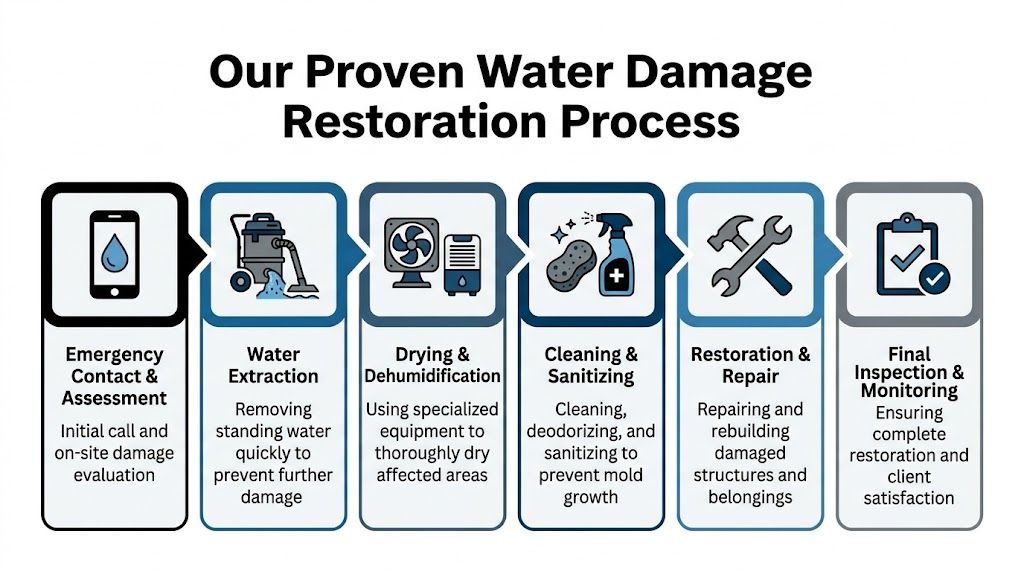
Emergency contact and inspection
The process starts with questions that shape the whole job. Where did the water start. How long was it active. Did it come from a supply line, an appliance, a roof leak, or monsoon runoff pushing toward the home.
Then the crew inspects the structure, not just the visible mess. Moisture meters check how wet a material is. Thermal imaging helps spot temperature differences that can suggest hidden moisture. Those tools matter because drywall, laminate, and baseboards often hide water longer than homeowners expect.
In Chandler, the path water takes can be unusual. Monsoon water may collect near thresholds, seep along slab edges, or move through cracks made worse by shifting soil. Caliche soil adds another wrinkle. It drains poorly, so water can sit against the foundation instead of soaking away quickly. That changes both the inspection and the drying plan.
Water removal and mitigation
After inspection, crews remove as much liquid water as possible. The reason is simple. Every gallon left behind keeps feeding nearby materials.
Extraction equipment works like squeezing a soaked sponge before you try to air-dry it. Pumps or high-capacity extractors remove standing water first. Then crews pull water from carpet, pad, and low spots where it tends to collect. On some jobs, the carpet can be saved and only the pad is removed. On others, contaminated water or long exposure means both need to go.
Containment can start here too. If runoff entered from outside or the water source is unsanitary, crews may isolate the affected area, protect nearby rooms, and control foot traffic so contamination does not spread through the house.
Structural drying and dehumidification
This is usually the longest phase, and it is the one homeowners misread most often.
Drying works like laundry in a closed room. Air movement helps moisture leave the material. Dehumidification removes that moisture from the air so the material can keep drying instead of staying damp. If you only add fans, you can push humid air around without making real progress.
According to RMR AZ's Chandler water damage page, professional drying depends on psychrometric calculations that balance temperature, humidity, and airflow. In plain language, the crew is measuring how the room behaves and adjusting equipment to match it.
That is why air movers do not all point at one wet corner.
Why equipment placement looks so specific
Air movers are set to create a pattern across surfaces and into areas where moisture is trapped. Dehumidifiers are chosen based on room size, material load, and current readings. A wet bathroom, a soaked kitchen toe-kick, and a living room with water under laminate do not dry the same way, even if they are in the same house.
Chandler homes often make this stage more complicated after storm intrusion. Water that came in at a door may travel farther than expected along the slab, and caliche-heavy lots can keep the perimeter damp longer. That is one reason crews keep checking readings instead of guessing based on how the floor looks.
If you want a clearer sense of what affects the dry-out period, this guide on how long water damage restoration usually takes in Arizona homes explains the factors in plain terms.
Cleaning and sanitizing
Dry does not always mean clean.
After extraction and drying, the crew evaluates what the water touched and whether those materials can be safely restored. A clean-water supply line leak usually needs basic cleaning, odor treatment, and confirmation that materials reached a dry standard. Gray or black water calls for more controlled cleaning and, in many cases, removal of porous materials that cannot be reliably sanitized.
Contents are handled the same careful way. Hard, non-porous items often clean up well. Upholstery, paper goods, and some textiles need individual judgment based on contamination and how long they stayed wet.
Restoration and rebuild
Mitigation gets the structure dry and stable. Rebuild puts the house back together.
That may mean replacing drywall cuts, reinstalling insulation, repairing trim, repainting, or addressing damaged cabinets and flooring. This is also where clear documentation matters. Rebuild estimates depend on accurate measurements, material counts, and scope notes. For drywall-heavy repairs, contractors may use tools such as Exayard drywall estimating software to organize quantities and pricing.
Restore Heroes is one example of a Phoenix-area company serving Chandler that handles assessment, mitigation, structural drying, sanitation, and insurance documentation using standard restoration tools such as pumps, dehumidifiers, thermal imaging cameras, and air movers.
Monitoring until the structure is ready
Equipment is only part of the job. Rechecks are what confirm the job is working.
A careful crew returns to record moisture readings, compare wet materials to unaffected areas, adjust equipment, and decide whether any hidden pockets still need removal. Drying rarely happens at the same speed in every room. A hallway wall may test dry while moisture still lingers under vanity cabinets, inside insulation, or at the slab edge near an exterior wall.
What you should expect as a homeowner
You should be able to get clear answers throughout the process:
- Where the water originated
- How far it spread
- Which materials can likely be saved
- Which materials need removal
- How drying progress is being measured
- What photos and notes are being kept for insurance
That kind of clarity helps lower stress. It also helps you spot the difference between a crew that is following a measured process and one that is only treating the visible surface.
Estimating Restoration Timelines and Costs in Arizona
You walk into the kitchen after a monsoon storm, and the floor looks dry. Then you notice the baseboard near the back door is swollen, and the paint at the slab edge is starting to bubble. That kind of surprise is common in Chandler. Water often travels farther than the stain suggests, especially around door thresholds, garage transitions, and exterior walls where storm runoff and slab-level moisture can collect.
That is why timelines and costs start as ranges, not promises.
A crew has to answer a few basic questions first. What type of water entered the home? How far did it move? Which materials absorbed it? Did it stay near the surface, or did it follow hidden paths through drywall, insulation, cabinetry, or under flooring? In Chandler, caliche soil adds another layer to the puzzle because it can slow drainage and hold water near the foundation after heavy rain.
A realistic starting point for planning
It helps to think in phases instead of one lump sum. Emergency extraction and drying are one phase. Repairs and reconstruction are another.
A small clean-water loss in one area may stay relatively limited if it is found early and materials dry well. Costs rise when water reaches multiple rooms, gets under hard flooring, affects cabinets, or involves contaminated water. In Arizona homes, tile over slab can look stable while moisture lingers below surface finishes, which can extend drying time and change the repair scope.
So treat any early number as a planning range. The final cost depends on what testing and drying logs show over the first few days.
What usually changes the price
Restoration pricing works a lot like a medical bill after an injury. The visible problem matters, but the hidden complications often decide the final total.
Water category
Clean water from a supply line is handled differently from water that contains contaminants. Once gray or black water is involved, crews may need more protective equipment, more cleaning, and more material removal.
Material type
Drywall, insulation, carpet pad, hardwood, laminate, and cabinets do not absorb water the same way. Some can be dried and saved. Others swell, break down, or trap moisture behind the finish layer.
Size and hidden spread
A single-room loss is simpler than water that moved under flooring into a hallway or bedroom. In Chandler homes, water can also collect at low spots near exterior walls, especially after monsoon intrusion pushes moisture inward from outside.
Time before cleanup started
The longer water sits, the more likely secondary damage becomes part of the job. Odor, staining, swelling, microbial growth, and material breakdown can turn a drying project into a demolition and rebuild project.
Timelines make more sense in stages
Homeowners often want one finish date. A better way to look at it is to separate mitigation from repairs.
| Damage Level | Typical Mitigation & Drying Time |
|---|---|
| Minor | Often a few days if the loss is limited and found quickly |
| Moderate | Often several days to about a week when multiple materials are wet |
| Severe | Often a week or longer when water spread widely or reconstruction is needed |
Those ranges cover mitigation and drying only. Rebuild work can add more time depending on demolition needs, material availability, and insurance approvals. If you want a homeowner-friendly breakdown of those timing variables, this guide on how long water damage restoration takes gives a useful overview.
Why Chandler conditions can stretch a job
Arizona heat confuses a lot of homeowners. Dry air outside can help evaporation, but indoor drying is not just about heat. It is about getting trapped moisture out of materials and measuring the results.
Water under vinyl planks, inside vanity toe-kicks, behind cabinets, or along slab edges may dry much more slowly than the room air suggests. Monsoon events also create a different pattern than a simple pipe leak. Wind-driven rain can enter from doors, weep screeds, or exterior wall weak points. Caliche-heavy soil can keep water close to the home instead of letting it drain away quickly. That can leave perimeter walls and lower drywall damp even after standing water is gone.
How to review an estimate without getting lost in the jargon
A good estimate should read like a clear plan, not a mystery document. Look for:
- Where moisture was found
- What will be extracted, dried, cleaned, or removed
- How drying will be monitored
- Whether sanitation is included
- Which items are mitigation only and which belong to rebuild
- What assumptions could change the final price
If drywall removal is part of the repair phase, tools like Exayard drywall estimating software can make line items easier to understand during reconstruction discussions.
Ask for a scope you can read without a translator. You should be able to point to each room and understand what the team plans to do there, why it is needed, and what could change if moisture readings uncover more damage.
Why IICRC Certification and Local Expertise Matter
When you're choosing a restoration company, credentials aren't just nice to have. They affect how the work is performed, documented, and explained.
What IICRC certification signals
The IICRC is the standard many property owners, insurers, and restoration professionals look for because it points to recognized procedures for inspection, drying, cleaning, and documentation.
For a homeowner, that matters in practical ways. A certified crew is more likely to distinguish between water categories correctly, use moisture readings instead of guesswork, and document the job in a way that supports the claim file and the final dry standard.
Why local Chandler experience matters too
Certification gives a technical baseline. Local experience adds context.
A crew that regularly handles water damage restoration chandler az work understands the area patterns that can confuse out-of-town operators. They know that monsoon intrusion may not behave like a simple interior leak. They know slab edges, exterior door thresholds, garage transitions, and low-lying wall areas need careful checking. They know homeowners may be dealing with a plumbing issue one week and wind-driven rain the next.
That local familiarity often changes how the inspection is done and where moisture checks begin.
Questions worth asking before you hire
Use simple questions. You don't need industry jargon.
- Are you IICRC-certified?
- Are you licensed, bonded, and insured?
- How will you determine what is wet and what is dry?
- Will you document readings and progress?
- Do you handle both mitigation and repairs, or only mitigation?
- How do you communicate with the insurance carrier?
A qualified water damage restoration contractor should be able to answer those plainly and without dodging specifics.
Why documentation matters almost as much as drying
If two companies both remove water and set equipment, the difference may show up in the paperwork.
Moisture maps, photos, daily notes, and material readings help explain why certain cuts, removals, or drying days were necessary. That protects the homeowner from confusion later and gives the adjuster a clearer story of the loss.
A dry house and a poorly documented job can still leave a homeowner frustrated. Good restoration includes both physical drying and a clean record of how the work was done.
Frequently Asked Questions About Chandler Water Damage
Why do monsoon storms cause such odd flooding patterns in Chandler homes
One local reason is the ground itself. According to Flow State Restoration's Chandler page, Chandler's hard caliche soil layer prevents rainwater absorption during monsoons, which causes water to pool against foundations and seep into homes, including in neighborhoods such as Sunbird, Oakwood Hills, and Ashland Ranch.
That means a homeowner may not see dramatic indoor flooding right away. Instead, water can collect outside, press against the structure, and show up as damp baseboards, stained lower drywall, or wet flooring near perimeter walls.
If your home had a monsoon-related loss, ask the restoration team to inspect beyond the obvious wet area. Exterior-facing walls, closets along the slab edge, and adjoining rooms can all hold hidden moisture.
Can my wet carpet be saved
Sometimes yes, sometimes no.
The answer depends on the water category, how long the carpet stayed wet, whether the pad underneath is saturated, and whether the fibers or backing have started separating. Clean water found quickly gives the best chance. Contaminated water changes the decision fast.
A useful rule is to think of carpet as two parts: the visible top and the hidden cushion below. Even when the carpet surface looks recoverable, the pad may hold enough moisture or contamination to require removal.
Do I call insurance first or a restoration company first
If the damage is active, stopping further damage comes first. That usually means shutting off the source and getting mitigation underway. Then the claim conversation becomes easier because conditions have been documented early.
Many homeowners do both close together. They notify insurance, then work with the mitigation team to document source, affected materials, and drying progress. If you want a plain-language overview of how policy questions are often framed, Is My Claim Covered? is a helpful general resource for understanding the kinds of issues insurers review.
What matters most is avoiding long delays while waiting for perfect certainty. Water doesn't pause while paperwork catches up.
How can I tell if water is still hiding behind a wall or under the floor
Your senses can help, but they aren't enough by themselves.
Common clues include a musty odor, swelling at baseboards, bubbling paint, cupped flooring, or a floor area that feels cooler than the surrounding material. But hidden moisture often has no obvious visual sign at first.
That's why professional inspection uses tools such as moisture meters and thermal imaging. Think of those tools as the building version of a thermometer and scan. They don't guess. They look for patterns that tell the crew where to open, dry, or keep monitoring.
What should I do after the home looks dry again
Don't treat "looks dry" as the finish line.
Ask what readings confirmed dryness, whether any materials were removed because they couldn't be restored, and whether there are areas that deserve follow-up attention after monsoon season or after plumbing repairs are completed. Homes in Chandler sometimes deal with recurring moisture at the same perimeter locations, especially after storm-related intrusion.
Simple habits help after restoration:
- Watch exterior drainage: Make sure water isn't collecting near the slab.
- Check the same wall lines after storms: Repeat intrusion often shows up in the same places.
- Pay attention to odor changes: Mustiness is often an early clue.
- Keep repair records: They help if a related issue appears later.
A calm, careful response almost always beats a rushed one. The right goal isn't just to get the water out of sight. It's to understand where it went, how it affected the home, and what it takes to return the structure to a safe, stable condition.
If you're dealing with an active leak, storm intrusion, or signs of hidden moisture, Restore Heroes can inspect the damage, explain the mitigation steps in plain language, and help you understand what needs drying, cleaning, or repair next.