
You open a closet in July, pull out a jacket or a stack of towels, and that smell hits first. Not a strong sewage odor. Not smoke. Just a stale, damp, slightly sour mustiness that shouldn't be there in a Phoenix home.
That's what throws people off. Phoenix feels dry, so a musty closet seems out of place. But closets are small, closed-off spaces. During monsoon season, indoor humidity rises. During heavy AC use, surfaces cool down fast. After a pipe leak or overflow, those same closets can hold moisture far longer than the rest of the room. Venting a closet is often the missing piece, but it only works if you match the fix to the actual cause.
Why Your Closet Suddenly Smells Musty
A musty closet usually starts with trapped air and a small moisture source. In Phoenix, that source is often easy to miss. Clothes go back into the closet slightly damp from the laundry room. An exterior wall runs cooler during AC cycles. A bathroom-adjacent closet picks up moisture every time someone showers. Then monsoon season shows up and pushes indoor humidity higher.
Generic DIY articles often miss the desert-climate problem. In Phoenix, enclosed spaces can still collect condensation when temperature swings and seasonal humidity line up the wrong way. During monsoon season, humidity spikes can turn an unventilated closet into a mold risk, and after water damage, that same closet can become a recontamination zone if it never fully dries, as noted in this discussion of humidity-related closet ventilation risks.
Why the smell lingers in a closed closet
The closet doesn't need standing water to smell bad. It only needs stale air, a little moisture, and time. Fabrics hold odor. Carpet padding holds odor. Painted drywall can hold odor after a leak even when the surface looks fine.
A lot of homeowners first notice it in one item. A blazer. A blanket. A pair of shoes. Then they realize the whole closet smells different from the bedroom around it.
A musty odor is often the first warning, not the whole problem.
What Phoenix homes do differently
Phoenix homes run air conditioning hard for long stretches. That keeps living spaces comfortable, but it can leave closets behind, especially if the door stays closed and there's no transfer air path. The room feels fine. The closet doesn't.
If you've also noticed stale rooms, lingering humidity, condensation, or rooms that feel stuffy with the doors shut, this overview of 8 crucial signs of poor ventilation is a useful companion check.
For closets where odor keeps coming back, it helps to look at moisture control as well as airflow. This practical guide on how to prevent mold in a closet covers the habits and warning signs homeowners should watch closely.
Do You Actually Need to Vent Your Closet?
Not every closet needs a fan or a cut-in wall vent. Some closets are stuffy. Others are showing early signs of a moisture problem that won't improve until you deal with hidden water, damp drywall, or contaminated contents.
The first step is diagnosis. The EPA reports that 21% of U.S. homes have dampness issues that can lead to mold, and in post-disaster conditions, secondary mold affects 70% of water-damaged structures within 48 hours, according to the cited overview here. That matters because a musty closet can be a symptom, not just an inconvenience.
Check the closet before you cut anything
Use your eyes, your hands, and your nose.
- Smell the contents, not just the room: If the odor clings to fabric even after the door has been open for a while, the closet likely has a persistent moisture source.
- Touch the drywall and baseboards: Cool is normal. Damp, soft, crumbly, or swollen is not.
- Look at corners and behind stored items: Mold often starts where air doesn't move, especially along exterior walls and lower corners.
- Check the floor surface: Carpet, tack strip areas, and closet thresholds can hold moisture long after a small leak.
- Notice timing: If the smell gets worse after showers, laundry, rain, or AC-heavy evenings, moisture is cycling in and out of the space.
When a vent might be enough
A venting fix is often reasonable when the problem is limited to stale air and minor humidity buildup. That usually looks like a closet that smells closed-up but improves after airing out, with no staining, no warping, and no evidence of past water intrusion.
Good candidates for simple venting a closet projects include:
| Situation | Likely issue | First move |
|---|---|---|
| Door stays shut all day | Stagnant air | Add passive airflow |
| Bathroom-adjacent linen closet | Humidity drift | Add transfer vent or fan |
| Small hall closet with dense storage | Poor circulation | Reduce packing and improve airflow |
| Electronics or network gear in closet | Heat buildup plus stagnant air | Use active ventilation |
When you're likely dealing with more than airflow
Some signs push this out of DIY territory quickly.
Practical rule: If the closet smells musty and the wall, flooring, or trim also shows damage, treat it as a moisture investigation first and a venting project second.
If you want a room-by-room way to evaluate what you're seeing, this mold inspection checklist is a useful starting point before deciding whether passive venting, active drying, or a full inspection makes more sense.
Passive vs Active Closet Ventilation Solutions
A Phoenix closet can stay stale even when the rest of the house feels fine. During monsoon season, outdoor humidity rises fast. Then the AC runs in cycles, doors stay shut, and that small enclosed space never gets enough air exchange to dry out. After a minor leak or cleanup, that pattern matters even more because residual moisture trapped in drywall, baseboards, or stored fabrics can keep feeding odor.
What passive venting does well
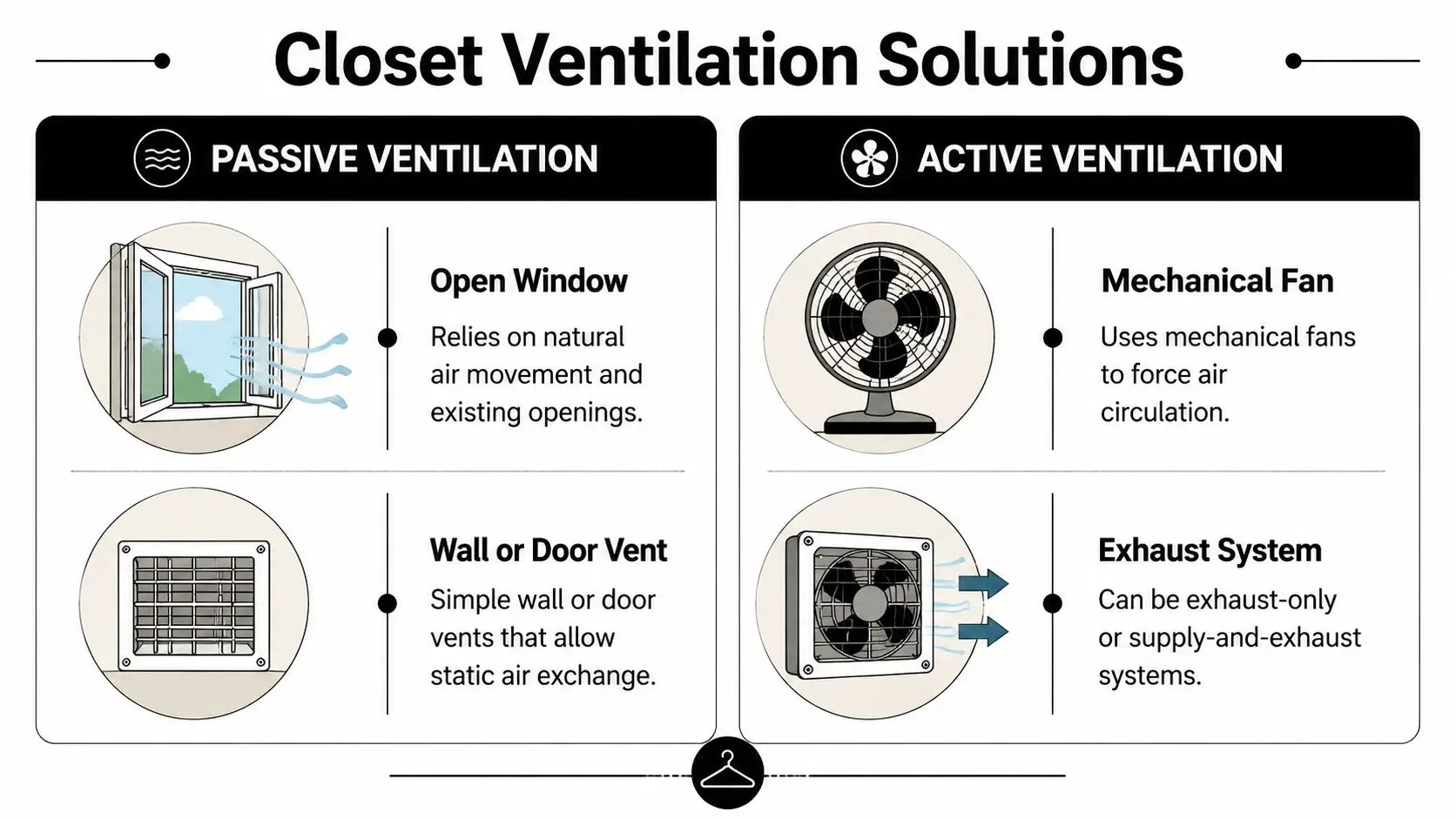
Passive ventilation relies on pressure differences and normal room air movement. In practical terms, that usually means a door undercut, a louvered door, or a transfer grille into an adjacent conditioned space. For a closet with light odor, no visible damage, and no history of water intrusion, that is often the cleanest first step.
Schneider Electric's analysis of small enclosed-space cooling found that passive venting removes heat more effectively than a fully sealed enclosure in small spaces used for equipment, which supports the same basic principle in storage closets: trapped air creates problems, and an air path helps (Schneider Electric analysis of small enclosed-space cooling).
Passive venting is usually the better fit when:
- The closet opens to a conditioned hallway or bedroom. The surrounding air is already reasonably dry.
- The odor is occasional, not constant. A closed-up smell that clears after the door is open points to stagnant air more than active moisture.
- You need a low-noise, low-maintenance fix. No motor, no wiring, less to fail.
- The closet is not part of a recent restoration job. Passive airflow helps maintenance. It does not dry wet building materials on a reliable schedule.
When active ventilation is the better tool
Active ventilation uses a fan to move air on purpose. That matters in Phoenix homes because many closets are interior spaces with little natural air movement, especially in newer homes with tighter envelopes. It also matters after water damage, when drying speed affects whether odor stays cosmetic or turns into a mold problem.
I recommend stepping up to active ventilation when the closet has a steady moisture load, sits next to a bathroom or laundry area, stores damp linens, or has already had a leak repaired. In those cases, waiting for natural airflow is often too slow. As noted in the same Schneider Electric analysis, fan-assisted ventilation is the better approach when the enclosed space has more heat or moisture to remove.
A fan also gives you control. You can run it on a timer, pair it with a humidity switch, and create a consistent airflow path instead of hoping the AC cycle does enough work.
In a post-loss closet, passive venting helps maintain conditions. Active venting is what actually moves air fast enough to support drying and odor control.
Closet venting methods compared
| Method | How It Works | Best For | Relative Cost | Installation Difficulty |
|---|---|---|---|---|
| Door undercut | Increases airflow under the door | Mild stuffiness in a dry closet | Low | Low |
| Louvered door | Moves air through the door itself | Bedroom and hall closets | Low to moderate | Moderate |
| Wall transfer grille | Shares air with an adjacent room | Interior closets with no exterior wall | Low to moderate | Moderate |
| In-wall or through-wall fan | Actively pulls air between spaces | Persistent musty odor or humidity | Moderate | Moderate to high |
| Ducted mechanical ventilation | Moves air through a planned exhaust path | Restoration-sensitive closets, heat-producing contents, recurring moisture issues | Higher | High |
There are trade-offs. Passive options are quieter, cheaper, and easier to keep code-compliant. Active systems work better for moisture, but they need power, airflow planning, and more attention to fire separation, noise, and where the air is being discharged.
For a mild, isolated problem, moisture absorbers can help with short-term control between ventilation upgrades. This guide on choosing a closet moisture absorber is a useful companion if the closet is dry but still tends to hold humidity. If the space has damp materials, warped trim, or recurring odor after a leak, skip the absorber-only approach and treat it as a drying problem first.
How to Safely Install a Closet Ventilation System
One of the most practical DIY methods for venting a closet is an inter-closet or closet-to-adjacent-space fan. It's simple enough for a capable homeowner, but only if you treat it like a real wall modification and not a quick cut-and-screw project.
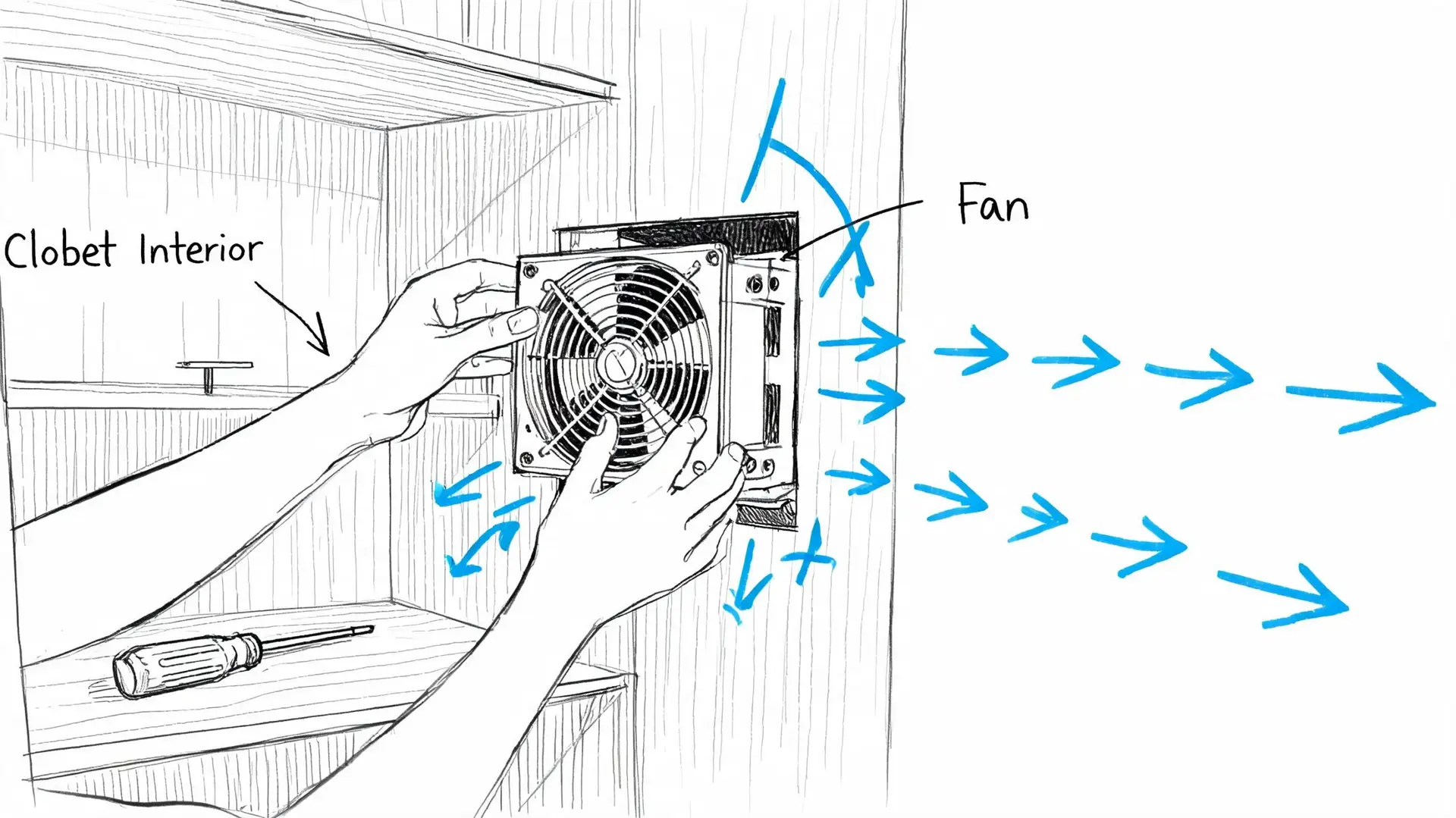
A Fine Homebuilding case study described a successful setup using an 11-inch square opening, a 50 to 80 CFM exhaust fan, and a 24-hour timer set to run 2 hours nightly. That under-$100 approach eliminated musty odors by creating a steady airflow path and reducing humidity below the 60% mold-growth threshold, as documented in the Fine Homebuilding example.
Start with safety checks
Before cutting drywall, confirm three things:
- The wall is clear of utilities. Use a stud finder with wire detection. Don't assume a simple closet wall is empty.
- The wall is not part of a required fire separation. This matters near garages, mechanical spaces, and some multifamily conditions.
- The airflow has somewhere to come from. A fan can't move air effectively if the closet door seals tight at the floor.
A lot of failed DIY installs come down to one issue: the fan was added, but no return air path was provided. That leaves the fan struggling against a vacuum effect.
A practical install sequence
This kind of project usually goes best in a shared wall between two closets or between a closet and another interior space where odor transfer won't create a new problem.
- Locate the studs: Mark the bay carefully. Stay high enough to avoid shelf conflicts and low enough to service the fan.
- Cut the openings cleanly: An oscillating multi-tool gives better control than a reciprocating saw in finished interiors.
- Frame the opening: Add blocking so the fan body mounts solidly and the drywall edge won't crumble over time.
- Install the fan unit: Quiet bath-style fans are a good fit. Panasonic models are commonly used because they're compact and low-noise.
- Provide power safely: If you're plugging into a nearby receptacle, use a timer rated for the load and keep cords protected, not pinched through trim or drywall.
- Create the air path: Trim the door if needed so air can enter the closet while the fan pulls from the opposite side.
Here's a visual walkthrough before you start laying out cuts:
Small details that make the system work
The fan itself gets the attention, but the surrounding details decide whether the project solves anything.
A closet fan without makeup air is like a bathroom fan in a sealed box. It runs, but it doesn't clear much.
Use a simple hygrometer to check whether the space improves after installation. Also pay attention to where the exhausted air goes. Moving musty air into another problem area just relocates the issue.
If you're opening walls and modifying enclosed spaces, it's smart to review a fire safety inspection checklist before you begin. It helps catch the kinds of separation and penetration issues homeowners often miss.
Keeping Your Closet Ventilation Safe and Legal
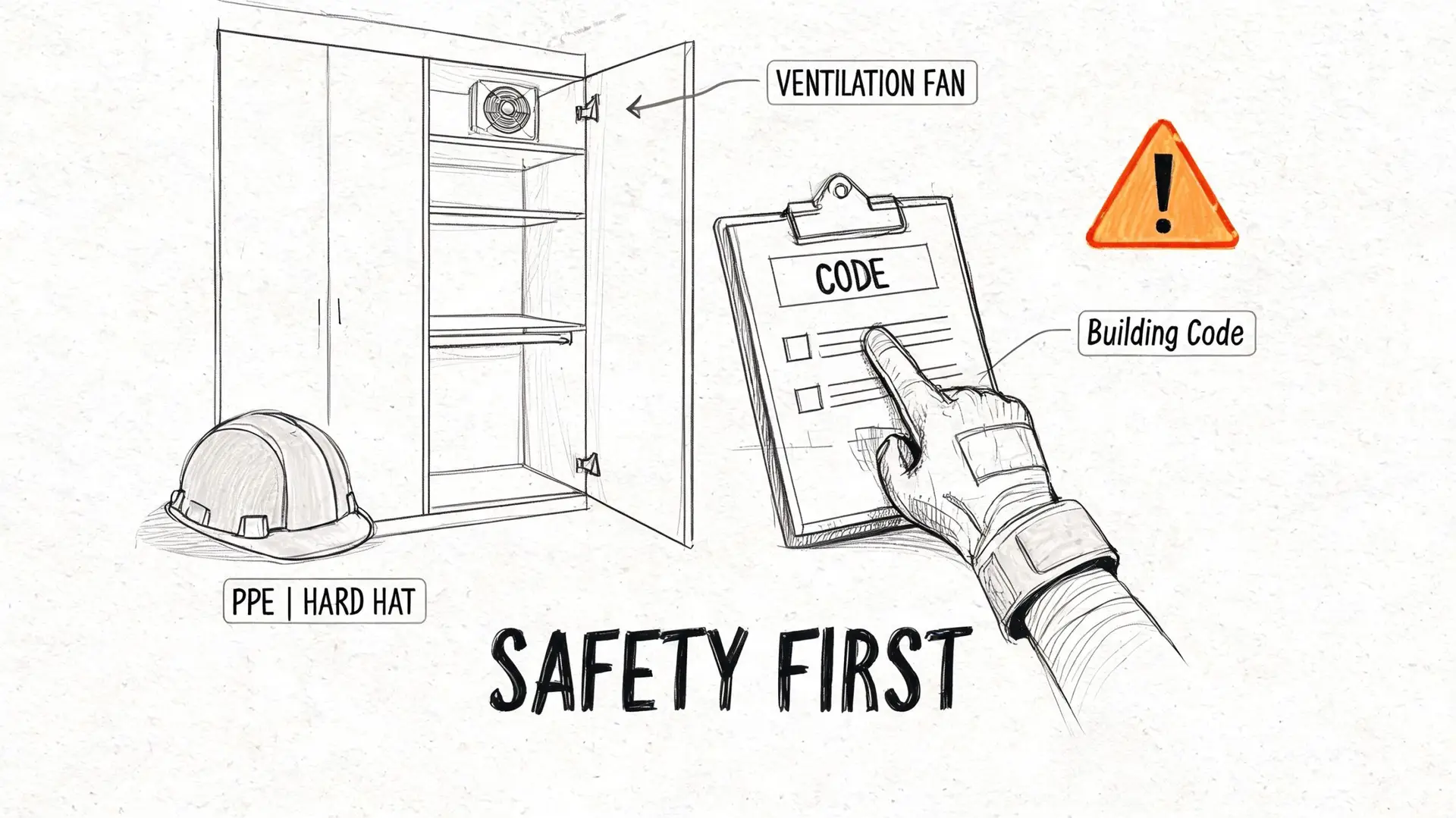
A closet vent can be effective and still be wrong. That's the part many online tutorials skip. In restoration work, we look at the whole building, not just the one opening being cut.
Professional drying protocols treat ventilation as part of a larger air-management plan. Improperly venting a closet can interfere with whole-home drying setups or create unwanted pressure effects in normal occupancy, as discussed in this overview of the gap between simple venting and integrated restoration airflow planning.
Walls you should not casually open
Some walls serve more than one purpose. A wall between the house and garage is the classic example. Some utility and multifamily assemblies also have fire-resistance requirements. If you cut those without understanding the assembly, you can reduce the safety of the home.
That doesn't mean a vent is impossible. It means the detail matters. Sometimes a listed component or a different routing strategy is needed.
Electrical shortcuts aren't worth it
Closet fans often look simple because the load is small. The risk is still real.
Keep these basics in mind:
- Use proper power access: Don't snake loose wiring through wall cavities unless you know the code and installation requirements.
- Protect damp-area circuits where required: Closets near laundry rooms, bathrooms, or other moisture-prone areas deserve extra caution.
- Avoid extension-cord solutions: Temporary cords become permanent surprisingly fast, and permanent use in enclosed spaces is a bad habit.
Pressure balance matters too
Air has to come from somewhere and go somewhere. If a closet fan pulls from a room that's already pressure-sensitive, you can create comfort and odor issues elsewhere in the home. In a restoration setting, poor pressure planning can also move contaminants where they shouldn't go.
Field note: The best closet vent is the one that improves the closet without creating a new problem in the room next to it.
The legal side is local, and the practical side is universal. If you don't know whether a wall is rated, whether a fan path is appropriate, or whether the electrical connection is compliant, stop there and verify it before cutting.
Knowing When DIY Is Not the Answer
Some closet problems are airflow problems. Others are damage problems wearing an airflow disguise.
If you open the closet and find a few isolated mildew specks on a washable surface, you may be able to improve storage habits, increase air movement, and monitor the space. If you find repeated odor, staining, soft drywall, warped trim, or signs that moisture has traveled beyond the closet, the job has changed.
Red flags that call for a pro
These are the conditions that should stop a DIY venting project:
- Visible growth across multiple surfaces: That suggests a broader contamination issue, not just stale air.
- Drywall that feels soft or swollen: Water has likely been there longer than you thought.
- Recent flooding, overflow, or pipe leaks: Drying strategy matters in the first critical window.
- Odor that returns quickly after cleaning: The source may be in wall cavities, carpet backing, insulation, or stored contents.
- Any sewage-related event: That is not a basic ventilation problem.
Why judgment matters more than confidence
A lot of homeowners are comfortable with tools. That's good. The issue isn't whether you can cut drywall. It's whether you can tell the difference between a circulation fix and a moisture-remediation project.
That same principle shows up in other home systems too. This article on why professional plumbing matters in Big Bear makes the point well. Some repairs look small until hidden damage, safety concerns, or code issues turn them into a larger job. Closet moisture problems behave the same way.
The right next step when the closet is part of a bigger loss
If the smell started after a burst pipe, appliance leak, roof issue, storm intrusion, or prior mold event, professional help isn't about overreacting. It's about finding residual moisture, drying the structure correctly, and preventing the closet from becoming the place where the problem comes back first.
For homeowners dealing with confirmed or suspected contamination, this page on mold removal services near me is a practical place to understand what professional remediation typically addresses.
A good DIY rule is simple. Venting a closet makes sense when the closet is the problem. It does not make sense when the closet is only the symptom.
If your Phoenix home has a musty closet after a leak, flood, or unexplained moisture issue, Restore Heroes can help assess the cause, dry affected materials, and address mold and odor concerns with an IICRC-certified restoration approach.