
If you've caught a musty whiff or spotted some funky discoloration around your home, your first instinct is probably to Google "mold removal services near me." Good. That's exactly the right move, because what looks like a minor annoyance can often be the tip of the iceberg for a much bigger, hidden problem.
Understanding Phoenix’s Unique Mold Challenges
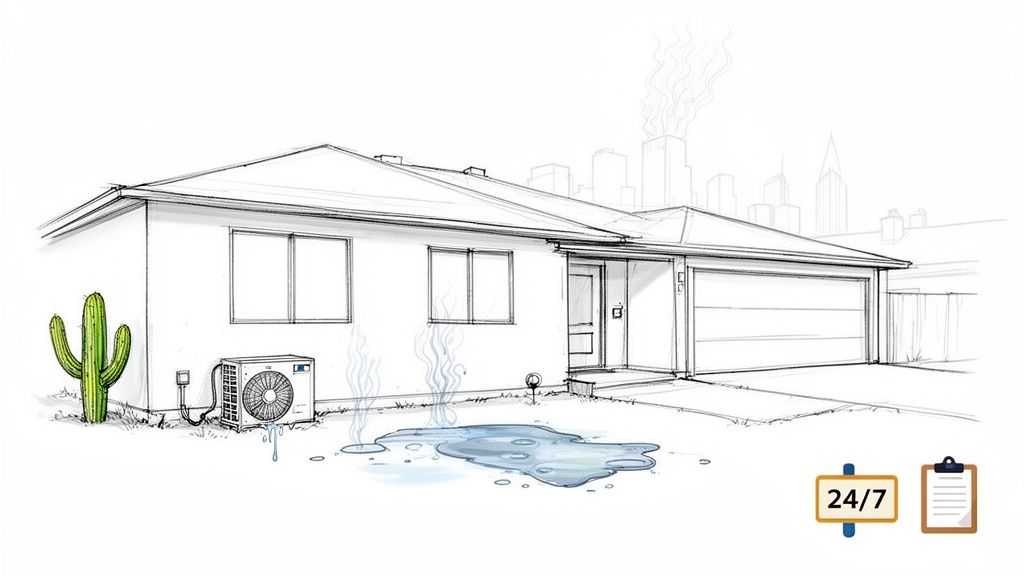
You'd think the dry heat in Phoenix would keep mold at bay, but our local climate actually creates some surprisingly perfect conditions for it to thrive. The mold threats here are unique to our desert lifestyle, and they can turn even the most well-kept homes into a breeding ground. Tackling these issues fast is non-negotiable when it comes to protecting your home and your health.
This isn't just a local problem; it’s a growing concern worldwide. The mold remediation market was already valued at around USD 9.5 billion in 2023 and is projected to hit USD 15.2 billion by 2032. That's a huge jump, and it’s happening because more people are becoming aware of the health risks mold poses. You can dive into the full market analysis over at dataintelo.com.
The Local Factors That Fuel Mold Growth
Here in the Valley of the Sun, mold doesn't need a damp, dreary season to get started. It capitalizes on a few specific situations common in Arizona homes:
- Monsoon Season Flooding: Our summer monsoons hit hard and fast. The sudden downpours can easily overwhelm drainage systems and cause water to sneak into places it shouldn't be.
- Struggling AC Units: Air conditioners are the unsung heroes of Phoenix, but they work incredibly hard. A leaky or malfunctioning unit can create a steady source of condensation and moisture inside your walls or attic—a perfect hideout for mold.
- Hard Water Pipe Leaks: Arizona's hard water is tough on pipes. Over time, mineral buildup and corrosion can cause slow, hidden leaks that feed mold for weeks or even months before you ever notice them.
That faint musty smell you've been trying to ignore? Think of it as your home’s early warning system. It means mold has already started growing, most likely tucked away behind a wall or under a floor where moisture has found a home.
Why a Professional Inspection Is Essential
Putting off an inspection can lead to serious problems down the road. Mold isn't just ugly; it can trigger allergies, cause respiratory issues, and slowly eat away at your home's structure, tanking its value. The longer it sits, the worse—and more expensive—the damage gets.
This is exactly why having a trusted, IICRC-certified local expert is so crucial. A team like Restore Heroes is available 24/7 for a free onsite inspection, which may give you peace of mind right away. Instead of guessing and worrying, you get a clear, professional diagnosis from people who know Phoenix and its specific mold challenges inside and out. One simple call can turn that nagging uncertainty into a solid action plan, helping to ensure your home is safe and the problem is handled right from the very beginning.
How to Spot the Hidden Signs of Mold
Think of mold like the roots of a tree. That little spot you see on the wall is often just the tip of the iceberg, hinting at a much larger, unseen problem growing behind the scenes. Most people only think to search for "mold removal services near me" after they find visible growth, but the real trouble often starts with more subtle clues.
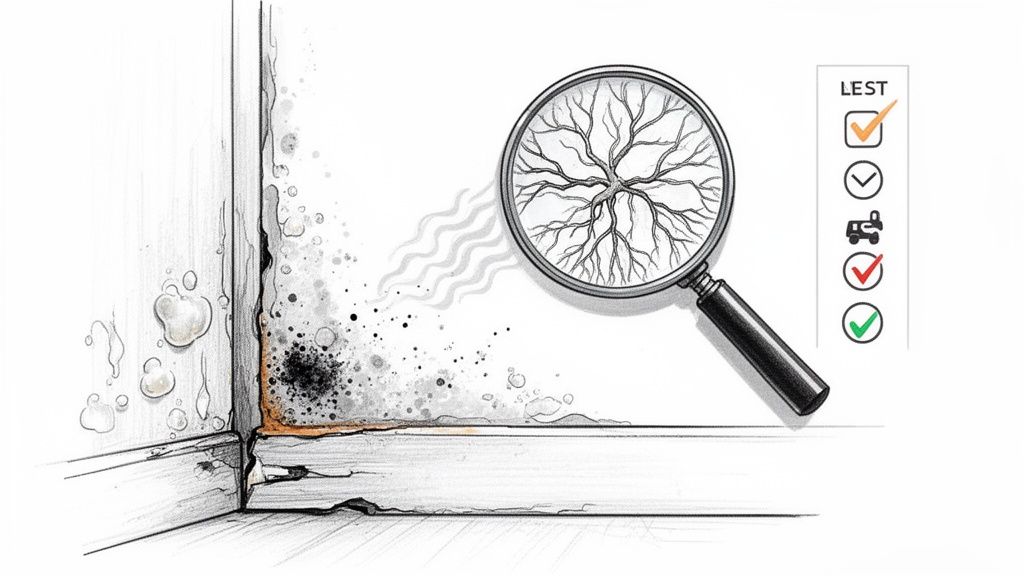
Learning to recognize these early warnings is your best defense. It allows you to catch a developing issue and get a professional opinion before it spirals into a major headache.
Trust Your Senses and Observations
Your own senses are surprisingly effective tools for detecting hidden mold. Long before you see anything, you'll likely smell or even feel its presence.
That persistent, earthy, or musty odor is the classic giveaway. If you notice the smell gets stronger in a particular spot—like the basement, a bathroom cabinet, or the laundry room—that's a huge red flag. Don't just write it off as a generic "damp smell." It’s a direct signal that mold is actively growing somewhere close by.
Also, pay close attention to how your family feels inside the house. Are you dealing with allergy-like symptoms that just won't quit, like sneezing, coughing, or itchy eyes? If these issues seem to get worse at home but clear up when you leave, mold could very well be the culprit.
That musty smell isn't just a nuisance; it's a byproduct of mold's life cycle. As mold grows, it releases gases called microbial volatile organic compounds (MVOCs). What you're smelling is literal evidence of an active, growing colony.
Physical Clues Around Your Home
Beyond what you can smell or feel, your house will often show physical signs of a moisture problem—and where there's moisture, mold isn't far behind. Keep a sharp eye out for these tell-tale changes:
- Paint and Wallpaper Changes: Notice any paint that's bubbling, peeling, or cracking? That often means moisture is trapped underneath, pushing the paint right off the wall. The same goes for wallpaper that's peeling away or showing odd discoloration.
- Warped or Stained Surfaces: Drywall and wood are like sponges. When they soak up moisture, they can start to warp, bow, or feel soft and spongy. Check your baseboards, ceilings, and walls for any weird curves or stains. Those yellowish-brown water marks are a dead giveaway.
- Condensation Issues: A little condensation on a window is normal, but if you're seeing it constantly on windows, pipes, or other surfaces, your indoor humidity is too high. This creates the perfect damp environment for mold to set up shop, even without a major leak.
We dive deeper into how moisture impacts your home in our guide on the signs of mold in walls.
Mold Warning Signs Checklist
Use this quick checklist to give your home a regular inspection. A few minutes of searching can help you spot a small issue before it becomes a massive, expensive problem.
| Warning Sign | Where to Look | What It Could Mean |
|---|---|---|
| Musty Odors | Basements, bathrooms, laundry rooms, closets | Active mold is growing nearby, releasing gases. |
| Visible Stains | Ceilings, corners, walls, near plumbing | A slow leak or past water damage has occurred. |
| Bubbling Paint | Walls, especially near windows or baseboards | Moisture is trapped behind the paint, causing it to separate. |
| Warped Materials | Wood floors, baseboards, drywall | Materials have absorbed moisture and are swelling or bending. |
| Health Symptoms | Unexplained allergies, coughing, sneezing at home | Your body may be reacting to airborne mold spores. |
Catching any of these signs early is the key to protecting both your home and your family's health.
The Difference Between DIY Cleaning and Professional Remediation
When you spot mold, your first instinct might be to grab a bottle of bleach and go on the attack. I get it. But as tempting as it is to tackle it yourself, that common DIY approach can often make things much, much worse. It’s a bit like just pulling the tops off of weeds—it looks better for a little while, but since you never got the roots, you know they'll be back.
Professional remediation, on the other hand, is a full-scale, root-and-all approach. It’s a methodical process designed not just to scrub away the stain, but to eliminate the mold and fix the conditions that let it grow in the first place. Knowing this difference is key when you're searching for "mold removal services near me" that will actually solve the problem.
Why DIY Methods Fall Short
The biggest issue with trying to clean mold yourself is what you can't see. Mold spores are microscopic, they float on the slightest air current, and they are incredibly tough. The moment you start scrubbing at that visible patch of mold, you're disturbing the colony and launching millions of these invisible spores into the air.
That's where a small problem can turn into a huge one. Those airborne spores can easily travel through your home’s HVAC system, finding new places to land and start new colonies. Suddenly, that isolated spot in the corner of your bathroom has turned into a whole-house issue.
Here's a hard truth: household cleaners like bleach are mostly useless on porous materials like drywall or wood. Bleach might kill the surface mold and get rid of the ugly stain, but it doesn't soak deep enough to kill the "roots" of the mold. The core of the problem is left behind, ready to grow again.
The Professional Remediation Advantage
Certified technicians come at mold from a totally different angle. The entire strategy is built around safety, containment, and thoroughness. We don't just clean; we remediate. It’s a detailed, multi-step process that a simple spray-and-wipe job can never match.
Here’s what really sets a professional service apart:
- Proper Containment: We use heavy plastic sheeting to build physical barriers and run negative air pressure machines to completely seal off the affected area. This is a critical step—it stops spores from escaping and contaminating the rest of your home while we work.
- Specialized Equipment: Our teams use commercial-grade equipment like HEPA vacuums and air scrubbers. These machines are specifically designed to capture tiny mold spores from the air and surfaces, something your household vacuum just can't do.
- Addressing the Source: This is the most important step. We find and fix the moisture problem that let the mold grow in the first place. Whether it's a leaky pipe or poor ventilation, without stopping the water, any cleanup is just a temporary fix.
Safety and Expertise Matter
Dealing with mold without the right personal protective equipment (PPE) can expose you and your family to allergens and mycotoxins. Certified technicians are trained to handle contaminated materials safely, protecting everyone from exposure. For a deeper dive into this, our article on how to remove black mold from drywall offers more detailed insights.
Ultimately, choosing professional remediation isn't just about cleaning up a mess. It’s about restoring a safe and healthy environment for your family. It's the difference between a quick visual fix and a lasting solution that protects both your property and your health.
What a Professional Mold Remediation Process Involves
Seeing a team of professionals show up to handle a mold problem can be a little intimidating, but understanding what they're doing can turn that stress into relief. This isn't just a deep clean; it's a systematic process designed to get rid of the mold and help prevent it from coming back. Think of it less like a housekeeping task and more like a minor surgical procedure for your home's health.
The work starts long before anyone picks up a cleaning tool. A certified team follows a precise set of steps, each one building on the last, to help ensure no corner is missed and no hidden spores are left behind.
This flowchart really highlights the difference between a quick DIY spray-and-pray and a thorough, professional job that gets to the root of the problem.
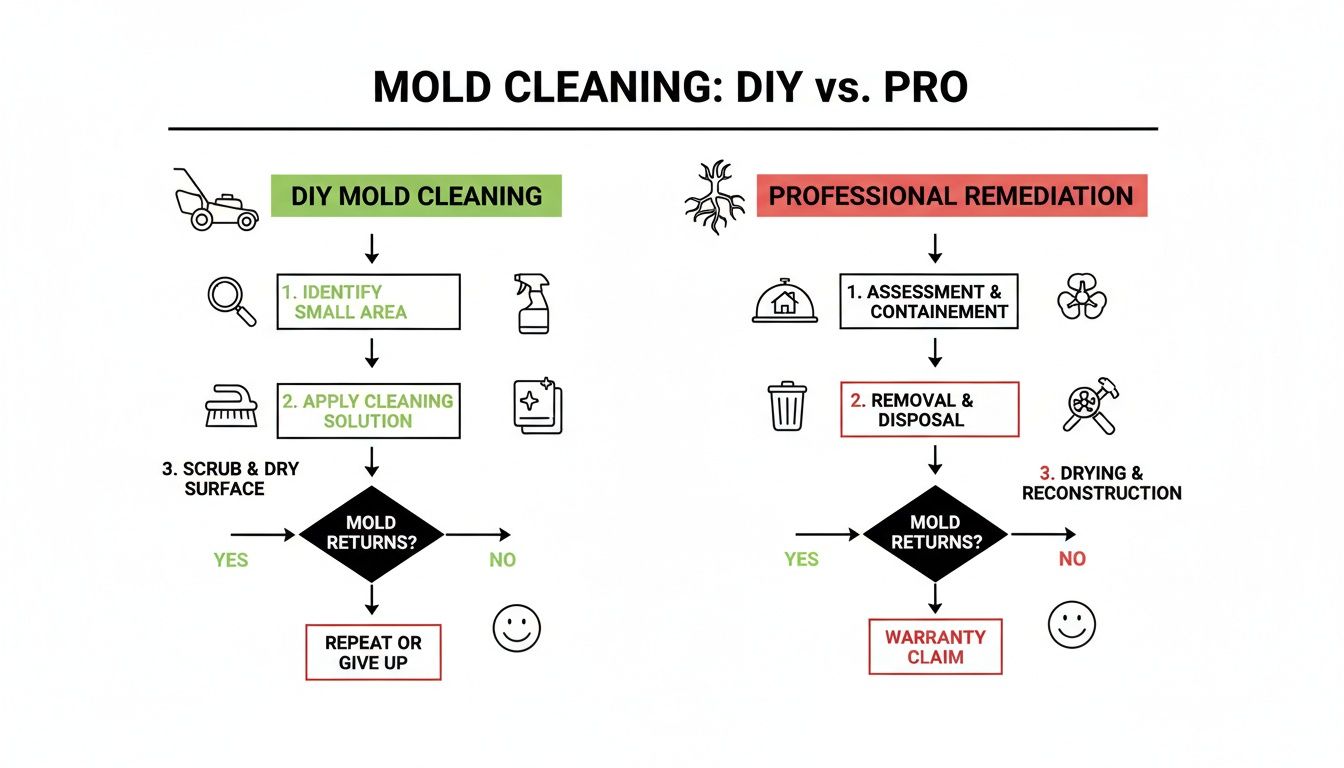
As you can see, DIY methods often just knock down the visible part of the problem. True remediation is about digging out the entire issue so it's less likely to grow right back.
Step 1: Detailed Inspection and Assessment
It all begins with a thorough inspection. Our technicians come equipped with more than just a flashlight; they use specialized tools like moisture meters and thermal imaging cameras. This tech allows them to see behind walls and under floors to find not only the mold you can see but also the hidden moisture that's feeding it.
This initial diagnostic phase is critical. It's like creating a blueprint for the entire project, telling us exactly how big the problem is, where the water came from, and what equipment and safety measures are needed to fix it right.
Step 2: Isolating the Contaminated Area
Once we know the full scope of the issue, the very next priority is containment. We have to stop microscopic mold spores from traveling to clean areas of your home. To do that, we set up a sealed containment zone.
This involves two key actions:
- Creating Physical Barriers: We use heavy-duty plastic sheeting and tape to completely seal off doorways, air vents, and any other openings.
- Setting Up Negative Air Pressure: We use specialized machines called air scrubbers that pull air from the contaminated area. This air is forced through HEPA (High-Efficiency Particulate Air) filters before being safely exhausted outside, which helps to capture any spores we kick up, rather than circulating them.
This step is absolutely non-negotiable for a safe and effective job. It’s what protects your family and the rest of your property from cross-contamination while we work. The demand for this level of detail is why the professional remediation market is projected to grow from USD 1.50 billion in 2024 to over USD 2.02 billion by 2032. Why? Because certified remediation can cut the chances of mold returning by an incredible 90%.
Step 3: Removing Contaminated Materials and Cleaning
With the area safely contained, the real work of removal begins. Anything porous that has been heavily contaminated—think drywall, insulation, or carpet—can't be saved. These materials are carefully cut out, double-bagged in thick plastic, and disposed of according to strict local and federal regulations.
Hard, non-porous surfaces are treated differently. They're meticulously scrubbed and cleaned with powerful, EPA-approved antimicrobial agents.
This is so much more than a simple wipe-down. Our technicians use special cleaning techniques and HEPA vacuums to capture every last spore from every surface inside the containment zone. Nothing gets left behind.
A truly complete remediation often involves looking beyond the immediate area. We frequently recommend professional duct cleaning services to clear any spores that may have settled in your HVAC system, preventing them from being blown through your house later. After everything is cleaned, we bring in high-powered equipment to get the area bone-dry. You can read about some of this gear on our post about https://restoreheroesaz.com/water-damage-fans/.
Finally, for your total peace of mind, we can arrange for an independent third-party professional to conduct post-remediation testing. This air quality test verifies that the mold levels have returned to a normal, acceptable state and the area is officially safe, giving you complete confidence in the results.
The Cost of Mold Removal and How Insurance Can Help
Let’s face it, after the shock of finding mold, your first two thoughts are probably: "What's this going to cost me?" and "Will my insurance actually cover this?"
There’s no simple, one-size-fits-all answer. The cost of professional mold removal isn't a flat fee because every situation is unique. Think of it less like buying a product off the shelf and more like calling a specialist for a custom solution—the price depends entirely on the problem at hand.
What Goes Into the Cost of Mold Remediation?
Several key factors determine the final price tag for a mold removal project. The biggest one is simply the scale of the problem. A small patch of mold on a bathroom wall is a completely different beast than a widespread issue that has crept into your HVAC system and multiple rooms.
Here’s what our technicians look at when assessing the job:
- Size of the Moldy Area: We measure the total square footage of contamination. More space means more labor, more specialized materials, and more time to get the job done right.
- Location, Location, Location: Mold growing on an open wall is one thing. Mold hiding behind drywall, tucked away in a crawlspace, or spreading through an attic is much harder to get to, which impacts the complexity and cost.
- What Materials are Affected?: Cleaning mold from a non-porous surface like glass or tile is relatively straightforward. But for porous materials like drywall, carpet, or insulation, the contaminated sections often have to be cut out and completely replaced, which adds to the project's scope.
- Is There Structural Damage?: If mold has been festering for a while, it can start to eat away at wood and other building materials. In these cases, the job goes beyond cleaning and into actual structural repairs.
Will Homeowner's Insurance Cover Mold? It Depends.
Trying to figure out insurance coverage for mold can feel like reading a different language. Here's the most important thing to know: coverage often comes down to the original source of the water.
Insurers typically draw a hard line between a sudden, accidental water event and a problem that developed slowly due to lack of maintenance.
For example, mold that grows after a pipe suddenly bursts and floods your kitchen has a much better chance of being covered than mold that grew over months from a slow leak under your sink. Your specific policy is king here, so it's crucial to read it carefully. Some policies offer limited mold coverage, while others require a special add-on (often called a rider). For a deeper dive, check out our guide with tips for water damage insurance claims.
The key phrase your insurance adjuster will be looking for is "proximate cause." Was the water damage from a sudden and accidental event, or was it from a slow, ongoing maintenance issue? That distinction is often the deciding factor in whether a claim gets approved.
We know this is a headache. That’s why at Restore Heroes, we work directly with all insurance companies. Our goal is to make the claims process as smooth and straightforward as possible for you.
Making a Smart Financial Decision
Homeowners are more aware of mold's dangers than ever, which is why residential properties are the biggest part of the mold remediation market—a trend expected to continue through 2032. This is particularly true for us here in the Phoenix area, from Mesa and Gilbert to Scottsdale, where our summer monsoons and overworked AC units can create the perfect storm for mold growth.
Beyond the health risks, ignoring mold can seriously hurt your wallet. Studies show that an unresolved mold problem can slash a home's value by a staggering 20-30%. You can read more about these findings from industry reports by Coherent Market Insights.
To help you get clear answers without any pressure, we offer a free, no-obligation onsite inspection. One of our certified technicians will come to your property, perform a thorough assessment, and give you a detailed breakdown of the situation and the costs involved. This way, you have all the information you need to make the best decision for your home and your budget.
Choosing the Right Mold Removal Company in Phoenix
When you search for "mold removal services near me," you’ll get a long list of options. So, how do you sift through them all to find someone you can actually trust with your home and your family's health? This is the most critical step. Getting it right means finding a lasting solution, not just a temporary fix.
The best companies don't just scrub away the visible mold; their goal is to make your home a truly safe and healthy environment again. This takes more than just elbow grease—it requires technical know-how, a solid process, and a genuine commitment to doing right by the customer. A good team will give you clear, honest information, not use scare tactics to rush you into a decision.
Essential Qualifications to Look For
Before you hire anyone, there are a few non-negotiables you need to check off your list. Think of these as your quality control—they’ll help you weed out the amateurs and find a real pro.
Here’s what to ask for:
- IICRC Certification: In our line of work, the IICRC (Institute of Inspection, Cleaning and Restoration Certification) is the gold standard. It’s proof that the technicians have been properly trained on the safest and most effective ways to handle mold.
- 24/7 Availability: Mold and water damage don't stick to a 9-to-5 schedule. A company offering 24/7 service gets that, and they’re ready to jump into action to stop the problem from getting worse.
- Proof of Insurance: This one is huge. Make sure the company is fully licensed, bonded, and insured. It’s what protects you and your property from any liability while they’re on the job.
Verifying a Company's Local Reputation
It's easier than ever to see what past customers have to say. When you're picking a mold removal service, the importance of online reputation is a major factor for homeowners, as it helps build trust. Take a few minutes to look up reviews from other people right here in the Phoenix area.
A solid local reputation is a fantastic sign. When a company has been serving communities like Mesa, Gilbert, Scottsdale, and Chandler for years, it’s because they’ve built their business on delivering real results and earning trust. They have a reputation to protect.
This is where your search for qualified mold removal companies near me pays off. When you choose a certified, locally trusted team like Restore Heroes, you’re not just hiring a crew—you're partnering with neighbors dedicated to getting your home back to normal.
We want to make this easy and stress-free for you. That's why we start with a free, no-obligation inspection. It’s your chance to meet our certified pros, get straight answers to your questions, and see a clear plan of action with zero pressure. Let's turn that overwhelming search into a confident solution.
Got Mold Questions? We've Got Answers.
When you suspect you have a mold problem, your mind probably starts racing with questions. That's completely normal. Getting straight answers is the first step toward peace of mind. Here are some of the most common things Phoenix homeowners ask us when they're searching for "mold removal services near me."
How Long Does Mold Removal Actually Take?
This is a big one, but the honest answer is: it depends. The timeline for getting rid of mold isn't one-size-fits-all. It really comes down to the specifics of your situation—how much mold there is, what kind of material it’s growing on, and where it’s located.
A small, contained spot under a leaky bathroom sink? We can often address that in 1-3 days. But if the mold has worked its way into your drywall, spread through the attic, or gotten into the HVAC system, it’s a more involved job that will take longer. Once we do a thorough inspection, we can give you a solid, realistic timeline.
Can We Stay in the House While You Work?
Your family's safety is our number one priority, period. Because of that, we strongly recommend that you, your kids, and your pets stay clear of the work area while we’re actively removing the mold.
We set up a containment zone with heavy-duty plastic sheeting and use negative air pressure machines. This is a crucial step that helps keep the mold spores from escaping and spreading through the rest of your house. Think of the work zone as a temporary construction site—it’s best to let the pros handle it safely.
Your project manager will walk you through the safety plan before any work begins, so you'll know exactly what to expect.
How Can I Stop Mold from Coming Back?
This is the most important question you can ask. After all, you want a lasting solution, not a quick fix that will just come back to haunt you later. The secret to keeping mold away comes down to one simple thing: moisture control. Without water, mold can't survive.
A true professional doesn't just scrub away the visible mold; they hunt down the source of the water that caused it in the first place. Keeping your home mold-free long-term is all about being proactive.
- Fix Leaks Fast: Don't let a small drip from a pipe or a minor roof leak linger. Tackle it right away.
- Keep Humidity in Check: Your home's humidity should be in a healthy range. If you have a damp basement or bathroom, a dehumidifier can be a lifesaver.
- Let Your House Breathe: Always use the exhaust fans in your kitchen and bathrooms to get that steamy air outside.
By getting to the root of the moisture problem, you're not just cleaning up—you're working to ensure your home stays safe and healthy for years to come.
Ready to get clear answers and a professional opinion on your home's air quality? The IICRC-certified team at Restore Heroes is available 24/7 to provide a free, no-obligation onsite inspection. Visit us online at restoreheroesaz.com to schedule your appointment.