
You open the closet for a shirt or a pair of shoes, and that stale, damp smell hits first. Then you notice a gray film on a shelf, spotting on leather, or a faint haze on the wall behind hanging clothes. Most homeowners assume they need a stronger cleaner. In practice, the cleaner is only part of the fix.
Mildew in a closet usually starts because moisture stayed trapped in a dark, low-airflow space. In Phoenix, that moisture isn't always from outdoor humidity. It can come from an AC issue in an adjacent wall, condensation near a vent, a small plumbing leak from a nearby bathroom, or damp clothes stored before they were fully dry. If you only wipe the surface and move on, the smell often comes back.
A calm, methodical approach works better than panic cleaning. Remove the contaminated items, clean what can be cleaned, dry the closet completely, and then figure out why the space got damp in the first place. If you ignore that last part, you may end up cleaning the same closet again a few weeks later.
That Musty Smell a Sign You Need to Act
A musty closet smell is usually the first warning sign. Homeowners often notice it before they see visible growth. The odor tends to cling to fabric, shoes, handbags, and cardboard boxes because closets trap air and hold moisture longer than open rooms.
Mildew is a surface-level fungal growth. It often shows up as a powdery or flat patch on walls, shelves, fabric, or wood. That matters because surface mildew can sometimes be cleaned successfully. But if the odor stays strong after cleaning, or if discoloration keeps returning, the closet may be telling you the underlying problem is hidden behind the wall, under shelving, or above the ceiling line.
In Phoenix homes, I pay close attention to closets that share a wall with a bathroom, laundry room, or HVAC line set. Air conditioning keeps indoor spaces comfortable, but it can also create condensation problems when there's an insulation gap, a cold line nearby, or restricted airflow inside a tight closet.
Musty odor is not a sign of a dirty home. It's usually a sign that moisture found a place to stay.
There's also a practical safety reason to take it seriously early. If the smell is coming from more than the closet interior, it may be worth checking for broader warning signs such as staining, bubbling paint, or odor spreading into nearby rooms. If that sounds familiar, this guide to signs mold may be growing behind walls can help you spot whether the closet issue is isolated or part of a larger moisture problem.
What usually makes closets vulnerable
- Limited airflow: Closet doors stay shut, and packed clothing blocks circulation.
- Stored damp items: A slightly damp jacket, towel, or pair of shoes can raise moisture in a small enclosed space.
- Nearby building systems: Plumbing lines, condensate lines, and supply vents can all contribute to hidden moisture.
- Porous storage materials: Cardboard, fabric bins, wood shelving, and drywall all hold moisture longer than homeowners expect.
Your Action Plan for Mildew Removal
If you're searching for how to get rid of mildew in closet spaces without making the problem worse, start with containment and sorting. Don't spray everything at once. Empty the space first so you can tell what's affected.
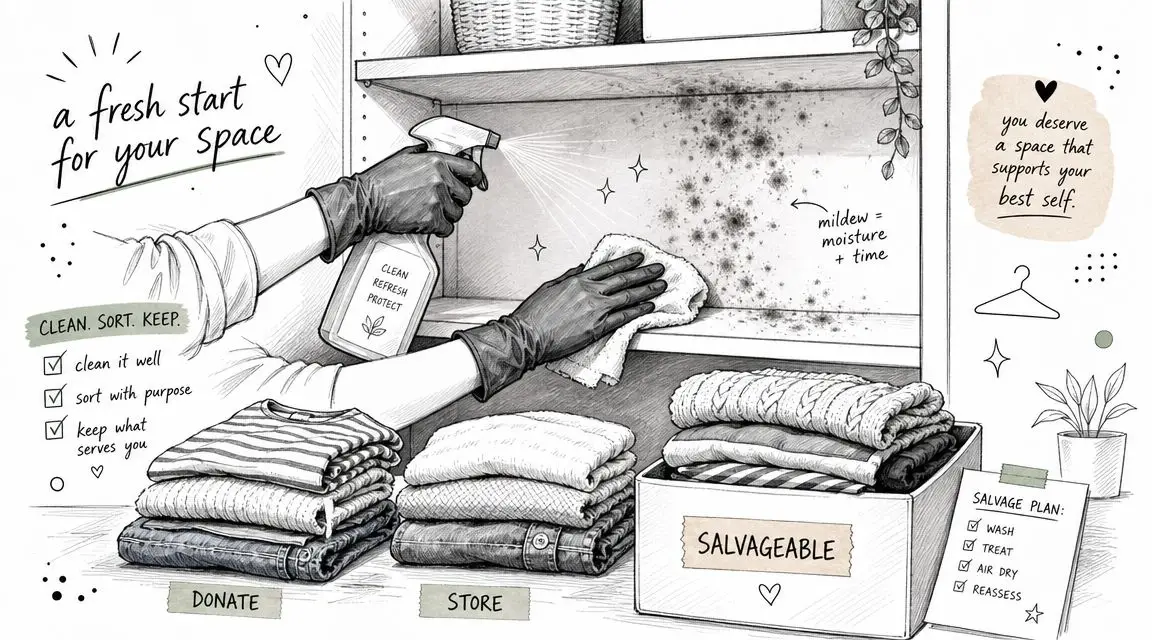
Wear gloves and a mask before you handle contaminated items. If mildew is visible on cardboard, paper, particleboard, or heavily affected fabric storage bins, disposal is often the cleaner and safer choice because porous materials are hard to fully restore once growth is established.
Start with an empty closet
Move everything out into a well-ventilated area. As you sort, create three groups:
- Washable fabrics: Clothing, some linens, and fabric organizers that can go through a cleaning cycle.
- Cleanable hard items: Plastic bins, coated shelving, metal hangers, sealed containers, and non-porous accessories.
- Likely discard items: Cardboard boxes, damaged shoes, porous shelf liners, and anything with visible growth that has penetrated the material.
A lot of homeowners try to clean around belongings. That rarely works. You need direct access to corners, shelf undersides, wall intersections, and the floor line where moisture often lingers longest.
Clean fabrics the right way
For textiles, a pretreat-plus-wash method is the safest practical approach. Guidance for clothing cleanup recommends brushing loose spores outdoors, pre-soaking in a vinegar solution for about 30 to 60 minutes, then washing on the hottest fabric-safe cycle. It also notes that bleach should only be used on bleach-safe whites, and that mixing bleach with vinegar or ammonia creates toxic fumes. Drying in sunlight or high heat can help reduce remaining spores and odor, according to this clothing mildew removal guidance.
Practical rule: Don't put mildewed clothing straight into a packed hamper or back into the closet after washing. If it isn't fully dry, you're rebuilding the same problem.
If odor is still present after one wash, inspect the item before repeating the cycle. Some garments can be saved. Others keep holding odor because the fibers stayed contaminated too long.
Clean hard surfaces without overcomplicating it
For closet walls, shelves, trim, and doors, use a detergent solution or a vinegar-based cleaner on hard, non-porous or semi-non-porous surfaces. Wipe, scrub as needed, and change cloths when they get dirty. The goal is removal, not just wetting the area.
Here's a simple comparison that reflects what works in real household cleanup.
| Solution | How to Use | Best For | Safety Note |
|---|---|---|---|
| Detergent and water | Apply with a cloth or sponge, scrub visible residue, wipe clean | Painted shelves, finished trim, coated surfaces | Avoid soaking drywall seams or unfinished wood |
| Vinegar-based solution | Apply to affected hard surface, let it dwell briefly, then wipe and scrub | Light surface mildew and odor on hard closet surfaces | Never mix with bleach or ammonia |
| Bleach on bleach-safe whites only | Use only for appropriate laundry items, then rinse and wash as directed | White textiles that are bleach-safe | Mixing bleach with vinegar or ammonia creates toxic fumes |
If you've dealt with mildew smell in a bathroom before, many of the same cleaning habits carry over to closet work. This roundup of professional tips for lasting clean bathrooms is useful because it reinforces the same principle: odor control only lasts when moisture control is part of the cleanup.
What doesn't work well
- Air fresheners: They mask odor and leave the moisture problem untouched.
- Heavy spraying without wiping: Wetting mildew doesn't remove it.
- Restocking too soon: Clean shelves that are still damp can restart growth quickly.
- Using every cleaner at once: That raises safety risks and often damages finishes.
Find and Fix the Hidden Moisture Source
A closet mildew problem is often misdiagnosed as a housekeeping issue. In many homes, it's really a building moisture issue that happens to be showing up in the closet first.
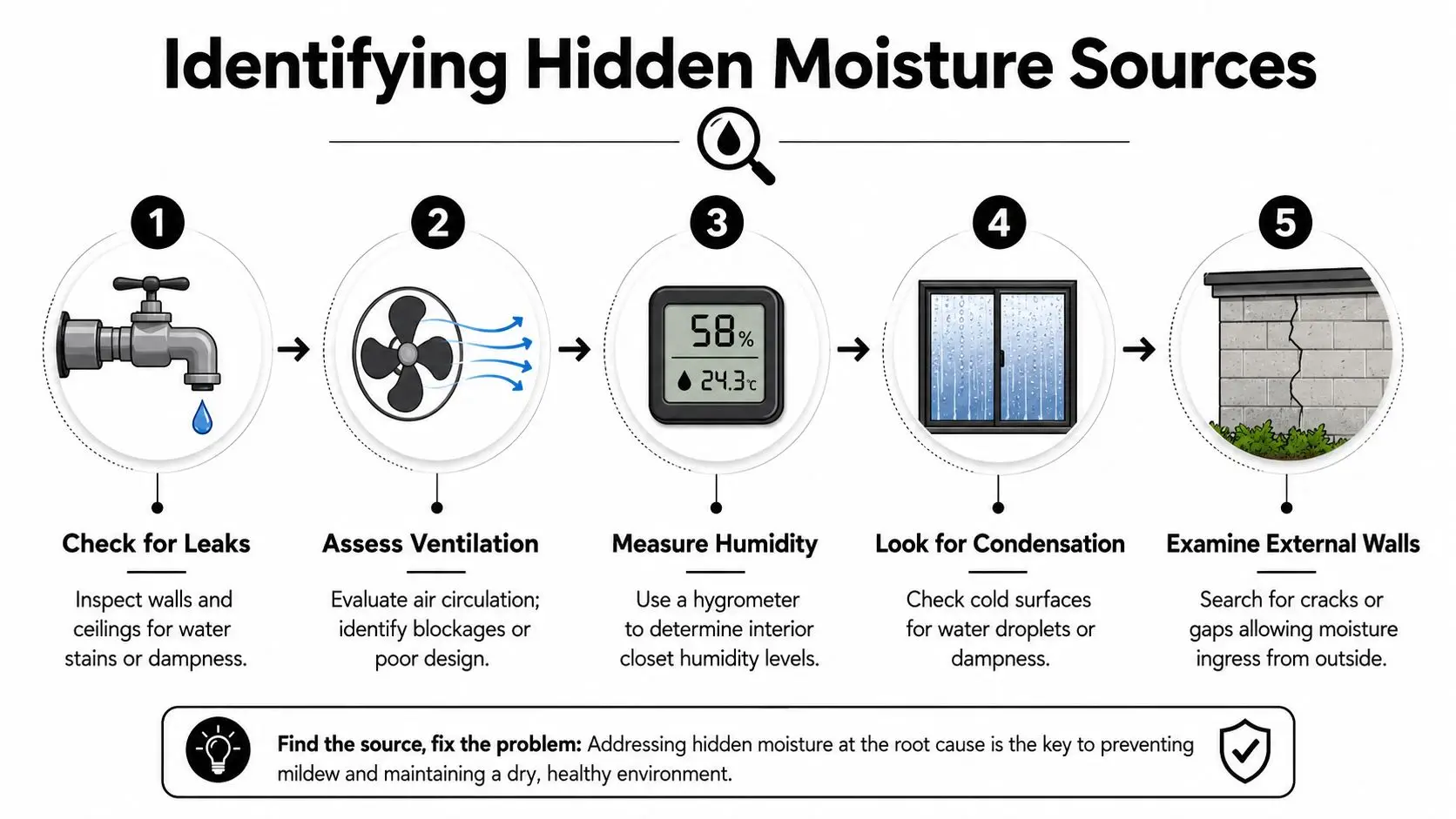
That distinction matters. Inspection-focused guidance points out that many articles stop at scrubbing visible mildew, even though recurring growth often means you need to inspect for hidden leaks, insulation gaps, or HVAC-related condensation in nearby walls, ceilings, and floors. If mildew keeps returning after cleaning, the next move is usually diagnosis, not stronger disinfecting, as noted in this discussion of closet mold as a moisture-pathway problem.
Clues that point beyond the closet surface
A one-time issue usually has a clear cause. A damp coat was stored wet. A drink spilled. A box sat against an exterior wall and trapped moisture. Those cases are frustrating but straightforward.
Repeated mildew is different. Look for patterns like these:
- The smell is strongest near one wall: That can suggest a hidden leak, cold line, or condensation point.
- Only the lower shelf or floor edge is affected: That can indicate moisture wicking upward or coming from an adjacent room.
- The problem worsens when AC runs hard: In Phoenix homes, that can point toward condensate issues, duct sweating, or cold-surface condensation.
- The closet shares space with plumbing: Slow leaks around supply lines, drains, or shower plumbing often show up nearby first.
A practical inspection routine
Open the closet and inspect with a flashlight. Check corners, baseboards, shelf brackets, the ceiling line, and any wall that backs up to a bathroom or air handler path. Touch surfaces carefully. You're looking for cool, damp, or stained areas, not just visible mildew.
If the closet feels noticeably stuffier than the room around it, airflow may be part of the problem. This guide on improving closet ventilation is useful if your closet has dead air, tightly packed contents, or no way for conditioned air to circulate properly.
A moisture meter can also help if you suspect damp drywall or trim but can't confirm it by sight. While the context is different, this piece on preventing costly boat problems gives a helpful plain-language explanation of why moisture meters are valuable for finding trapped water in enclosed materials.
If mildew comes back after a proper cleaning, stop repeating the same cleaning cycle. Find the water source.
Phoenix-specific trouble spots
Closets in the Phoenix area often develop mildew from causes homeowners don't expect:
- AC condensate line issues in or near interior chases
- Cold supply air meeting warm closet air in a tight, under-ventilated space
- Insulation gaps on exterior-facing walls
- Monsoon-season moisture spikes that hit enclosed storage areas first
- Bathroom humidity drift into nearby bedroom closets
This is the point where a professional inspection becomes logical. Not because the cleaning is difficult, but because moisture pathways can be hidden.
Thoroughly Dry and Sanitize the Space
Cleaning is only half the job. Drying is what determines whether the mildew stays gone.
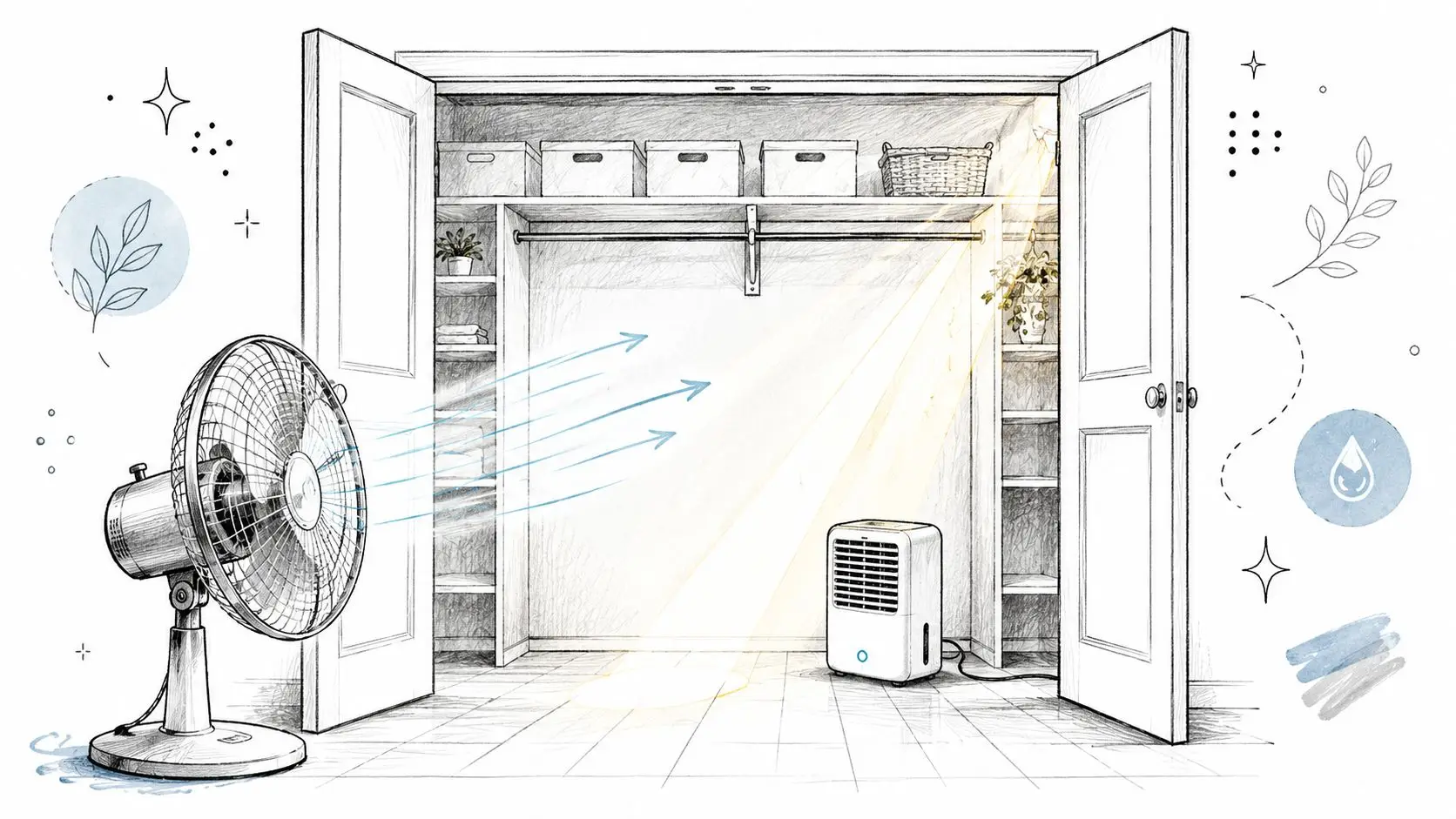
The U.S. EPA says wet or damp materials dried within 24 to 48 hours will usually prevent mold growth, and it advises keeping indoor relative humidity below 60%, ideally between 30% and 50%. The same guidance recommends using fans, open windows, or dehumidifiers to improve airflow and dry the space completely, which is especially important in enclosed areas like closets. You can review that directly in the EPA's mold and moisture guidance for the home.
Drying has to be complete
Leave the closet empty while it dries. Keep the door open. Run a fan so air moves across shelves, walls, and floor surfaces instead of just circulating in the room. If the room tends to hold moisture, add a dehumidifier.
Pay attention to the shelf supports, wall corners, and the floor-to-baseboard joint. Those areas often stay damp longer than the visible center of the wall.
If you need stronger airflow after a leak or repeated dampness, this overview of how restoration drying fans are used gives a practical sense of why directional air movement matters more than “letting it air out” alone.
Final wipe before restocking
After the space is dry, do one more light wipe-down of hard surfaces with your chosen cleaning solution and a clean cloth. This isn't a second heavy scrubbing. It's a final sanitation pass to remove settled residue and confirm the surfaces are dry and clean.
Use this short checklist before anything goes back in:
- Walls feel dry: No cool dampness or tacky finish.
- Shelves are clean: No powdery residue or odor film.
- The floor line is dry: Especially at corners and baseboards.
- Stored items are dry too: Clean clothes, shoes, and bins must be fully dry before restocking.
Patience matters here. Homeowners often undo a good cleanup by refilling the closet too early.
How to Prevent Mildew from Returning
The best prevention plan is simple. Keep the closet dry, keep air moving, and avoid storing moisture inside it.
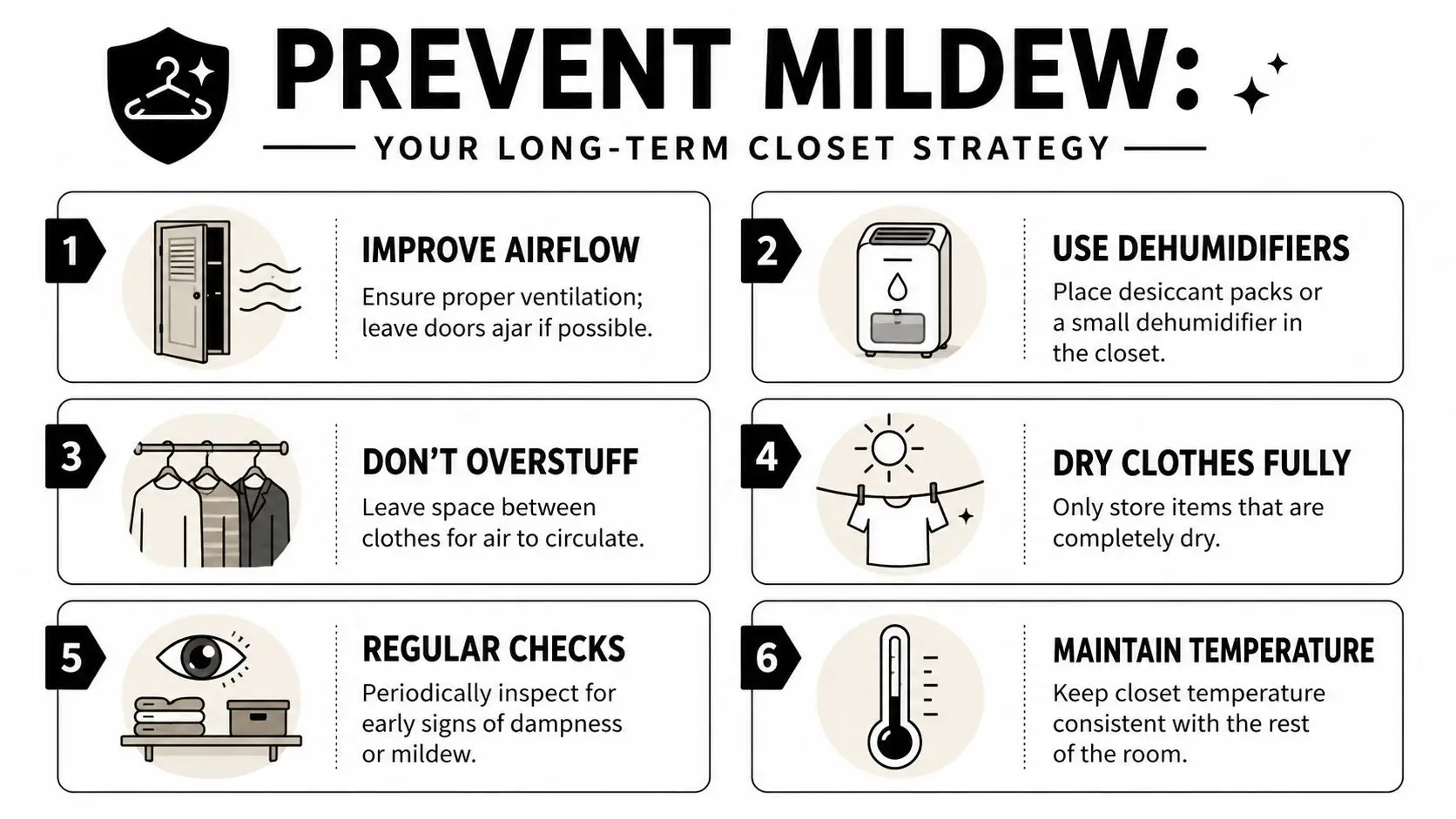
Closet mildew prevention isn't about one miracle product. It's a set of small habits that lower the chance of trapped moisture building up again.
Build a closet that can breathe
A practical cleanup sequence for closets is to empty the space fully, discard porous items with visible growth, clean hard surfaces with a detergent or vinegar-based solution, then dry the area thoroughly with ventilation or a fan before putting anything back. Guidance aimed at closet mildew prevention stresses that moisture control is the step that determines whether mold returns, as explained in this closet mold prevention article.
That same logic applies to prevention. Leave room between hangers. Don't pack shelves tight to the wall. Avoid long-term cardboard storage if the closet has had a moisture issue before.
Prevention habits that actually help
- Store only dry items: Jackets, uniforms, towels, and shoes should be fully dry before they go in.
- Create air gaps: A little space between clothes and between bins does more than fragrance products ever will.
- Use moisture absorbers thoughtfully: Desiccant packs or a small closet dehumidifier can help in problem spaces, but they are backup tools, not a substitute for fixing leaks.
- Check the closet regularly: A quick look and smell test catches trouble earlier than a yearly deep clean.
- Keep conditions stable: Closets do better when they stay close to the temperature and airflow of the room around them.
For a broader house-wide approach, indoor filtration can also support a cleaner environment after remediation. This article on improving indoor air quality through filtration is a useful companion if you're dealing with lingering odor concerns in adjacent rooms.
A short visual walkthrough can also help reinforce what to watch for:
If you want a simple home maintenance reference, this guide on how to prevent mold in a closet covers practical upkeep steps that fit well after cleanup is complete.
A dry, slightly underfilled closet is far easier to keep clean than a tightly packed one full of fabric and cardboard.
When to Call a Phoenix Mold Remediation Company
Some closet mildew problems are small and manageable. Others look small on the surface but point to hidden moisture inside the building. The hard part for homeowners is knowing when they've crossed that line.
A professional call makes sense when mildew keeps returning after cleaning and drying, when the odor stays strong but you can't find the source, or when the affected materials appear to extend into drywall, trim, or adjoining spaces. It also makes sense if anyone in the home is reacting poorly to the area and you want the space assessed more carefully.
If you're in the Phoenix area and need local options, this page on mold remediation companies near you is a practical starting point. Restore Heroes is one local company that handles mold removal, water damage restoration, and structural drying, which is relevant when a closet mildew issue turns out to be tied to a leak or hidden damp building materials.
DIY works best when the issue is clearly limited, the source of moisture is known, and the affected surfaces are accessible. Professional remediation becomes the safer path when the source is hidden, the contamination is recurring, or the closet is only the visible edge of a larger moisture problem.
The biggest mistake I see is not “using the wrong cleaner.” It's assuming the closet itself is the whole problem.
If your closet still smells musty after cleanup, or you suspect the mildew is being fed by a hidden leak, AC condensation, or moisture inside the wall, Restore Heroes can help assess the problem and determine what needs to be dried, cleaned, or professionally remediated.