
You clean a room after painting, open the windows, and expect the sharp solvent smell to disappear. Instead, it returns when the room warms up. Sometimes the odor is strongest near a wall, carpet edge, cabinet, drain, or upholstered chair, even though the original spill looked small.
That pattern matters. A chemical smell may come from volatile organic compounds, residues, or contaminated porous materials, not just from the air. Spraying fragrance or running a fan can make the room seem better while leaving the source untouched. Safe chemical odor removal starts with investigation, then source control, cleaning, adsorption, filtration, and verification.
Introduction to Chemical Odors at Home
A lingering smell after painting, cleaning, flooring work, an appliance leak, or a chemical spill is a signal to slow down. The first question isn't, “What deodorizer should I use?” It's, “What material is releasing this odor, and is the space safe to occupy?”
Carpet padding, drywall, insulation, unfinished wood, upholstery, and cabinet bases can hold residues after the visible liquid has dried. Heat and humidity can increase release from those materials, so an odor that fades during a cool morning may become obvious again in the afternoon. Quick ventilation helps dilute airborne contaminants, but it doesn't remove a soaked substrate or contaminated dust.
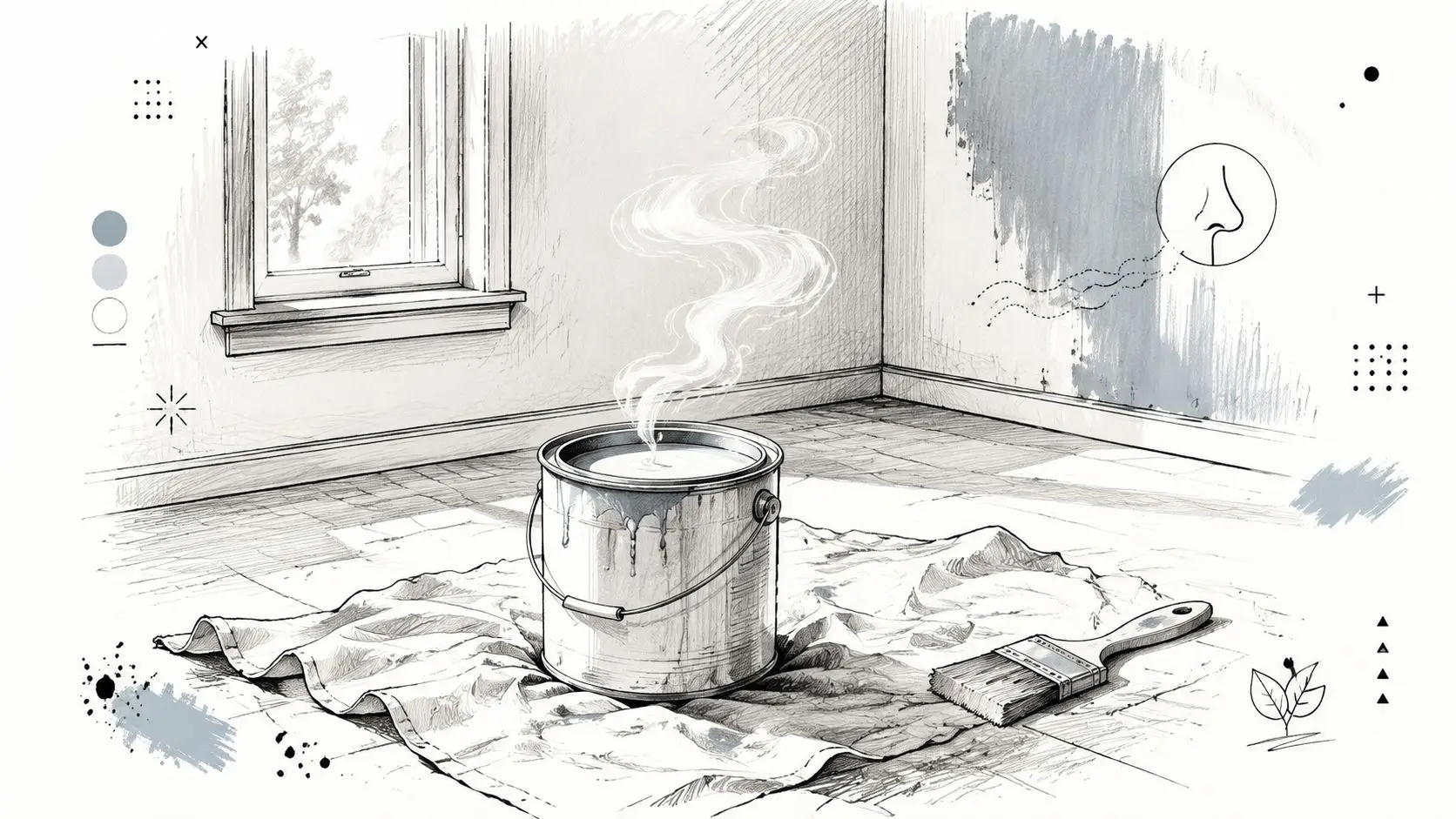
Treat the odor as evidence
Odor can point toward a source, but your nose can't identify every chemical or prove that air is safe. A sweet solvent smell, sharp bleach-like odor, smoky residue, and musty chemical mixture each suggest different questions. A mixed odor can also mean more than one product, a reaction between products, or a chemical source combined with water damage.
Activated carbon technology shows how long odor treatment has been an engineered discipline. Carl Wilhelm Scheele scientifically recognized charcoal's adsorptive power in 1773, including its ability to remove impurities from water that affected taste and odor. In the United States, powdered activated carbon was used for taste and odor control as early as 1928 to 1929, while early granular activated carbon filters appeared in Germany in 1929 and the United States in 1930. By 1932, about 400 U.S. plants used activated carbon for odor control, rising to nearly 1,200 plants by 1943, as documented in this history of activated carbon technology.
That history doesn't mean a bag of charcoal will solve a contaminated home. It shows that adsorption works within a designed treatment system, where contact time, airflow, media condition, and the target compounds matter.
Practical rule: If the smell returns after ventilation, assume the source remains until inspection and cleaning show otherwise.
Some situations shouldn't become a DIY experiment. If anyone has breathing difficulty, unusual dizziness, confusion, eye irritation, nausea, or worsening symptoms, leave the area and contact emergency or poison-control resources as appropriate. For spills, unknown chemicals, fire residues, sewage, or suspected biohazard contamination, use a qualified remediation provider. Restore Heroes also maintains guidance for hazardous clean-up situations.
No chemical odor removal method can guarantee the same result in every building. The right sequence depends on the product, concentration, surface, ventilation, humidity, and whether the source has spread into the structure.
How to Identify the Source and Assess Safety
Before you wash anything, build a simple source map. Start with the most recent activity. Ask whether someone painted, stripped flooring, applied pesticide, used a strong cleaner, repaired an appliance, stored fuel, treated a drain, or brought in new furniture. Check maintenance records if you manage a rental or commercial property.
Don't assume the strongest smell marks the source. Air movement can carry vapors through door gaps, return-air paths, wall cavities, and plumbing penetrations. Close interior doors briefly, then compare rooms from the doorway. Notice whether the odor is stronger near the floor, ceiling, cabinets, vents, drains, or soft furnishings.
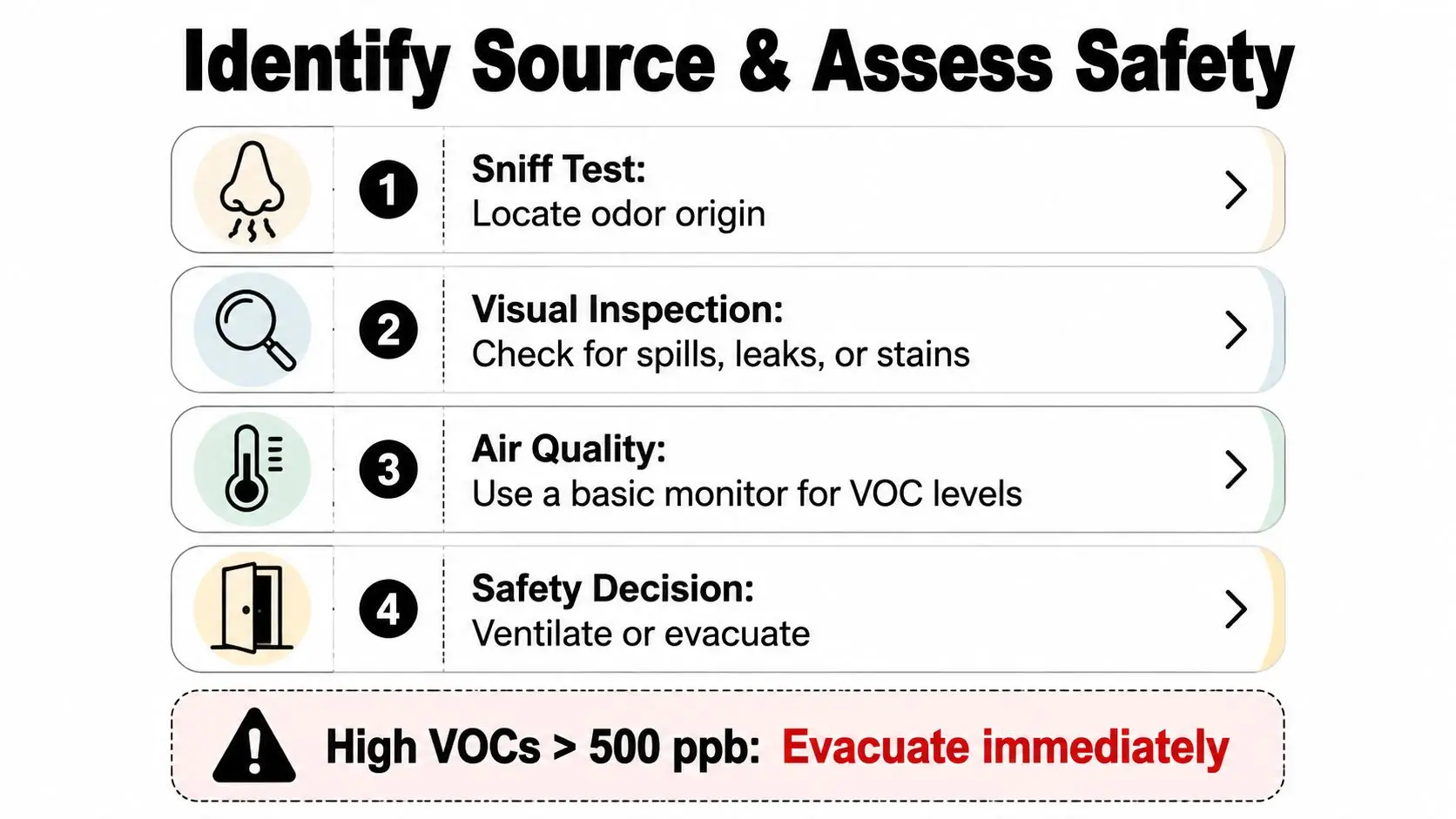
Use observation before equipment
A visual inspection can reveal a wet ring, bubbled finish, discolored grout, swollen flooring, residue on a shelf, or a container with a damaged seal. Look under sinks, behind toilets, around water heaters, inside cabinets, beneath appliances, and along the edge of carpet. Avoid touching unknown residue, mixing products, or leaning close to a suspected spill.
A basic VOC monitor can add context, but it isn't a complete chemical analysis. Readings can change with temperature, humidity, cleaning products, and airflow, and a low reading doesn't prove that every odorant is absent. Use the monitor as one observation alongside the product history, symptoms, visible conditions, and odor pattern. The Phoenix homeowners guide to air quality testing can help you understand why testing needs interpretation rather than a single number.
Make a clear safety decision
Use the information you have to choose among three actions:
- Leave the space: Evacuate if symptoms develop, the source is unknown and strong, a spill is active, or you suspect a dangerous gas or incompatible chemical reaction.
- Ventilate without disturbing materials: If no symptoms are present and the source is known, increase outdoor-air exchange while keeping people and pets away from the affected area.
- Stop and call for help: Get professional guidance when the odor follows smoke, floodwater, sewage, a dead animal, a pesticide application, or a chemical spill into porous construction.
Treat an infographic threshold such as “High VOCs > 500 ppb” as a warning within that visual, not as a universal clearance standard for every chemical. Different instruments measure different compounds, and safe occupancy depends on the substance and exposure conditions.
Drain products deserve extra caution. Never combine bleach, acids, ammonia, or other cleaners, and don't pour an unidentified mixture into a drain just to make the smell disappear. For safer maintenance ideas, review these eco-friendly drain cleaning alternatives from South Mountain Window Cleaning, LLC.
Before cleaning, write down the product names, locations, dates, symptoms, and changes after ventilation. That record helps a technician select appropriate protective measures and prevents guesswork.
Proven Steps for Chemical Odor Removal at Home
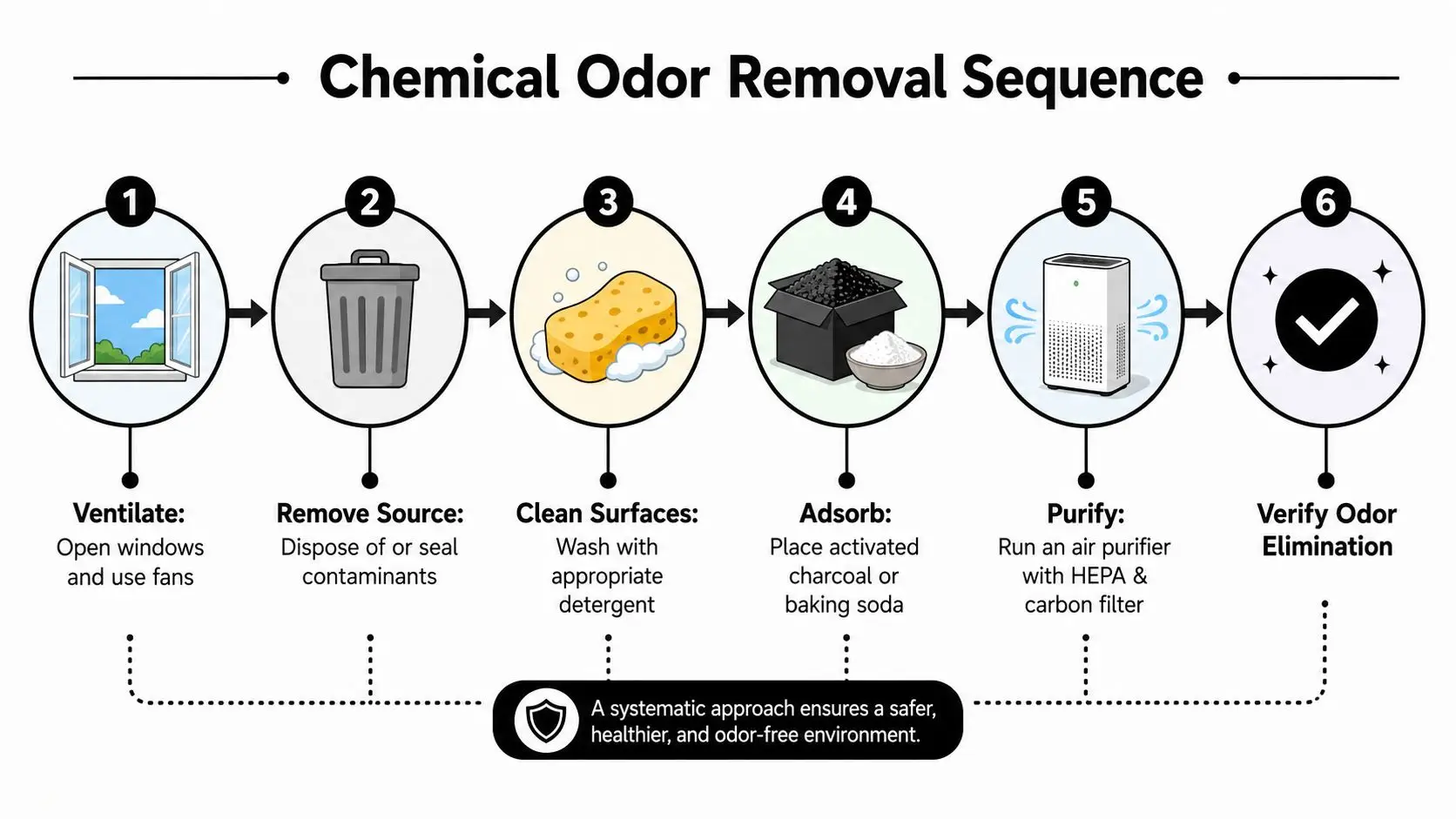
The order of work determines whether you remove the odor or redistribute it. Start with safety and source control, then clean residue, treat the air and remaining emissions, and verify the result under changing conditions.
Control the air and isolate the source
If the space is safe to enter, open exterior windows and use fans to move air outdoors, not deeper into the house. Turn off recirculating HVAC operation if it would carry contaminants through the building. Don't aim a high-velocity fan across a wet spill, because that can spread contamination and increase evaporation into the occupied area.
Remove the source only when you can identify it and handle it safely. Seal or relocate leaking containers, bag contaminated disposable materials, and isolate affected rooms. Don't throw chemical-soaked rags into an indoor trash can. Follow the product label and local disposal rules, especially for solvents, pesticides, fuels, and reactive cleaners.
Clean hard surfaces carefully
Use a compatible detergent and clean water on surfaces that the product manufacturer says can be washed. Work from cleaner areas toward the affected area, change rinse water when it becomes dirty, and let surfaces dry fully. Never combine cleaners to create a stronger treatment. Chemical reactions can produce additional vapors or damage finishes.
Hard surfaces can look clean while retaining an odor film in joints, undersides, cabinet seams, and textured materials. Clean those areas without flooding them. Excess water can push contamination into flooring assemblies or wall materials.
Handle porous materials as contaminated reservoirs
Carpet, pad, upholstery, unfinished wood, drywall, and insulation need a more conservative assessment. If a material absorbed a chemical, surface wiping may not reach the retained residue. Extraction, controlled removal, or replacement may be safer than repeated deodorizer application.
Smoke-related residues need their own treatment logic. A resource on how to remove smoke smell from a house can help distinguish cleaning and deodorization from simple fragrance use. Do not seal or paint over an odor before cleaning, because the coating may trap contamination temporarily and complicate later work.
Use adsorption as a controlled treatment
Activated carbon can capture many gas-phase contaminants, but it isn't a universal sponge. The EPA identifies granular activated carbon as useful for taste- and odor-producing compounds, VOCs, synthetic organic compounds, and disinfection byproduct precursors, with removal efficiencies up to 99.9% for many VOCs such as TCE and PCE in relevant treatment applications, as described in its drinking-water treatment technology overview.
For a home, choose a gas-phase filter with meaningful carbon media rather than relying on a particle filter alone. Place the unit near the suspected source when safe, maintain airflow through the media, and follow replacement guidance. Carbon capacity falls as the media loads, and an odor can return through breakthrough or desorption.
Baking soda can help with limited household odors, but it shouldn't be treated as proof of chemical removal. Bowls of powder, fragrance sprays, and essential oils may change what you smell without reducing the residue that causes it.
Filter and recheck
A purifier with HEPA and carbon components can address particles and some gases, but HEPA by itself doesn't control gaseous pollutants. Run filtration after source removal and cleaning, not instead of those actions. Keep doors positioned so the unit treats the affected zone rather than circulating air throughout the home.
Recheck the room after it has been closed for a period and again when temperature and humidity change. If the smell returns, inspect porous materials, hidden cavities, HVAC pathways, and carbon media. That return is useful evidence, not a reason to add more fragrance.
Choosing the Right Filtration and Treatment Options
The right tool depends on the contaminant and whether the building is occupied. Ventilation can dilute airborne vapors, carbon can adsorb compatible gases, particle filtration can collect suspended material, and oxidation can transform some compounds. None of those categories replaces source removal.
| Method | Best For | Limitations to Watch |
|---|---|---|
| Outdoor-air ventilation | Diluting airborne odors when outdoor conditions are suitable | Doesn't remove absorbed residues and may spread vapors if airflow is poorly controlled |
| Activated carbon or gas-phase filtration | VOCs, hydrocarbons, many aldehydes, organic acids, and compatible odorants | Media saturates, contact time may be too short, humidity and mixed contaminants can reduce performance |
| HEPA particle filtration | Dust, soot, and other airborne particles | Particle-only devices can't control gases and some odors |
| Wet scrubbing | Selected soluble or reactive contaminants in designed systems | Can produce waste liquid and may have poor VOC performance depending on the setup |
| Ozone oxidation | Controlled, unoccupied treatment designed around specific chemistry | Unsafe for occupied spaces, compound performance varies, and byproducts may form |
| Combined treatment trains | Complex odor profiles requiring source work plus air and surface treatment | Requires assessment, sequencing, monitoring, and managed disposal |
The EPA explains that gas-phase filters use sorbents such as activated carbon to adsorb gaseous pollutants. It also notes that these filters can remove most hydrocarbons, many aldehydes, and organic acids, while particle-only devices don't control gases, as described in this residential air-cleaner guidance.
Why carbon often works, then stops
Activated carbon performance depends on the contaminant class, media amount, airflow residence time, humidity, and loading. A pilot-scale odor and VOC study reported average to excellent removal from carbon towers, while wet scrubbers achieved good odor removal but low to negative VOC removal in that comparison. An indoor-air study found VOC-family removal varied across indoor and outdoor conditions and observed aldehyde desorption under some conditions, reinforcing the need to monitor breakthrough rather than assume permanent capture. These findings are summarized in the activated-carbon odor and VOC study.
Small carbon bags can be useful for a cabinet, vehicle, or localized odor source. They won't replace an engineered air-cleaning system when contamination affects a room, HVAC system, or porous building assembly. If you're comparing simple odor-control products, you can review shop odor control at EcoQuest Purifiers while keeping the product's limited capacity and placement in mind.
Why ozone is a poor occupied-space choice
Ozone is often marketed as a powerful deodorizer, but safe indoor concentrations aren't a dependable solution for many chemical odors. The EPA states that ozone concentrations within public-health standards aren't effective against many odor-causing chemicals, and it isn't considered useful for odor removal in building ventilation systems. In one formaldehyde experiment cited by the agency, ozone showed no effect. The agency's ozone generator guidance explains the limitation.
Ozone can also create secondary concerns. EPA testing found that generators can produce indoor exposures above workplace limits and harmful byproducts such as formaldehyde, while ozone can have negative effects on lung function that linger for 24 to 48 hours, according to this EPA evaluation of ozone generators. Never operate an ozone generator around people, pets, or plants, and don't treat reentry as a simple timer decision.
Thermal fogging also requires professional judgment. It can reach some difficult areas, but it doesn't excuse source removal or structural cleaning. A thermal fogging odor removal overview can help explain why treatment method selection should follow the contamination profile.
When to Call Certified Restoration Professionals
DIY work usually stops being sensible when the odor has a complex history. Fire and smoke can leave soot and combustion residue. Floodwater can carry sewage, fuels, cleaners, or biological contamination into porous materials. A single room can then contain VOCs, sulfur compounds, residue, and moisture-related odor at the same time.
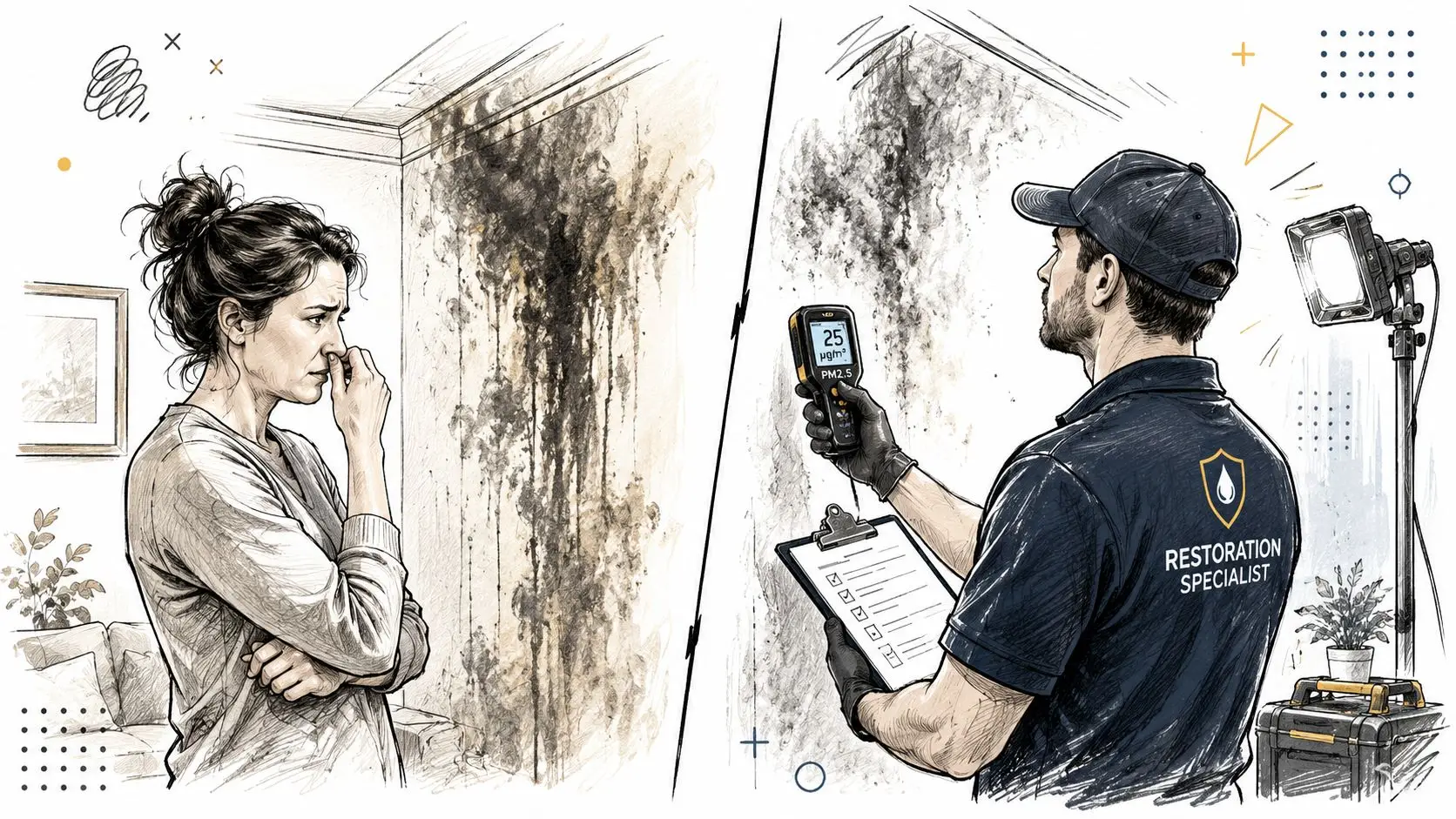
Call for an assessment when the source is unknown, symptoms continue, the odor returns after cleaning, HVAC equipment may be involved, or contaminated materials can't be safely removed. The same applies when a landlord, tenant, insurer, or facility manager needs a documented scope of work.
What qualified technicians do differently
A competent restoration team begins with a history, visual inspection, moisture review, odor mapping, and identification of affected materials. Technicians may establish containment, use appropriate personal protective equipment, remove unsalvageable porous materials, clean structural surfaces, place specialized adsorption media, and control air movement so contaminants don't migrate.
Verification should address the entire odor profile, not just one marker compound. A 2025 review warns that odorant interactions can change how a mixture behaves and that chemical absorption systems may overestimate real-world odor control when monitoring relies on a narrow set of odorants. That review recommends better monitoring choices and operating parameters, as discussed in its analysis of odor control in complex mixtures.
A professional should explain what will be removed, what will be cleaned, what equipment will run, how occupied areas are protected, and how results will be checked. For contractor verification, documentation, insurance information, and relevant credentials, contractor verification with HomeProBadge offers a practical screening resource.
Watch for aggressive treatment plans that focus on smell alone. A 2024 bench-scale study found that wet scrubbers can remove odors efficiently while generating waste liquid linked to secondary pollution and transportation-related carbon dioxide emissions, as reported in this study of wet-scrubber sustainability trade-offs. Disposal and byproduct management belong in the plan.
When the source involves bodily fluids, sewage, or another biological hazard, don't handle it as an ordinary cleaning job. Review the requirements for a biohazard remediation company and ask how the team will manage sanitation, contaminated materials, and odor verification.
A Phoenix restoration provider may also coordinate structural drying, fire and smoke cleaning, odor removal, and sanitation. Restore Heroes is one local option for those services, but no contractor can promise the same outcome for every structure or contamination profile.
Professional equipment should support a process, not substitute for one. This video provides additional context for understanding restoration assessment and treatment decisions.
Final Tips to Prevent Return and Verify Success
True success means the odor stays gone after the room changes. Don't judge the result immediately after fragrance, fogging, heavy ventilation, or a fresh coat of paint. Close the space, revisit it later, and check it again after normal heating, cooling, and humidity changes.
Keep chemicals in sealed, labeled containers away from heat and living areas. Store paint, solvents, pesticides, and fuel outside occupied rooms when the product label allows it. Repair leaks promptly, keep HVAC filters maintained, and replace carbon media when the manufacturer indicates that capacity has been reached or odor breakthrough appears.
Use a simple verification checklist
- Source check: The original container, spill, residue, or contaminated material is removed, sealed, or professionally treated.
- Surface check: Hard and porous materials have an appropriate cleaning or removal decision, not just a fragrance application.
- Air check: Ventilation and filtration no longer move the odor into other rooms.
- Time check: The smell doesn't return after the room is closed or conditions change.
- Occupancy check: No one experiences irritation or other symptoms when the space is used normally.
If the odor reappears, stop adding products. Reinspect hidden edges, cavities, drains, HVAC pathways, and loaded carbon media. Schedule a professional reinspection when the source remains uncertain or the odor follows fire, flooding, sewage, mold, or a biohazard event.
Phoenix homes often need practical decisions rather than dramatic treatments. Remove what can be removed, clean what can be cleaned, control the air, use adsorption with realistic limits, and verify the result before returning the space to normal use.
Restore Heroes helps Phoenix-area homeowners and property managers address odor linked to fire and smoke damage, water loss, mold, and biohazard conditions through assessment, cleaning, deodorization, and sanitation. If a chemical smell keeps returning after reasonable source-control work, visit Restore Heroes to request an evaluation and discuss the safest next step for the property.