
A free water damage restoration estimate is usually an initial moisture-mapping and risk-triage assessment, not a final guaranteed price. The EPA advises drying wet materials within 24–48 hours, because materials dried during that window will usually not support mold growth.
You may be reading this with a bucket beneath a ceiling stain, standing beside a burst supply line, or staring at flooring that looks dry on top but feels wrong underneath. In a Phoenix home, a small plumbing failure can spread into baseboards, cabinets, drywall, and subfloors before the full scope is visible. The first useful decision isn't choosing the cheapest number. It's getting a clear assessment of what is wet, what may be contaminated, and what must happen next.
Why a Water Damage Restoration Free Estimate Matters
A pipe breaks behind a kitchen cabinet during the night. By morning, the homeowner has shut off the water, mopped the floor, and placed towels along the wall. The room looks better, but moisture may remain beneath the flooring, inside the cabinet base, or behind drywall. A visual inspection alone can't reliably answer whether the structure is dry.
That makes a water damage restoration free estimate a triage tool. A technician can document the source, inspect affected areas, and look for hidden moisture while mitigation decisions remain time-sensitive. The EPA recommends drying wet or damp building materials and furnishings within 24–48 hours after a leak, spill, or flooding event, and says mold will usually not grow when materials are dried within that period. EPA mold guidance also cautions that mold may already have developed when materials stay wet for more than 48 hours, although growth isn't guaranteed in every case.

What early inspection can reveal
A professional may recommend extraction, air movement, dehumidification, selective material removal, or a mold evaluation depending on the findings. Those choices depend on more than the visible puddle. They also depend on how long materials have been wet, how far water traveled, and whether the water came from a clean supply line, appliance, sewage backup, or external flooding.
Phoenix properties face varied sources, including burst pipes, appliance failures, roof leaks, monsoon-related intrusion, and HVAC problems. Surface drying doesn't prove that a wall cavity or subfloor has dried. A no-cost visit can create an informed starting point before secondary damage expands.
For a plain-language explanation of the broader process, see what water damage restoration involves. The practical lesson is simple: request an inspection promptly, but treat the estimate as an assessment of conditions and next actions, not a promise that the entire project will fit one fixed price.
What a Professional Estimate Actually Covers
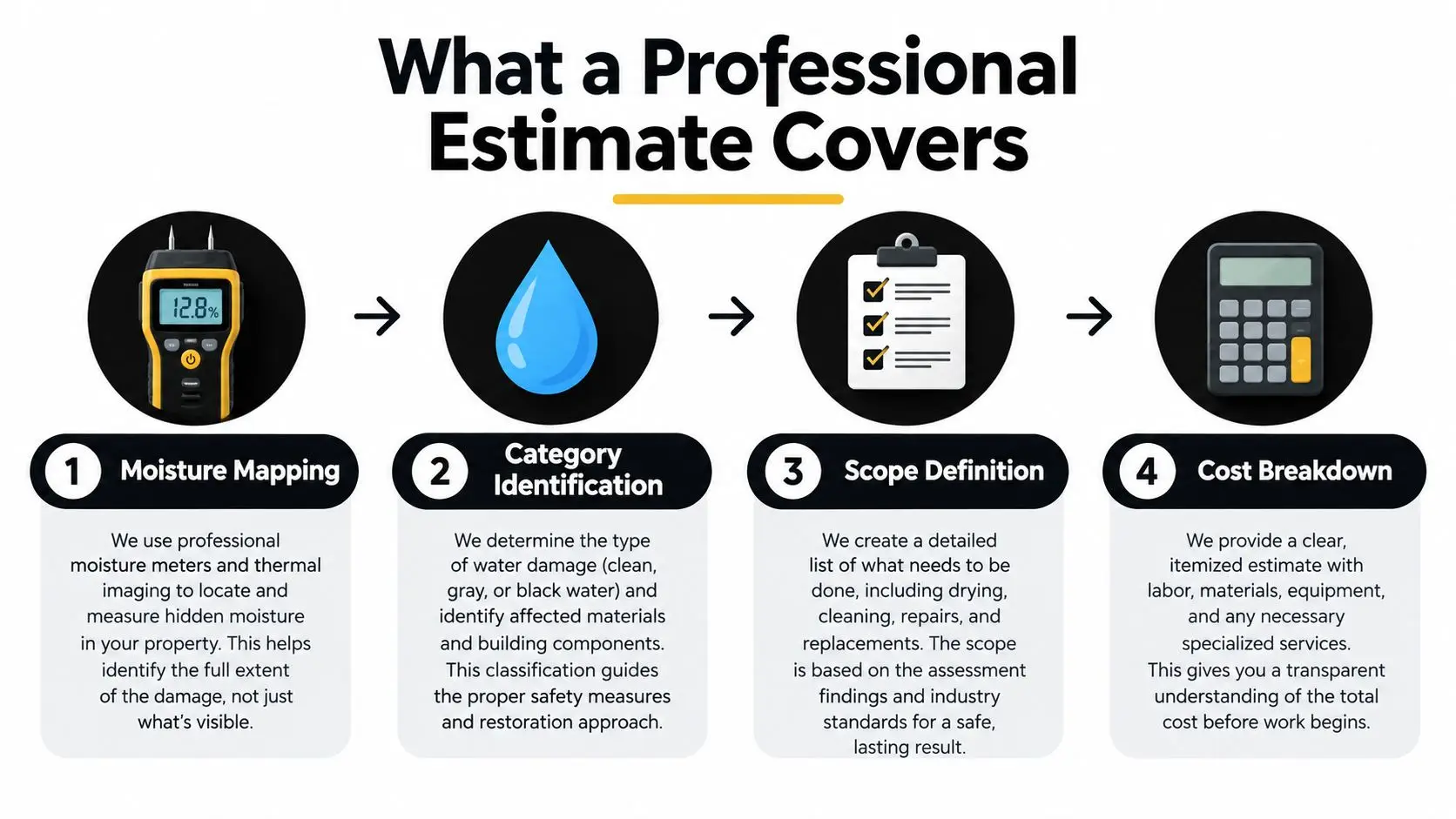
A credible onsite estimate should answer more questions than “How much will this cost?” It should show where moisture is located, what caused the loss, how long materials may have been wet, and which actions are urgent. That is why a technically credible free onsite estimate should function as an initial moisture-mapping and risk-triage assessment, not merely a visual price quote. EPA guidance on moisture and mold supports prompt drying and careful attention to damp materials that may require removal.
The technician should first identify the water source and record the affected rooms. They should inspect flooring, wall assemblies, cabinets, ceilings, and areas below or beside the visible damage. Moisture meters, thermal imaging where appropriate, and comparative readings can help identify damp areas that a flashlight won't reveal.
The four questions behind a sound scope
- Where is the moisture? The inspection should map affected materials, including concealed areas beneath carpet, flooring, cabinets, and wall finishes.
- What kind of water is involved? A broken clean-water supply line presents a different response from sewage, floodwater, or water that has remained stagnant. Contamination changes safety controls, removal decisions, cleaning, and disposal.
- How long has the structure been wet? Elapsed wetting time helps determine whether drying may be possible or whether porous materials need removal.
- What could change the scope? The written estimate should identify assumptions, exclusions, and conditions such as hidden subfloor moisture, damaged insulation, microbial growth, or electrical hazards.
A useful report distinguishes mitigation from reconstruction. Mitigation may include extraction, air movement, dehumidification, monitoring, and controlled removal. Reconstruction may involve replacing drywall, flooring, trim, cabinetry, or other finished components after the structure has reached its drying goal.
Ask the contractor what readings were taken, which areas were inaccessible, what equipment is proposed, and how progress will be monitored. A company that only walks through the room and names a price hasn't provided the same level of information as one that documents moisture and risk. More background on the work performed by restoration professionals is available in what a restoration company does.
Estimate vs. Final Price, Understanding the Difference
A homeowner may hear one number during the walk-through, then see the scope change once drying starts. That shift usually comes from what the first inspection could not confirm. Water behaves less like a surface stain and more like spilled ink on paper. It spreads past the obvious edge, wicks into layers, and shows its full reach only after materials are opened and measured.
| Initial Estimate | Often Excluded Initially | Final Restoration Price |
|---|---|---|
| Visible rooms and accessible materials | Concealed subfloor moisture, insulation, and wall-cavity damage | Confirmed affected materials after inspection and controlled removal |
| Preliminary extraction and drying assumptions | Contents manipulation, storage, antimicrobial treatment, testing, and disposal | Actual labor, equipment, cleaning, and handling required |
| Early mitigation scope | Reconstruction, permits, code-related work, and finish matching | Mitigation plus documented repair and rebuild work |
| Initial equipment recommendation | Additional equipment if readings fail to improve | Equipment and monitoring adjusted to measured drying progress |
This is why the scope, assumptions, and exclusions matter more than the headline number.
A visual inspection can identify wet carpet, staining, swollen baseboards, or obvious ceiling damage. A documented drying plan goes further. It compares wet materials to unaffected materials, sets a drying goal, and adjusts equipment based on measured conditions inside the structure. The The IICRC S500 equipment approach explains why equipment selection is tied to structure volume and psychrometric performance, including dehumidifier capacity and air movement, not just the number of rooms.
That difference matters because the final bill reflects the work required to reach a dry standard, not the first impression at the doorway. If technicians remove a toe-kick, lift flooring, or open a small wall section and find trapped moisture, the scope changes because the conditions changed from assumed to documented.
Practical rule: A low first number only helps if the document clearly states what it includes, what it excludes, and which findings can lead to a revised scope.
When you compare proposals, read them the way you would read a repair diagnosis for a car. The first look may identify the visible problem. The price depends on what testing and access reveal underneath. Focus on the listed tasks, drying assumptions, and separation between mitigation and rebuild work. General guides on water remediation costs can help with context, but they cannot replace measurements taken inside your home.
How to Prepare for Your Onsite Inspection
Your actions before the technician arrives can improve both safety and documentation. Don't enter standing water if electricity may be present, and don't operate electrical equipment in a wet area. If it's safe, shut off the water source and contact the appropriate utility or plumbing professional.
Record the conditions
Use photos and video to capture the source, affected rooms, flooring, ceilings, cabinets, contents, and any visible staining. Include wide views that show location and close views that show material damage. Keep the original files, and write down when you discovered the loss, when it may have started, and what you did first.
A simple timeline helps the technician interpret moisture readings. Note whether water was extracted, whether fans were used, whether flooring was lifted, and whether any materials were moved. Don't throw away damaged items before documenting them unless they create an immediate health or safety hazard.
Protect the property without spreading the damage
Move valuables away from the affected area only if you can do so safely. Separate wet contents from dry contents, avoid walking through contaminated water, and don't cut into walls or remove flooring unless the restoration professional or another qualified specialist recommends it.
If the water may be entering through the roof, document the interior damage from a safe location and avoid climbing into wet attic spaces. Property owners dealing with roof intrusion can also consult these Willamette Valley roof leak tips for general guidance on documenting and responding to roof leaks.
Bring your insurance information, but don't delay urgent mitigation while waiting to understand every coverage detail. Ask the technician to provide baseline moisture readings, affected-material categories, proposed equipment, monitoring frequency, and the criteria for declaring the structure dry. Those details make the free estimate more useful than a simple verbal quote.
Navigating Insurance Claims with Your Estimate
Water is already in the house, the floor feels soft, and your phone starts filling with questions from the insurer, the mitigation company, and your family. In that moment, a free estimate helps you sort the situation. It gives the claim a starting record. It does not decide what the policy will pay.
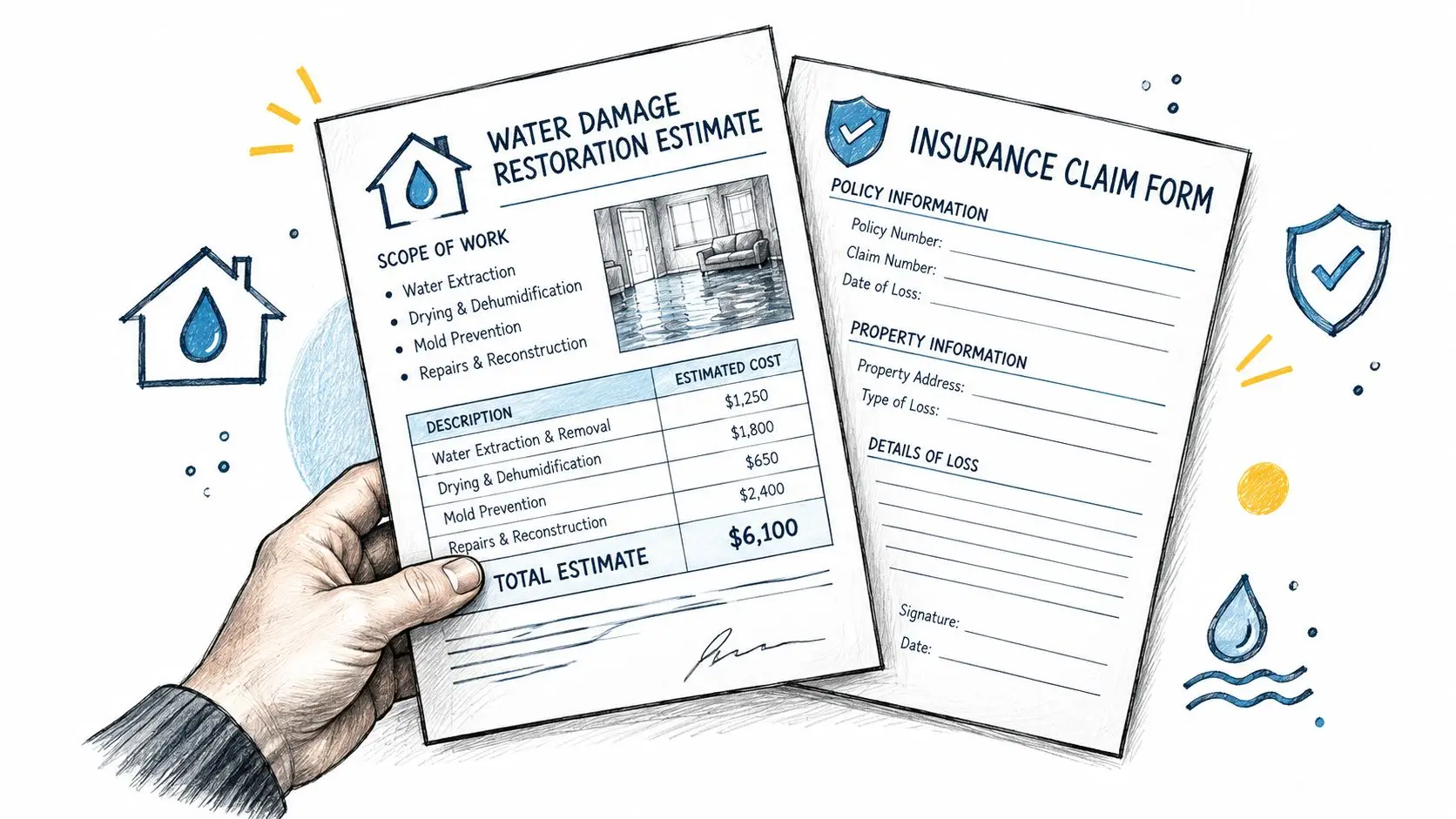
That distinction matters. A restoration contractor can document what was seen during the inspection, what materials appear affected, and what work is recommended right away. The insurance carrier still reviews cause of loss, exclusions, deductibles, limits, and how the policy values repair or replacement. The estimate is closer to triage than a final settlement. It shows what the responder saw on day one, before walls are opened or wet materials reveal more damage.
Documentation that helps explain the work
A useful claim file may include:
- Cause and timing: What happened, when it was discovered, and what steps stopped the source.
- Moisture map: Which rooms and materials were affected, including hidden or inaccessible areas.
- Drying records: Moisture-content readings, temperature, relative humidity, equipment used, and monitoring visits.
- Scope separation: Emergency mitigation, material removal, contents handling, cleaning, and reconstruction shown as distinct parts.
- Changing conditions: Any concealed damage or safety issue discovered after opening assemblies.
Adjusters use this kind of documentation to understand why the scope may change after the initial visit. Homeowners can use it too. It helps you see whether the number in front of you covers only emergency drying, or whether it also includes pack-out, demolition, cleaning, and later rebuild. For practical record-keeping ideas, these insurance claims settlement tips can help you organize questions, photos, and approvals.
Report the loss promptly and ask who approves scope changes if hidden damage appears after demolition begins. Keep emails, invoices, photos, technician notes, and daily drying updates together in one file. Clear, factual communication reduces confusion.
For Phoenix homeowners, a good next step is reviewing these water damage insurance claim tips before speaking with the adjuster in detail.
Hidden Costs and Coverage Pitfalls to Watch For
Many homeowners assume that “water damage” is one insurance category. It isn't. The source and path of the water matter, and interior water from a sudden plumbing failure can be treated differently from floodwater entering from outside.
The Insurance Information Institute explains that standard homeowners insurance generally doesn't cover flood damage, while certain sudden plumbing or appliance losses may be covered. Mold coverage may also be limited or excluded. Homeowners insurance guidance is a useful starting point, but your policy language controls the actual decision.
Separate the source before discussing payment
Ask whether the loss came from a burst pipe, appliance failure, roof intrusion, sewer backup, rising water, or water entering from surrounding ground. Arizona Department of Insurance guidance states that standard homeowners insurance doesn't cover flood damage and that flood protection generally requires a separate National Flood Insurance Program policy. It also explains that interior water damage from rain or snow may be excluded unless water entered through a roof or wall damaged by wind or hail. Arizona insurance guidance for storms and disasters makes clear that an inspection can document damage, but the insurer and policy determine coverage.
A free estimate should identify possible cost exposures rather than hide them in a single number. Those exposures can include:
- Deductibles and limits: The policy may require you to pay a deductible, and coverage may stop at stated limits.
- Excluded living costs: Flood policies can exclude temporary housing, additional living expenses, loss of use, and business interruption.
- Exterior property: FEMA flood guidance lists landscaping, fences, patios, pools, and septic systems among many exterior items that may be excluded.
- Contents and treatment: Moving, cleaning, storing, antimicrobial treatment, testing, and disposal may appear separately from structural drying.
- Timing and causation: Flood loss that occurred before a policy's purchase or effective date is generally excluded, and a policy bought after a flood began typically won't cover damage from that event.
FEMA's National Flood Insurance Program guidance also distinguishes sewer backups caused directly by flooding from backups caused by another problem. Coverage limits can matter too. Arizona guidance says homeowners may obtain up to $250,000 of flood insurance for a residence and up to $100,000 for contents, but those limits don't mean every repair or expense will be paid. Arizona flood insurance information explains why a policy limit isn't the same as a guaranteed reimbursement.
Choosing the Right Restoration Partner in Phoenix
The right contractor should be able to explain the work in measurable terms. Ask whether technicians hold relevant IICRC credentials, whether the company is licensed and insured, what equipment it uses, how often readings are taken, and how the team handles contaminated water.
A local response matters because drying decisions begin with the condition of the property, not with a generic estimate form. The contractor should identify the water source, map affected materials, separate mitigation from reconstruction, and explain what could change after concealed areas are opened.
Questions worth asking before authorizing work
- Will I receive moisture readings and a written drying plan?
- What is included in the free onsite estimate?
- Which work is emergency mitigation, and which work is reconstruction?
- What assumptions or exclusions could change the scope?
- How will you coordinate documentation with my insurer?
- Who will contact me if readings show that equipment or removal needs to change?
Restore Heroes is one Phoenix-area option that provides onsite water damage inspections and restoration services, including extraction, structural drying, sanitation, and insurance coordination. You can learn more about choosing a water damage restoration contractor and compare the documentation each company provides.
Speed matters, but speed without measurement can leave moisture trapped behind finished surfaces. Choose a team that can respond promptly, explain its findings calmly, and support each recommendation with recorded conditions rather than a premature promise about price or coverage.
Request a free onsite inspection from Restore Heroes to document moisture, define urgent mitigation, and separate the initial scope from potential reconstruction. Their Phoenix-area team handles water extraction, drying, sanitation, and insurance documentation so you can make the next decision with clearer information.