
Arizona does not issue one water damage restoration license; a contractor needs an appropriate Registrar of Contractors classification when state licensing applies, generally when labor and materials exceed $1,000 or the job requires a permit. But if a company says it's certified, does that mean it's legally authorized to rebuild your damaged home?
Not necessarily. State licensing, technical certification, and insurance credentials answer different questions. For a Phoenix homeowner dealing with a burst pipe, or a property manager reopening a flooded office, the useful question is which credential covers each task on the estimate.
Licenses and Certifications at a Glance
Arizona's credential system separates legal authority from technical training and financial protection. A provider's badge collection can look reassuring, but it doesn't tell you whether the business can perform the particular repairs your property needs.
Water damage restoration credentials and what they cover
| Credential | Issued by | What it shows | Legally required? |
|---|---|---|---|
| Arizona contractor license, residential, commercial or dual | Arizona Registrar of Contractors | Legal authority to perform covered construction or repair work | Yes, when labor and materials exceed $1,000 or the job needs a permit |
| Trade classification for electrical, plumbing or air-conditioning work | Arizona Registrar of Contractors | Authority for specialized building systems | Yes, for that work; otherwise it must go to an appropriately licensed specialist |
| IICRC Water Damage Restoration Technician, or WRT | Institute of Inspection, Cleaning and Restoration Certification | Training in S500-based restoration procedures | No, voluntary |
| ANSI/IICRC S500 standard | IICRC through an ANSI-accredited consensus process | Recognized procedures for inspection, drying and documentation | No, it's a standard rather than a license |
| Insurance and bonding | Insurance carriers and surety providers | Financial protection subject to policy and bond terms | Not a state license; confirm applicable requirements and protection with the provider |
A single company can hold several of these credentials, so check each one separately rather than treating a provider's list as proof of any one of them. At Restore Heroes, we're IICRC certified, licensed, bonded, and insured. Those are separate credentials, not interchangeable descriptions.
Read the credential against the task
Say a leaking appliance damages a kitchen. A technician's restoration training matters when evaluating wet materials and planning drying, while a construction classification matters when the estimate includes rebuilding cabinets or walls.
Insurance and bonding raise another set of questions. Request the insurer's name, evidence of current coverage, and bond details rather than assuming that the word insured means every possible loss is covered.
A standard is different again. You don't hire a standard, and a company doesn't gain government authorization by saying it follows one. You hire people who should be able to explain how their procedures apply to your building.
Practical rule: The state license decides legal authority. The other credentials address training, financial protection, and recognized procedures.
That distinction helps you compare estimates fairly. A detailed drying proposal and a reconstruction proposal may describe different responsibilities, even when both companies advertise water damage restoration.
When Arizona Requires a State Contractor License
The Arizona Registrar of Contractors' license-classification guidance covers businesses that contract or offer to contract to build, alter, repair, improve, move, wreck, or demolish a building or other structure, and generally requires licensing when labor and materials exceed $1,000, or whenever a permit is required regardless of price.
The practical triggers are:
- The combined labor and materials exceed the licensing threshold. Don't judge the project by the equipment charge alone.
- The work requires a permit. A smaller price doesn't remove this trigger.
Consider a short extraction-and-drying visit with no reconstruction and no permit requirement. If the total stays below the threshold, it may fall outside the general licensing trigger, but that isn't a blanket exemption for anything described as emergency mitigation.
A kitchen project that includes replacing damaged drywall, cabinets, and flooring is more likely to trigger licensing. The estimate's actual work matters more than whether the company calls itself a cleaning business, mitigation company, or restoration specialist.
What the state application establishes
Arizona requires a qualifying party with the necessary experience, knowledge, and skills. Corporations and LLCs must also be registered and in good standing with the Arizona Corporation Commission.
Contractors must be properly licensed before submitting bids, not just before starting construction. A promise to obtain the right license later isn't equivalent to current authorization.
Licenses are issued by construction trade or field, with residential, commercial, and dual categories. A company's authority must fit both the type of property and the work it proposes.
Don't stop at “Are you licensed?” Ask “Which classification covers the repairs on this estimate?”
For a commercial facility manager, that means checking the classification against the office, store, or other commercial property involved. For a homeowner, it means checking that the proposed residential repairs fall within the contractor's authority.
Keep a written estimate that distinguishes extraction, material removal, drying, and rebuilding. Clear task descriptions make it easier to identify licensing questions before the project changes from stabilization to construction.
IICRC Standards and Technician Certification
The ANSI/IICRC S500 is the professional standard for water damage restoration identified by the Institute of Inspection, Cleaning and Restoration Certification. The IICRC describes its standards as voluntary consensus standards accepted as the industry's standard of care, with ANSI accreditation addressing due process and consensus in their development.
This distinction separates the procedure a technician follows from the authorization a business needs.
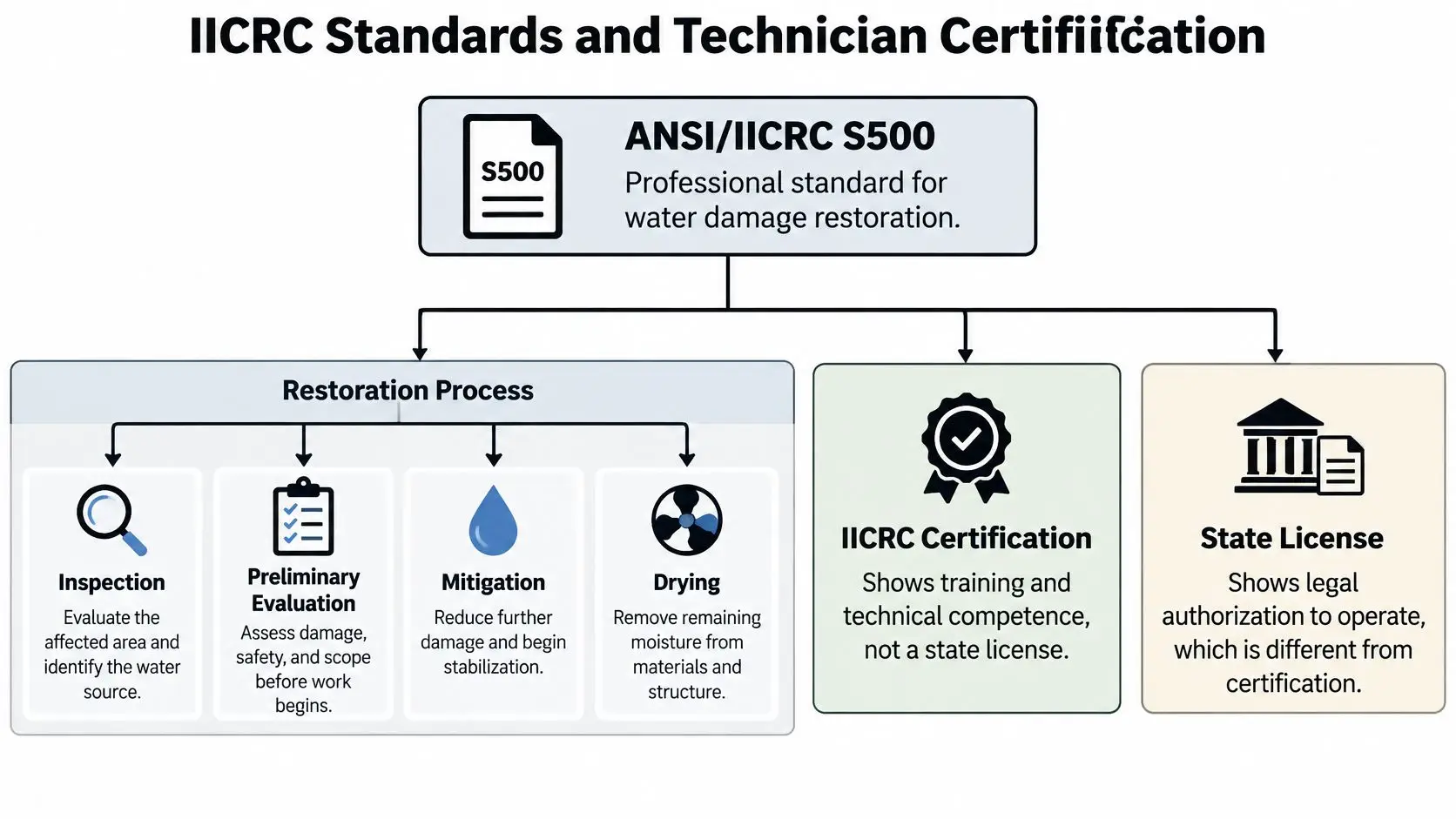
S500 addresses inspection, preliminary evaluation, psychrometry, drying technology, equipment, safety, antimicrobial practices, documentation, and risk management. Psychrometry means evaluating air conditions, including temperature and moisture, to understand and manage drying.
The Water Damage Restoration Technician certification, commonly called WRT, is a technician-level credential. It shows specialized restoration training, not permission from Arizona to perform every construction trade.
Training isn't a substitute for authorization
A WRT certificate is like a chef's training diploma, while a state contractor license is like the health permit that lets the kitchen open to the public. The analogy isn't a legal equivalence, but it illustrates why evidence of skill and authorization serve different purposes.
The standard is revised periodically. Technicians need to keep their methods current rather than treating training as a finished achievement.
Our guide to water damage restoration technician certification provides additional context for understanding technical credentials. At Restore Heroes, we provide hands-on training and opportunities for team members to pursue certification.
Use the video below as a companion to the distinction between technical training and state authorization.
Before work starts, request the assigned technicians' WRT certificate numbers and confirm their credentials with the IICRC. Don't assume a company-level certification statement identifies the qualifications of everyone entering your property.
Finish the conversation with concrete questions:
- Who holds WRT certification? Identify the technicians assigned to your project.
- What are their certificate numbers? Keep the identifying information with your estimate.
- How will the team apply S500? Request an explanation of drying decisions and documentation, not just a promise to follow industry standards.
Which Work Needs Which Credential
Emergency mitigation and reconstruction aren't the same scope. Extracting water, drying materials, and stabilizing a building require different decisions from replacing drywall, flooring, cabinetry, or structural components.
A restoration firm may be prepared to stabilize a loss while needing additional construction classifications or licensed subcontractors for rebuilding. Use the tasks on your estimate to identify those boundaries.
Which credential applies to each restoration task
| Task | Credential that applies | Notes |
|---|---|---|
| Water extraction, drying and sanitation | Arizona contractor license when state licensing is triggered; IICRC-trained technicians for technical competency | Core restoration scope; training isn't itself a government license |
| Drywall, flooring and cabinetry replacement | Arizona contractor license in a matching construction classification | Reconstruction is separate from mitigation |
| Failed plumbing line repair | Appropriately licensed plumbing contractor, subcontracted when needed | Required when outside the restorer's authorized scope |
| Electrical component repair | Appropriately licensed electrical contractor, subcontracted when needed | Required when outside the restorer's authorized scope |
| Air-conditioning system repair | Appropriately licensed air-conditioning contractor, subcontracted when needed | Required when outside the restorer's authorized scope |
| Fixing the water intrusion source | Property owner's responsibility unless separately contracted | Allocate the work expressly |
| Mold-affected materials | Match construction licensing to the actual tasks; confirm containment and completion criteria in writing | Moisture correction and material condition matter, not an assumed federal airborne mold limit |
Separate drying from repairing the cause
The IICRC's S500 guidance assumes that identifying and correcting the underlying water-intrusion source is the property owner's responsibility, although the owner can contract with the restorer or another specialist to do it. Don't assume that authorizing drying also authorizes or includes repairing the failed pipe.
For example, after a supply-line leak, the restoration team may extract water and monitor wet wall materials. A licensed plumbing contractor may repair the line, while a contractor with the appropriate construction classification handles replacement finishes.
Apply the same reasoning to electrical components and air-conditioning systems. Arizona also identifies boilers, swimming pools, spas, and water wells as specialized work requiring appropriately licensed contractors when outside the restorer's authorized scope.
For mold-affected materials, define who evaluates the work area, selects containment, removes damaged materials, and documents completion. Suspected asbestos or other regulated hazards need separate attention rather than being folded into a generic demolition allowance.
Our guide to choosing a water damage restoration contractor can help you evaluate the provider's proposed responsibilities. Request a written division of in-house work and subcontracted work, including who handles source repair.
Keep that task list with the estimate. If someone later discovers wet cabinetry or a damaged circuit, update the scope before treating the new work as part of the original agreement.
How to Verify a Contractor's Credentials
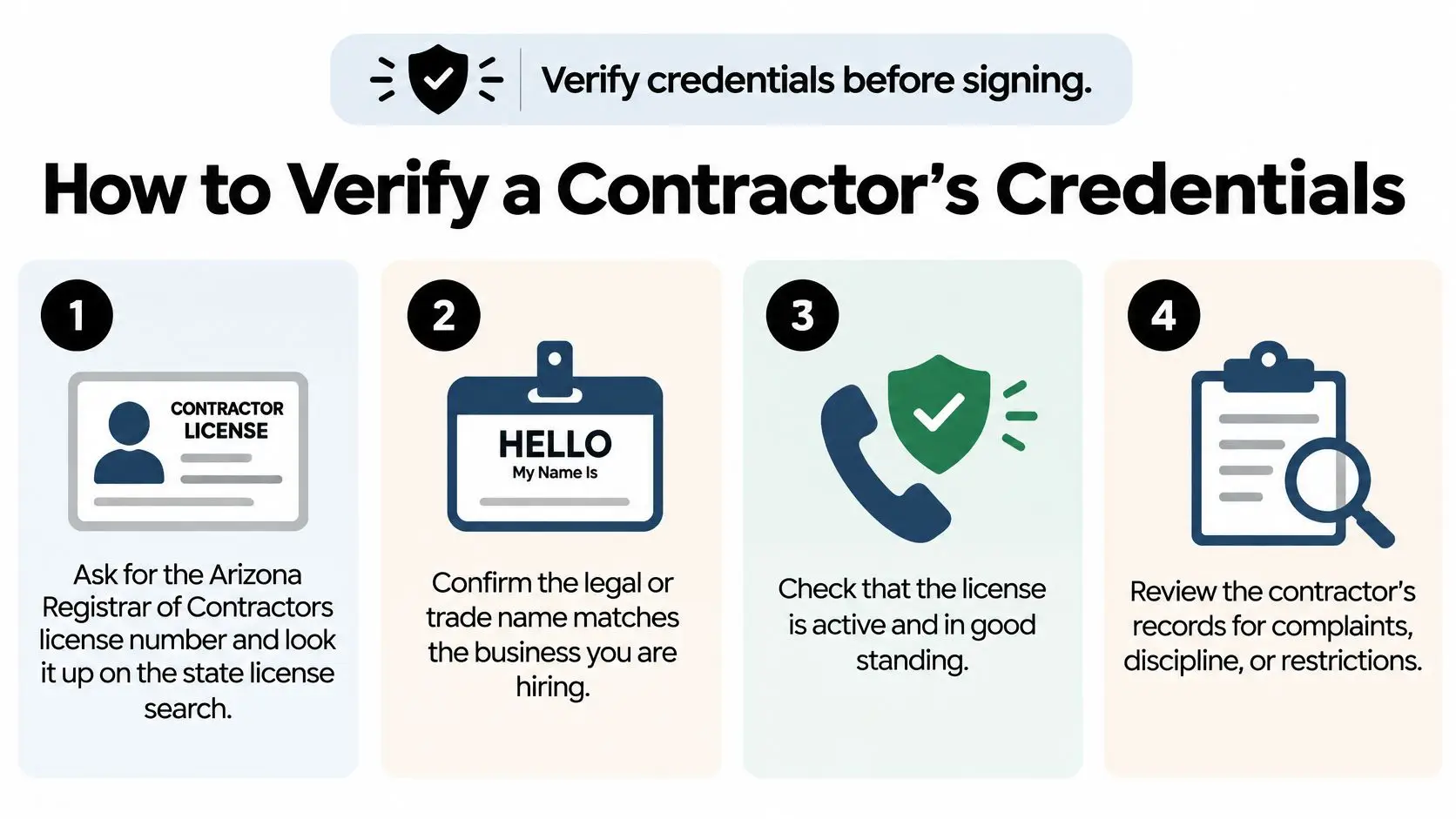
Verify the business you're hiring, not just a familiar logo. The Arizona Registrar of Contractors' application guidance explains the qualifying-party requirements and emphasizes that licensees must conduct business under their official or licensed trade name.
Use this visual checklist alongside the more detailed routine below.
Run the checks before signing
Request the ROC license number and search the state's records. Check current status, restrictions, and available complaint or disciplinary information. A number that doesn't appear, or belongs to another business, needs resolution before you proceed.
Match the contract name to the license. Compare the estimate, agreement, and invoice with the official or licensed trade name. An unexplained mismatch is a red flag; our legal business name is Restore Heroes LLC.
Identify the qualifying party and classification. Compare the authorized field with the demolition, repairs, and reconstruction proposed. A valid license in an unrelated classification doesn't settle the question.
Verify the assigned technicians' WRT credentials. Request certificate numbers and confirm them with the IICRC. A badge on a website without identifiable technician credentials isn't enough for this check.
Request insurance evidence and bond details. Confirm the named business and relevant documentation rather than accepting an undated marketing statement. Our explanation of a bonded and insured contractor helps distinguish those protections.
Get the subcontractor allocation in writing. Identify which tasks the hiring company will perform and which licensed trades will handle the rest. An estimate that includes specialized repairs but names no responsible trade deserves clarification.
Request a pre-restoration evaluation before drying begins. It should identify the affected areas and establish a documented starting point. Treat a proposal to run equipment without baseline observations or readings as a reason to ask more questions.
For broader business-identity checks beyond restoration credentials, Recepta.ai's guide can help you check whether a company is legitimate. Use those checks alongside regulator and certification records, not instead of them.
Build a verification file
A legitimate contractor should be prepared to address reasonable credential questions in writing. If documents take time to obtain, resolve the missing information before authorizing the affected work rather than relying on verbal reassurance.
Save the license record, classification, WRT certificates, insurance proof, bond information, and task list with the estimate. Keep the version you reviewed when approving the work, so later changes don't obscure what was originally represented.
Why Credentials Matter for Your Insurance Claim
A useful starting point is a written pre-restoration evaluation identifying the moisture source, affected materials, safety risks, drying plan, equipment placement, readings, and final verification. That documentation approach aligns with the procedural framework described in the ANSI/IICRC S500 material available through ANSI.
The mistaken assumption is that hiring a licensed contractor guarantees a successful claim. It doesn't guarantee approval, payment of any particular amount, or coverage for the loss.
A license establishes authority to perform covered work. Your policy terms and the insurer's assessment address a different question: what the insurer will pay for under that policy.
Give the adjuster a usable record
Photographs and moisture logs help an adjuster understand what the contractor found and why the crew performed particular tasks. Ask for records that connect each action to an observed condition.
- Before work: Preserve images of affected rooms, materials, and the suspected source.
- During drying: Keep material-moisture readings, air-condition measurements, equipment locations, and changes to the plan.
- At completion: Retain final readings, photographs, invoices, and unresolved source-repair responsibilities.
For mold-affected buildings, the EPA's remediation guidance emphasizes correcting moisture, selecting appropriate containment and protective equipment, and cleaning and drying materials; it also states that no federal airborne mold-concentration standard exists. Completion therefore shouldn't be presented as meeting an invented federal sampling threshold.
A room that smells better isn't, by itself, evidence that the contractor corrected the moisture problem.
Say a homeowner hires a contractor who leaves no written readings or equipment log. When the adjuster questions the drying scope, the homeowner may have to reconstruct dates, conditions, and conversations from memory.
That situation is harder to explain than a file with dated photographs and material-specific readings. It also leaves uncertainty about whether concealed areas were checked before reconstruction.
Review your own policy and ask your insurer which contractor qualifications and documents it accepts. Our water damage insurance claim tips can help you organize questions, but neither credentials nor documentation can promise a coverage outcome.
What to Do If an Unlicensed Contractor Already Worked
Pause additional work and preserve evidence. Save photographs, texts, estimates, invoices, payment records, and the contract. If an active leak or electrical hazard remains, arrange qualified help for the immediate safety issue rather than leaving it unattended.
Confirm the contractor's status in ROC records. Check the business name, license status, and classification instead of relying solely on what someone told you. Record what you find and when you checked it.
Request an explanation in writing. Ask the contractor for its license number and the classification covering the completed work. Preserve the reply, including any explanation that another business or subcontractor performed particular tasks.
Notify your insurer. Describe the work already completed and ask which records it needs. Don't assume either that the claim is lost or that the contractor's invoice will be accepted without questions.
Arrange an independent inspection before rebuilding. Have the moisture source, affected materials, current drying status, and remaining hazards documented. Verify the inspector's relevant credentials and scope just as carefully as you would for a restoration contractor.
Consider a complaint to the Arizona Registrar of Contractors. If the work required licensing and the contractor lacked the appropriate authority, preserve your evidence and ask the regulator about the complaint process. Don't treat a complaint as a promise of reimbursement or a particular outcome.
Keep the next decision documented
Organize your records by date, with separate folders for agreements, photographs, communications, and inspection findings. Our guidance on insurance claim documentation can help you assemble a readable file without altering or discarding the original records.
For a Phoenix-area property, an independent assessment can help clarify what remains unfinished before another crew covers exposed materials. Outcomes, timing, and repair prices depend on the inspection and the resulting scope.
Before signing any further contract, verify the next provider's credentials against the work it will perform. Don't let the pressure to finish replace that check.
We offer a free inspection that you can request through our contact form or by calling 480-690-5277. Visit Restore Heroes, select Water Damage, Fire & Smoke Damage, Mold Removal, Trauma & Biohazard Cleanup, or Others, and use the credential checks above before authorizing work.