
You're standing in a wet hallway at 2 AM, listening to water drip through a ceiling you didn't expect to fail tonight. The first reaction is panic, the second is to search for 24 hour water restoration, and the right move is to treat the next hour like it matters. It does, because the difference between a fast mitigation job and a bigger repair bill is usually decided before daylight.
What 24 Hour Water Restoration Actually Means
A real emergency call isn't a polite promise to “get back to you in the morning.” It's a live dispatcher, a confirmed arrival window, and a crew that shows up with extraction and drying equipment ready to work. In practice, 24 hour water restoration means the company is able to start mitigation when the loss is still active, not after the damage has sat overnight.
That matters because water doesn't wait for office hours. A burst pipe, an overflowing washer, or storm intrusion can keep spreading into flooring, wall cavities, and cabinets while a phone line just rings to voicemail. A provider that answers after hours but doesn't deploy technicians is marketing availability, not emergency response.
A homeowner should ask one simple question: “Who is coming, and when?” If the answer is vague, the company probably isn't operating like a true emergency contractor. A real dispatch team should be able to tell you whether the crew can arrive, what they'll do first, and whether they'll begin extraction immediately on arrival.
Practical rule: if the company can't confirm a live arrival window, you're still shopping for help, not receiving it.
For Phoenix homeowners, that distinction matters even more because water events don't get cheaper while you wait. If you want a plain-language overview of how emergency extraction fits into the first response, the local 24/7 water extraction page is a useful reference, and if you're also sorting the claim side, tips for implementing AI in claims gives a helpful insurance-process angle without pretending the loss is simple.
Critical Steps to Take Before the Crew Arrives
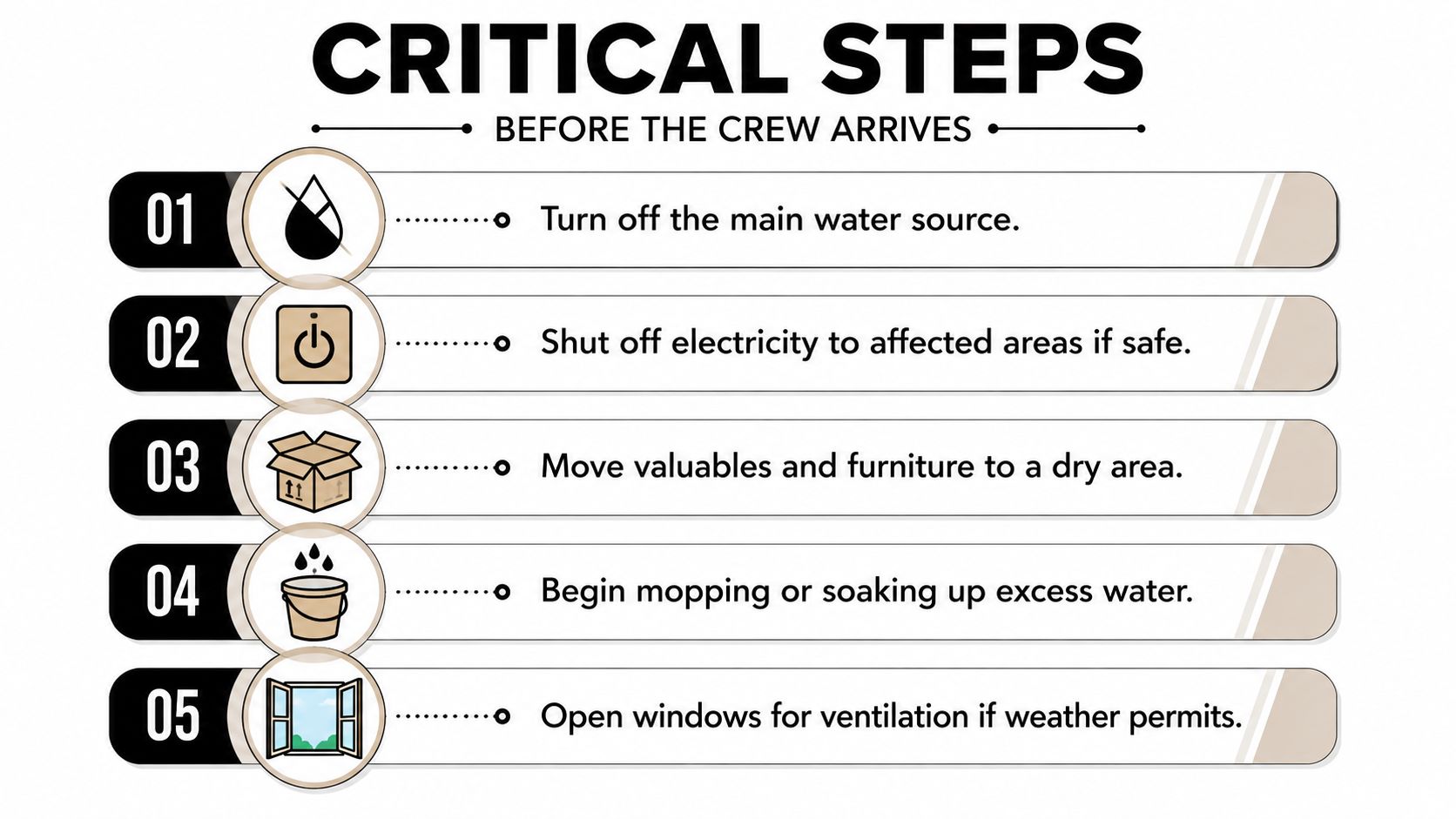
The first 1 to 3 hours are where homeowners make the easiest, safest decisions. Don't chase comfort, chase control. If you do the right things now, you protect the structure, preserve the claim record, and keep the job from getting harder than it already is.
Start with safety, not cleanup
If water is near outlets, appliances, or the panel, stay out of that area and shut off power only if you can do it without stepping into standing water. If the leak is from a supply line or fixture and the shutoff is easy to reach, turning off the main water source is the right move. If you're unsure, leave the source alone and wait for a technician rather than creating an electrical hazard.
Document everything before you move items. Use your phone to photograph rooms, warped flooring, dripping ceilings, wet baseboards, appliance leaks, and anything already stained or collapsed. Those photos help show what happened before furniture got moved or drying started, which makes the insurance file cleaner and the timeline easier to prove.
Take photos first, move second. Once items get relocated, the original pattern of damage gets harder to reconstruct.
Do the few things that actually help
Move valuables, electronics, and dry textiles away from the wet area if it can be done safely. Open windows only if the weather allows and if doing so won't let in more moisture or create a security issue. Start mopping or soaking up excess water only where it's safe and where you're not disturbing electrical risks or contaminated water.
What you should not do is just start ripping out drywall, prying up flooring, or spraying random cleaners everywhere. That usually adds confusion, not control. It also creates arguments later about what was preexisting damage and what was homeowner disturbance.
The point of the first hour isn't to finish the job. It's to stop the source, avoid injury, and leave the restoration crew with a clean, documented starting point. If you want a deeper look at the mitigation phase that follows arrival, the local water damage mitigation page fits that next step.
The Full Restoration Process From Extraction to Dry Standard
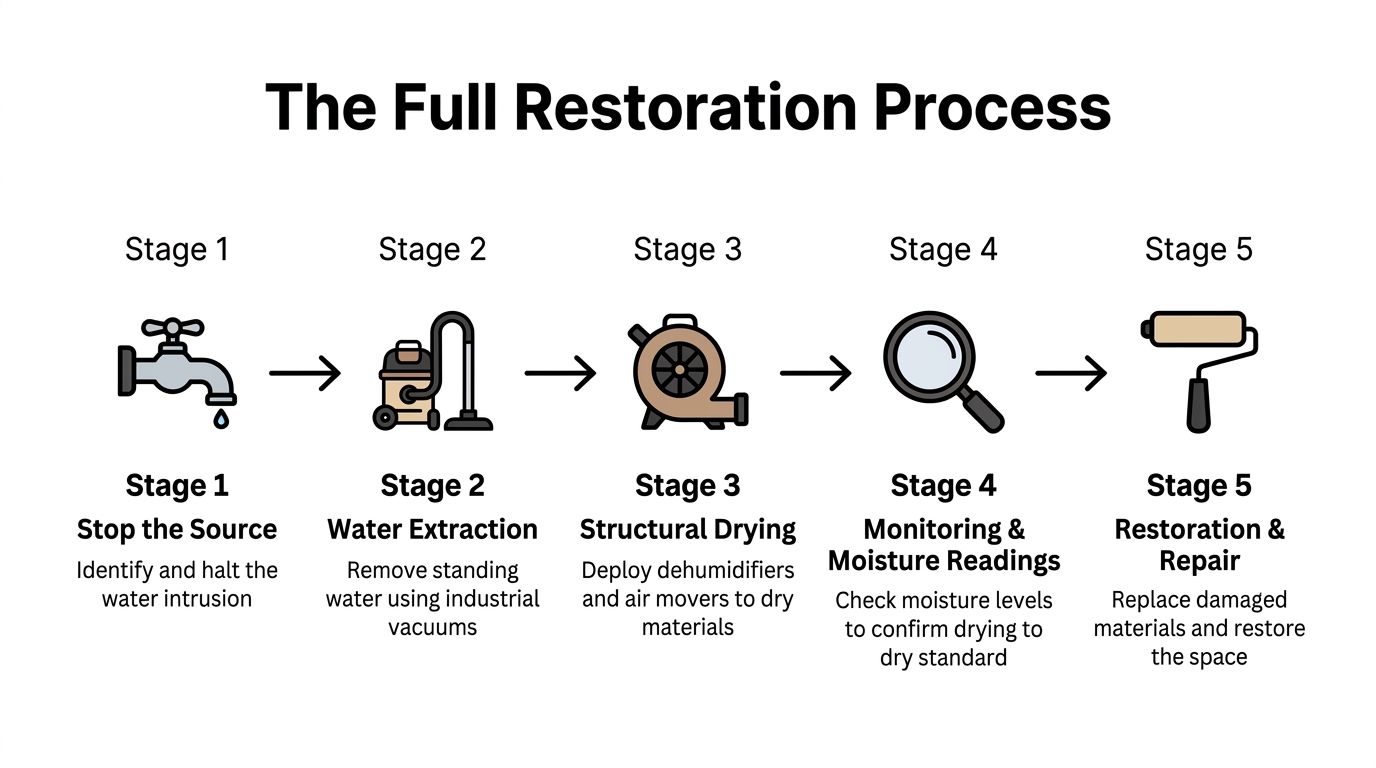
Professional water mitigation follows a sequence, not guesswork. The IICRC S500 framework organizes the work into Initial Response, Inspection and Pre-testing, Mitigation, Monitoring, and Completion, and that structure exists because drying wet materials the wrong way leaves moisture behind in places you can't see.
Source control and moisture mapping come first
Technicians start by stopping the source, then mapping the spread of moisture with penetrating and non-penetrating moisture meters, thermal imaging, hygrometers, and baseline psychrometric readings. Those readings include temperature, relative humidity, and grains per pound at equipment installation, which tells the crew what the air can hold and how aggressive the drying setup needs to be.
Drying capacity isn't guessed. It's calculated from the measured moisture load and the psychrometric gap between wet materials and the surrounding environment. That's how a crew decides whether a room needs a modest setup or a heavier structural-drying package.
Extraction beats evaporation every time
Bulk water comes out first because it's mechanically faster than waiting for it to evaporate. A professional setup may use truckmount systems, portable extractors, or pumps, then follow with dehumidification and airflow. The restoration workflow is straightforward: stop the intrusion, extract standing water, remove unsalvageable materials, dry the structure, and monitor the readings until the material is dry.
Dry standard means numbers, not guesses
After extraction, crews remove materials that can't be saved, then place air movers and dehumidifiers to drive moisture out of walls, subfloors, and framing. Daily monitoring verifies that the structure is returning to dry standard rather than just feeling dry at the surface. The reason this matters is simple, hidden moisture is what turns a manageable loss into a second problem later.
Bottom line: the job is done when readings say it's dry, not when the carpet feels better under your foot.
For homeowners, that's the part worth paying attention to. If the crew is not measuring, adjusting, and logging progress, they're just blowing air around a wet room. If you want to see how airflow equipment fits into that process, the local water damage fans page is the right supplemental reference.
How Water Category and Delay Change Scope and Cost
Not every water loss deserves the same response. Clean water from a supply line, gray water from an appliance, and Category 3 contamination from sewage or floodwater are different jobs, different risks, and different scopes of work. The mistake homeowners make is assuming “wet is wet,” when the actual issue is what the water touched and how long it sat.
| Water category | What it usually means | What delay does |
|---|---|---|
| Category 1 | Clean water from a burst pipe or supply line | Scope stays smaller if addressed fast |
| Category 2 | Gray water from appliances or contaminated sources | Risk and cleanup complexity rise quickly |
| Category 3 | Sewage or flood contamination | Scope can become full remediation, sanitation, or rebuild |
Water left more than 48 hours is treated as a much more severe contamination risk under IICRC-based guidance. That's the threshold where drying alone often stops being enough, because porous materials can't be trusted the same way once contamination and time both enter the picture. Delays also push more jobs into mold territory, which changes how crews isolate the work and what materials get removed.
Industry guidance also notes that typical residential jobs can run about $2,500 to $7,500, while severe Category 3 losses can exceed $20,000. Use those figures as a reality check, not a quote. They show why a fast dispatch is financially protective and why some jobs need sanitation and demolition instead of just fans and a dehumidifier.
If you want the blunt version, here it is. A wet room caught early is a mitigation job. A contaminated room left too long becomes a remediation and rebuild problem. That difference is exactly why the local Category 3 water damage resource exists.
Choosing a Certified Restoration Provider in Phoenix
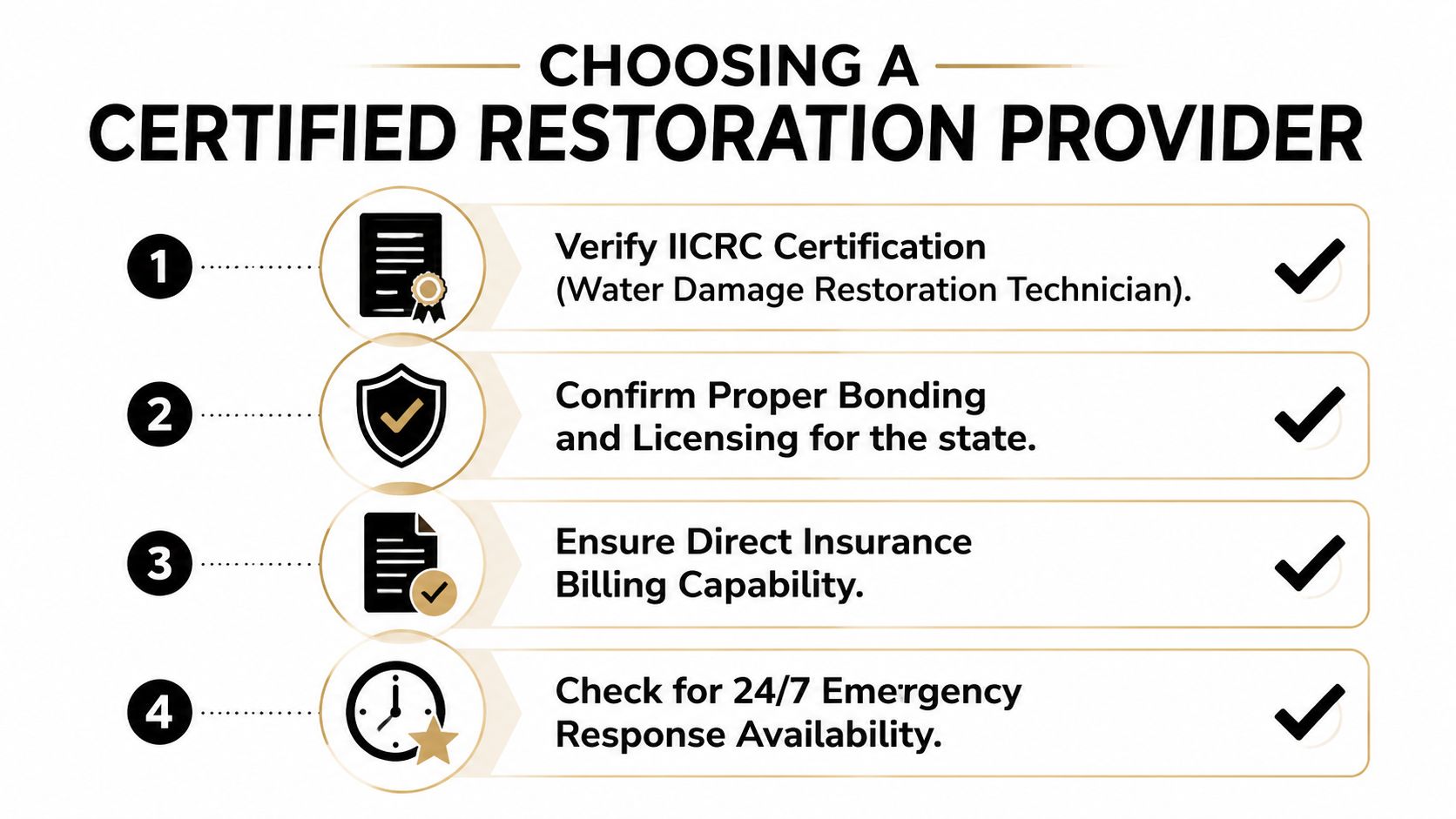
Credentials matter in restoration because the work affects safety, documentation, and insurance. IICRC certification tells you the technicians are trained to follow documented standards, use calibrated equipment, and produce moisture records that make sense to adjusters. Bonding and licensing matter because they protect you if the work is incomplete or improperly performed, and the company's insurance matters because it helps shield the homeowner from liability if a worker gets hurt on the property.
That isn't paperwork for its own sake. Restoration done badly creates extra demolition, messy claims, and unnecessary back-and-forth with insurers. A provider who can't explain moisture readings, drying goals, and the sequence of work probably isn't the one you want in your home during an emergency.
What to verify before you sign anything
- Verify certification: Ask whether the crew handling water loss is trained to recognized restoration standards, not just general handyman work.
- Confirm bonding and licensing: Don't assume the company is properly authorized to perform the work in your state.
- Check availability: A real emergency contractor answers live and can dispatch quickly.
- Ask about documentation: Moisture maps, equipment logs, and category classification should be part of the job file.
Restore Heroes is a licensed, bonded, insured, and IICRC-certified disaster restoration company serving the Phoenix metro area, available 24/7 with an Immediate Response Guarantee for water damage, fire and smoke damage, mold removal, and trauma and biohazard cleanup. If you're comparing providers in Mesa, Gilbert, Scottsdale, or Chandler, that's the baseline I'd use before I let anyone touch the structure.
Insurance Coordination and Cost Expectations
Water damage is usually an emergency and an insurance event at the same time. The restoration crew documents the loss so the claim has a clean trail, and that trail usually includes photos, moisture maps, equipment logs, and category notes. If the file is organized from the start, the adjuster has a better picture of what happened and what had to be done to stop further damage.
Ask your insurer how they want mitigation documented and whether they want updates as the project moves forward. Ask the restoration provider whether they can coordinate directly with the claim process and what happens before approval if the job can't safely wait. A company that says it accepts all insurance is telling you it can work with the claims process, not that the claim is automatically covered.
One practical advantage during a stressful loss is a provider with free onsite inspections and no upfront payment. That doesn't erase the cost of the damage, and it doesn't promise coverage, but it can reduce the pressure of making bad decisions while water is still active. If you need a local insurance-focused reference, the water damage insurance claim tips page helps frame the conversation.
Mitigation and rebuild are not the same thing. Mitigation is the work that stops active damage and dries the structure. Rebuild is the repair phase after demolition and drying are finished. Homeowners should expect those as separate conversations, with separate scopes if materials have to be removed.
Common Questions About Emergency Water Restoration
How fast can mold start? Mold can begin developing within 24 to 48 hours after water exposure, and that window is the point where quick drying still has a real chance to keep the job smaller. Wait past that, and the risk of remediation rises fast.
What if a storm slows response? A true 24-hour operation still needs live dispatch, but widespread storm events or rural travel can push arrival beyond the usual urban window. When that happens, homeowners should keep documenting damage, protect safety, and avoid making the area worse while they wait.
Should I dry anything myself? Yes, but only the safe, obvious steps. Turn off the source if you can do it safely, protect electrical safety, document the loss, and remove dry valuables from danger. Don't start demolition or use random cleaning products on porous materials.
When does it become remediation instead of drying? Once contamination enters the picture, or once the loss has sat long enough to change the water category and mold risk, the scope can move into removal, sanitation, and rebuild. That's why timing matters more than people want to admit.
If your home in the Phoenix metro area is dealing with active water damage, don't wait for the damage to settle in. Restore Heroes handles emergency water mitigation, drying, sanitation, and claim documentation with live 24/7 response, and you can start by visiting Restore Heroes to get a fast next step.